
Assigned reading: Read 2 Timothy 3:10–17 in your KJV Bible first. It is short — eight verses — and it contains the Bible's own claim about what it is.
Big Idea: The Bible is one true story, written by God through dozens of human authors across fifteen centuries, carefully recognized, preserved, and translated so you can hold it in your hands today. It was written to be read the way it was written — in context, by genre, as a whole — and once you understand what you're holding, you'll never have to pretend you understand it.
Lesson Objectives: By the end of this lesson, you will be able to - explain what the Bible is — 66 books, two testaments, one story — in your own words; - trace the Bible's storyline from creation to new creation; - name the major genres of Scripture and explain why genre changes how you read; - describe how the Bible came to be: written, recognized, preserved, and translated; - explain why there are so many English translations, how they differ, and why some Bibles contain extra books; - use the basic interpretation questions (context, author, audience, genre) on any passage you read; - describe how the FIRM process — Foundation, Interpretation, Reflection, Movement — works.
Before You Read: Open My Eyes
Method without dependence produces proud readers, not formed ones. Pray this before you go further:
"Open thou mine eyes, that I may behold wondrous things out of thy law." — Psalm 119:18 (KJV)
Father, before I learn what the Bible is, teach me to receive it as what it claims to be — Your breathed-out Word. I confess I have held it without understanding it, and sometimes without opening it at all. By Your Spirit, give me honesty about what I don't know and hunger to learn. Speak, Lord — Your servant is listening. In Jesus' name, amen.
Why We Start Here
Before we open a single passage together, we need to answer the question underneath every Bible study you'll ever do: what is this book I'm holding?
Most Christians were handed a Bible long before anyone explained it to them. They learned to open it, find a verse, and hope for the best. Some verses made sense. Many didn't. Over time, a quiet embarrassment settled in — the feeling that everyone else understands this book and you don't. This lesson exists to end that. There is nothing embarrassing about not knowing what the Bible is. Almost nobody is ever told.
Here is also where the whole FIRM journey begins. After this orientation, we'll walk through the Bible in formation order, not front-to-back order: Mark (meet Jesus first — the shortest Gospel), then Genesis (the foundation everything hangs on), then Romans (what Jesus' death and resurrection mean for you), then Psalms (learning to pray), then the rest of Scripture with real study skills in hand. Every book we study later will assume you know what this lesson teaches. So take it slowly. This is the on-ramp everything depends on.
Check What You Think You Know
Many sincere Christians carry quiet assumptions about the Bible that were never quite true. See if any of these sound familiar — there is no shame in them; they are extremely common.
"The Bible is basically a rulebook — a list of do's and don'ts." If that were true, most of it would be unnecessary. The Bible contains laws, yes — but it is mostly story: narratives, poems, letters, visions. Rules tell you what to do. Stories show you who God is. The Bible is far more interested in the second thing than the first.
"A council of church leaders invented the Bible by voting on which books to include." This one has a grain of truth wrapped around a misunderstanding. Church councils did formally list the books — but they were recognizing books Christians were already reading as Scripture, not creating Scripture by vote. We'll walk through exactly how that worked below, because the real story is more interesting than the myth.
"All those different translations mean nobody really knows what it says." It feels that way in a bookstore aisle with forty English Bibles. But the differences between translations are almost entirely about translation choices — how to render the same Hebrew and Greek into English — not about different underlying Bibles. Different translations are different trade-offs between accuracy and readability, and we'll compare the major ones side by side so the shelf stops being intimidating.
Hold those corrections loosely for now. The rest of this lesson fills in the picture.
1. A library, not a book
The word "Bible" comes from the Greek biblia, which simply means "books" — plural. That's your first key insight: the Bible is not one book. It is a library of 66 books, written by dozens of human authors over roughly 1,500 years — from around 1400 BC (Moses) to around AD 95 (John's Revelation) — in three languages: Hebrew (most of the Old Testament), Aramaic (a few passages in Ezra and Daniel, plus one verse in Jeremiah), and Greek (the New Testament).
The authors were wildly different people: kings and shepherds, priests and fishermen, a prime minister (Daniel), a doctor (Luke), a tax collector (Matthew), a tentmaker (Paul). They wrote on three continents, in palaces and prisons, during times of triumph and exile. And yet the library tells one coherent story. That coherence — across fifteen centuries, without the authors being able to coordinate — is part of why Christians believe a single divine Author stands behind the many human ones.
The library has two main sections:
- The Old Testament — 39 books. The story of God's covenant with Israel: creation, the fall, the patriarchs, the exodus, the Law, the kingdom, the prophets, the exile, and the return. It ends with promises still unfulfilled — a Messiah still to come.
- The New Testament — 27 books. The arrival of that Messiah: Jesus' life, death, and resurrection (the four Gospels), the spread of the good news (Acts), letters teaching the first churches what it all means (Romans through Jude), and a final vision of where history is heading (Revelation).
The word "testament" itself means covenant — a binding agreement. The two testaments are the two great covenants: the old covenant God made with Israel at Mount Sinai, and the new covenant Jesus established through His death and resurrection. The whole library is organized around what God has promised and what He has done.
2. The one storyline
Every book in the library fits into one unfolding story. Learn this storyline and you'll never be lost in the Bible again — every passage you ever study will sit somewhere on this map:
CREATION (Genesis 1–2) — God makes all things, and calls them good. Human beings are His image-bearers, made to know Him and rule creation under Him.
FALL (Genesis 3–11) — Humanity rebels. Sin enters, and with it death, shame, and brokenness. But in the wreckage God speaks the first promise: one day, an offspring of the woman will crush the serpent (Genesis 3:15). The rest of the Bible is God keeping that promise.
ISRAEL (Genesis 12 – Malachi) — God chooses one family, Abraham's, to become the nation through which blessing will reach the whole world. He rescues them from Egypt, gives them His Law, settles them in a land, raises up kings — and watches them break the covenant again and again. Prophets warn, exile comes, a remnant returns. The story ends with the promise still outstanding.
CHRIST (Matthew – John) — The promise arrives in person. Jesus of Nazareth — fully God, fully man — lives the obedient life Israel never lived, dies the death sinners deserved, and rises bodily from the dead. The serpent is crushed; the rescue is accomplished.
CHURCH (Acts – Jude) — The risen Jesus sends His followers to carry the news to every nation. The letters teach these new communities what the gospel means for daily life, suffering, holiness, and hope.
NEW CREATION (Revelation) — History ends where it began, only better: God dwelling with His people in a renewed creation, with no more death, sorrow, or curse. The story that started in a garden ends in a city — and the promise made in Genesis 3 is fully kept.
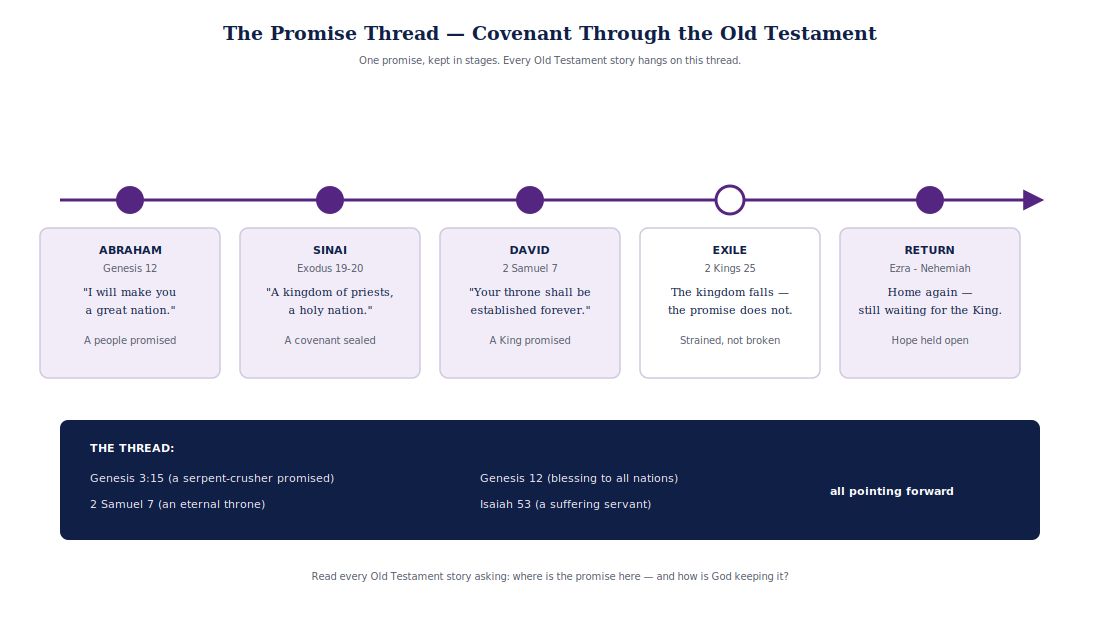
Memorize the six acts — Creation, Fall, Israel, Christ, Church, New Creation. In every FIRM lesson from here on, we'll tell you where the passage sits in this story, because a passage only makes full sense when you know what act you're in.
3. The genres — read each one the way it was written
The Bible's books weren't all written the same way, and they aren't meant to be read the same way. Each genre (type of literature) comes with its own reading rules. This is one of the most practical things you'll ever learn about Scripture:
- Narrative (story) — about 40% of the Bible. It shows more than it tells: you learn theology by watching what God and people do. Crucial rule: narrative is usually descriptive (telling you what happened), not prescriptive (telling you to do it). Just because someone in a story did something doesn't mean God approves — the Bible records plenty it doesn't endorse.
- Law — God's covenant instructions to Israel (Exodus through Deuteronomy). Read it as a window into God's character and Israel's calling first; the New Testament explains how each part applies to Christians now.
- Poetry and Wisdom — Psalms, Proverbs, Ecclesiastes, Job, Song of Solomon. Poetry speaks in images, emotion, and parallelism (saying one thing two ways), not in technical prose. Don't press a metaphor into a doctrine.
- Prophecy — God's spokesmen confronting their own generation and announcing God's future. Prophecy has layers: a message for then, and often a trajectory toward Christ and the end. Read it in its historical moment first.
- Gospels — four accounts of Jesus' life, death, and resurrection. Ancient biography with a purpose: each Gospel writer selected and arranged real events to show a particular portrait of Jesus. Read them as testimony, not just information.
- Letters — Romans through Jude. Written to real churches facing real problems — which means every letter is occasional: occasion-shaped. Always ask, "What situation was this answering?" before asking, "What does this mean for me?"
- Apocalyptic — Daniel and Revelation. Highly symbolic visions of cosmic conflict and God's final victory, written to suffering people. The symbols meant something to the first readers; start there, not with today's headlines.
The rule is simple: read each genre the way it was written. You don't read a poem the way you read a legal contract. The Bible deserves the same basic respect you'd give any book.
4. How the books relate to each other
The 66 books constantly talk to each other. The New Testament quotes the Old Testament hundreds of times. Promises made in Genesis get kept in the Gospels. Patterns repeat on purpose — Adam, Abraham, Moses, and David are all set up as previews of the greater One to come, and the New Testament says so explicitly (Romans 5:14 calls Adam "a type of Him who was to come").
This is why FIRM studies every passage in its whole-Bible context. No verse stands alone. The meaning of a passage includes how it fits the storyline — what came before it, what it anticipates, and how later Scripture interprets it. When we show you cross-references in future lessons, we're not decorating; we're letting the Bible interpret the Bible.
How the Bible Came to Be
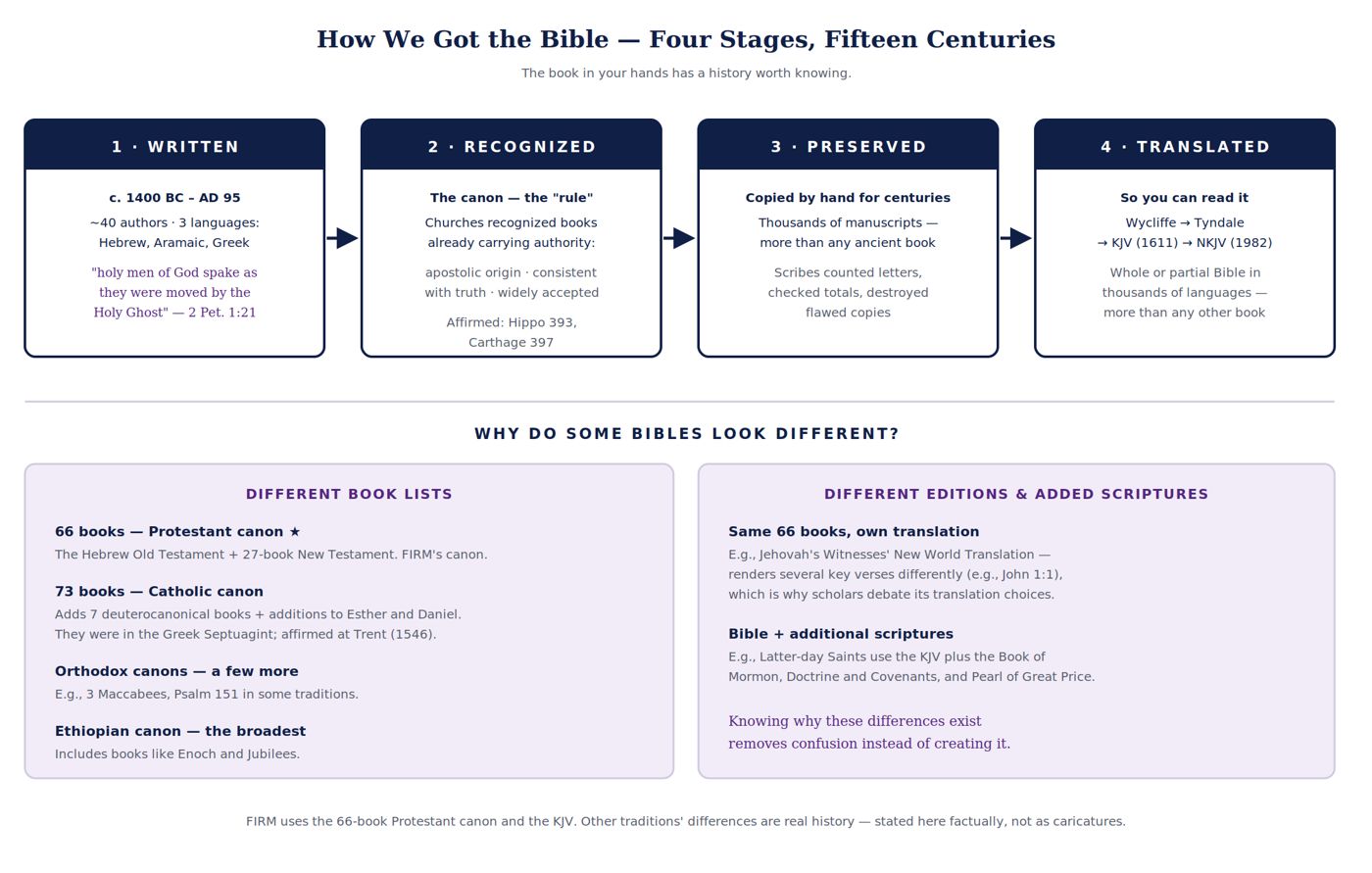
This is the question almost no one answers for new believers — and it leaves them defenseless the first time someone says, "The Bible was just put together by men." Here's the actual history, in four stages.
Stage 1: Written — God speaks through human authors
Over roughly fifteen centuries, God revealed Himself through human writers who wrote in their own languages, styles, and personalities. Moses writes differently than John; Paul argues, David sings, Luke investigates (read Luke 1:1–4 — he tells you he's doing historical research). The human fingerprints are real, and they're part of the design.
The Bible's own claim about this process is stated plainly — and we'll be honest that this is the Christian position, the Bible's claim about itself:
"All scripture is given by inspiration of God, and is profitable for doctrine, for reproof, for correction, for instruction in righteousness." — 2 Timothy 3:16 (KJV)
The word translated "inspiration" is theopneustos — literally "God-breathed." Scripture's claim is not that God dictated words to robots, but that He breathed out His Word through real human authors — "holy men of God spake as they were moved by the Holy Ghost" (2 Peter 1:21, KJV). Divine authorship and human authorship at the same time: that's the doctrine of inspiration, and it's why Christians treat the Bible as carrying God's authority, not just human wisdom.
Stage 2: Recognized — how the church identified the books (the canon)
The word canon comes from a Greek word for a measuring reed — a ruler. The canon is the rule, the official list of books that count as Scripture.
Here's the correction to the myth: the church didn't vote books into authority; it recognized books that already carried authority. The process worked more like a jeweler recognizing genuine diamonds than a committee inventing them. Three tests emerged in the early church:
- Apostolic or prophetic origin — was it written by an apostle (or someone close to one, like Mark with Peter or Luke with Paul), or a recognized prophet?
- Consistency with known truth — did it agree with what the churches had already received? A book contradicting the apostles' teaching was out.
- Widespread acceptance — was it already being read as Scripture across the churches, not just in one region?
Books that passed all three were recognized. Some books were debated for a time (a handful, like Hebrews, James, 2 Peter, and Revelation, took longer in some regions), and some popular books failed the tests and were set aside. Eventually, church councils — notably at Hippo (AD 393) and Carthage (AD 397) — formally affirmed the 27-book New Testament list that the churches were already using. The first surviving list matching our 27 books exactly comes a generation earlier: in AD 367, the church leader Athanasius wrote out all 27 in his annual Easter letter. The Old Testament books had been recognized by the Jewish community long before Jesus, and Jesus and the apostles treated them as Scripture.
This is where the fact-vs-inference-vs-disputed standard matters, and we'll keep using it through the whole curriculum: the criteria and the council dates are historical fact; whether a particular disputed book was rightly included is where traditions differ — which brings us to the extra-books question below.
Stage 3: Preserved — copied by hand for centuries
Before the printing press (1400s), every Bible was copied by hand — thousands of scribes across centuries. Jewish scribes developed almost obsessive copying practices: counting letters, checking totals, destroying flawed copies. Christian scribes copied the New Testament so widely that we now have more than 5,800 handwritten Greek manuscripts — and the count keeps growing as more are cataloged — plus early translations into Latin, Syriac, Coptic, and other languages. That is far more manuscript evidence than for any other ancient book.
Do the copies differ? Yes, slightly — mostly spelling, word order, and small scribal slips, the way any hand-copied text varies. Here's the key fact: no major Christian doctrine depends on any disputed wording. The manuscript evidence lets scholars compare copies and reconstruct the original text with high confidence — and discoveries like the Dead Sea Scrolls (more on those in the Scholar's Note) keep confirming that the copying was remarkably faithful.
Stage 4: Translated — so you can read it
The Bible has been translated more than any book in history — the whole Bible or portions of it now exist in thousands of languages (the complete Bible in nearly 800 of them, as of the mid-2020s). The English story alone is worth knowing: John Wycliffe produced the first English Bible (from Latin, 1380s); William Tyndale translated the first English New Testament from Greek (1526) — and was executed for it; the King James Version (1611) became the English-speaking world's Bible for centuries; and the New King James Version (1982) updated the KJV's archaic language ("thee," "thou," "verily") while keeping its translation philosophy. FIRM quotes the KJV itself — and this book ends with a short appendix, "Reading the KJV," that teaches you its older language as you go.
Why are there so many English translations?
Walk into a bookstore and you'll find KJV, NKJV, ESV, NASB, NIV, NLT, CSB, and more. This intimidates beginners — so let's demystify it. Translations differ for three honest reasons, and none of them is "nobody knows what it says":
1. Translation philosophy — the accuracy/readability trade-off. Every translator faces the same dilemma: stick close to the original words, or restate the meaning in natural English? Nobody can do both perfectly, so translations sit on a spectrum:
- Word-for-word (formal equivalence) — stays as close to the original wording as possible. Most precise, but can sound stiff. NASB 2020 (the most literal), ESV, KJV, NKJV.
- Thought-for-thought (dynamic equivalence) — renders the meaning in natural English phrasing. Easier to read, but the translator makes more interpretive decisions for you. NIV, NLT.
- Middle ground — CSB ("optimal equivalence") deliberately balances the two.
- Paraphrase — restates the Bible in highly modern idiom (The Message). Useful for freshness, but it's one person's restatement — not for careful study.
2. Source manuscripts. Remember the hand copies? Scholars work from two main families of Greek New Testament manuscripts: the Textus Receptus (the printed Greek text behind the KJV, based on later Byzantine manuscripts) and the modern critical text (built from older manuscripts discovered since, like Codex Sinaiticus and Codex Vaticanus, weighing all evidence). The KJV and NKJV translate from the Textus Receptus tradition; the NASB, ESV, NIV, NLT, and CSB translate from the critical text. The differences this creates are small and mostly footnoted — modern translations often note the differences in their margins ("NU-Text reads…" in the NKJV, for example), which is exactly this conversation happening in a Bible's footnotes.
3. Audience and reading level. A translation for scholars reads differently than one for new readers. Approximate reading levels: NLT (~6th grade), NIV and CSB (~7th–8th), NKJV (~9th), ESV (~10th), NASB (~11th), KJV (~12th, plus 400-year-old vocabulary). FIRM uses the KJV itself — the heritage translation of the English-speaking church, standing in the Textus Receptus line just described, and in the public domain, so this curriculum can print it in full without restriction. Its language is 400 years old, so this book ends with a "Reading the KJV" appendix that teaches you to read it well.
The takeaway: more translations = different trade-offs, not different Bibles. The underlying Hebrew, Aramaic, and Greek is the same. Serious students sometimes compare two translations side by side — where they agree, you're standing on solid ground.
Why do Catholic Bibles have extra books?
If you've ever picked up a Catholic Bible, you noticed: 73 books instead of 66. Seven additional Old Testament books — Tobit, Judith, 1 and 2 Maccabees, Wisdom, Sirach (Ecclesiasticus), Baruch — plus extra sections in Esther and Daniel. Catholics call them deuterocanonical ("second canon"); Protestants historically called them the Apocrypha.
Here's the history, stated factually. These books were written between the Old and New Testaments and were included in the Septuagint — the Greek translation of the Hebrew Scriptures made in the 3rd–2nd centuries BC, which was the Bible most early Christians actually used. For centuries, Christians disagreed about their status: many church fathers read them devotionally, while scholars like Jerome (who translated the Latin Vulgate) distinguished them as useful for edification but not for establishing doctrine.
The split became official at the Council of Trent (1546). In response to the Protestant Reformers — who had returned to the Hebrew canon of 39 Old Testament books — the Catholic Church formally affirmed the 73-book canon, including the deuterocanonical books as fully Scripture. So the difference isn't that Catholics added books out of nowhere or that Protestants ripped pages out: both sides were settling a centuries-old question, and they settled it differently.
Two more notes for completeness, covered factually and without hostility:
- Other traditions differ too. Eastern Orthodox canons include a few additional books (such as 3 Maccabees and Psalm 151 in some traditions). The Ethiopian Orthodox canon is the broadest in Christianity, including books like Enoch and Jubilees. These are real, historic Christian traditions with their own reasoning.
- Some groups have their own translations or additional scriptures. Jehovah's Witnesses use their own translation, the New World Translation, which renders several key verses differently than all major translations (for example, John 1:1) — which is why its translation choices are widely debated by scholars. The Latter-day Saints (Mormons) use the King James Bible plus additional scriptures: the Book of Mormon, the Doctrine and Covenants, and the Pearl of Great Price.
FIRM uses the historic 66-book Protestant canon and the KJV. Knowing why other Bibles differ removes confusion instead of creating it — and it prepares you for honest conversations with Catholic, Orthodox, and other neighbors, which deserve facts, not caricatures.
Word Study
Three words you'll meet constantly in Bible study. Learn them now and they'll pay rent for years:
"Testament" — covenant. When you see "Old Testament" and "New Testament," think old covenant and new covenant. A covenant is a binding, sworn agreement — stronger than a contract, closer to a marriage vow. The Bible is the record of God's covenant dealings with His people: the covenant He made with Israel through Moses, and the new covenant He made with all who believe through Jesus' death and resurrection (Luke 22:20). The whole library hangs on this frame.
"Canon" — measuring reed, rule. In the ancient world, a kanon was a straight rod used to measure. Applied to Scripture, it means the standard — the definitive list of books that measure up as God's Word. When someone says "the canon," they mean the recognized collection, not a weapon (that's cannon with two n's — a common mix-up worth avoiding).
"Inspiration" — God-breathed. The Greek theopneustos (2 Timothy 3:16) joins theos (God) and pneō (to breathe). Scripture's claim is that God breathed out these writings — that behind the human authors' real personalities, vocabularies, and research stands the breath of God Himself. That's why Christians don't treat the Bible as merely wise human religious literature. Inspiration is the reason for the reverence.
Why Context Matters
Here's the single most transformative reading skill in this whole lesson: never read a verse alone.
Every verse sits inside a passage, every passage inside a book, every book inside the storyline. Think of it as three widening circles:
- Immediate context — the verses around it. Who's speaking? What just happened? What happens next? Half of all misused verses are fixed by reading the next three verses.
- Book context — why was this book written, to whom, and what's its argument? A verse in Romans means what Paul's argument means.
- Whole-Bible context — where does this sit in the six-act story? What came before, and how does later Scripture interpret it?
A verse ripped from its context can be made to say almost anything — and people do it constantly, with good intentions and bad ones. ("I can do all things through Christ which strengtheneth me" is about contentment in need and plenty — Philippians 4:11–13 — not about winning your soccer game. The context says so.) The rule: context isn't optional background; it's part of the meaning. If you don't know the context, you don't yet know what the verse means — and that's fine, because now you know what to look for.
Responsible Reading — Basic Interpretation
You don't need a seminary degree to interpret the Bible well. You need good questions, asked in the right order, with honesty about what you find. Here are the questions FIRM will train you to ask of every passage:
- What does it actually say? (Observation.) Read slowly. Notice repeated words, contrasts, cause and effect. Don't rush to "what does it mean for me" before you've seen what's there.
- Who wrote it, to whom, when, and why? (Background.) Every book had a first audience with real problems. Find them first.
- What genre is this, and how does that genre communicate? A psalm's tears aren't a doctrine; a proverb's general wisdom isn't a promise; a narrative's description isn't a command.
- What did this mean to the first readers? (Original meaning.) The text meant something specific then before it means something for you now. Skip this step and you'll make the Bible about yourself too quickly.
- What is the timeless truth? (Theology.) What does this passage reveal about God, humanity, sin, salvation, or faithful living that transcends its original moment?
- How does this fit the whole story? (Canonical context.) Where's the promise, the fulfillment, the thread to Christ?
- What must change in me? (Application.) Specific, obedient, this week — never vague.
Two guardrails for the road:
- Let the clear passages interpret the unclear ones. When a difficult verse seems to contradict plain teaching elsewhere, the plain teaching governs. Don't build a doctrine on the hardest verse in the Bible.
- Separate what you know from what you're guessing. Throughout FIRM you'll see labels — Scripture explicitly says, the text strongly suggests, reasonable inference, disputed. Hold each with the right grip strength. Certainty where the Bible is certain; humility where it isn't. That honesty is not weakness — it's what makes your confidence trustworthy.
How FIRM Works
FIRM is the method this whole curriculum runs on — four movements, in order, every lesson. The name is the map:
F — FOUNDATION: "What am I looking at?" Before interpreting anything, we build the context: where the passage sits in the story, who the people are, what the words mean, what's happening historically and culturally. Foundation answers the beginner's real questions — who are these people, where is this place, why does this matter? — so nobody has to pretend. Most confusion about the Bible isn't a spiritual problem; it's a context problem. Foundation fixes that first.
I — INTERPRETATION: "What does it mean?" Only after the foundation is laid do we ask what the passage meant to its first readers — the author's intent, the theology, the difficulties honestly faced. Interpretation is disciplined: observation before conclusions, context before application, and the fact-vs-inference-vs-disputed standard keeping us honest. We don't skip hard passages, and we don't force meanings the text won't carry.
R — REFLECTION: "What is God showing me?" Understanding without self-examination is just information. Reflection turns the mirror around: what is God exposing, correcting, or developing in me through this truth? This is honest, not merely emotional — and it's private. Nobody grades your reflection.
M — MOVEMENT: "What will I do?" Formation, not just information. Every lesson ends with a specific, obedient response: a named sin confessed, a concrete action taken, a person told, a verse memorized, a prayer prayed. Vague intentions ("trust God more") don't count. Movement is where the Word becomes walk — which is why every lesson's reflection page is called From Word to Walk.
You'll also meet two recurring tools: the "Check What You Think You Know" box (surfacing common misreadings before they take root — you just read your first one), and the Fact vs. Inference vs. Disputed labels (keeping our confidence honest). And every lesson carries at least two meaningful visuals, because hard ideas get clearer when you can see them.
One more promise, and it's the brand's promise: you should never have to pretend you understand Scripture. If a lesson ever leaves you faking it, the lesson failed — not you. Tell your teacher. That's what this is for.
Fact vs. Inference vs. Disputed
Practice the standard on this lesson's own claims:
- Scripture explicitly says: all Scripture is God-breathed and useful for teaching and training (2 Timothy 3:16); holy men spoke as moved by the Holy Spirit (2 Peter 1:21); the gospel accounts present Jesus' death and resurrection as historical events (e.g., Luke 1:1–4; 1 Corinthians 15:3–8).
- Historical fact (outside the Bible): the 66-book Protestant canon, the 73-book Catholic canon, and the existence of the Septuagint, the Textus Receptus, and the modern critical text; the dates of Athanasius's list (367) and the councils at Hippo (393) and Carthage (397) and Trent (1546); the more than 5,800 surviving Greek New Testament manuscripts.
- The text strongly suggests: the traditional authorship attached to many books (Moses for the Pentateuch, Paul for the letters bearing his name) — early and widespread, though not every detail is provable.
- Reasonable inference: approximate dates for when many books were written, based on internal clues and history.
- Disputed / uncertain: which Greek text family best preserves the originals (Textus Receptus vs. critical text) — serious scholars disagree, and the differences are small; whether the deuterocanonical books belong in the canon — settled differently by different traditions; the exact dates of many Old Testament books.
Notice what this does: it lets you hold the essentials with full confidence while staying honest about the edges. That's the posture of a trustworthy student of Scripture.
Scholar's Note (Flex)
What a cave full of old scrolls proved — and didn't prove. In 1947, a shepherd boy threw a stone into a cave near the Dead Sea and heard pottery shatter. Inside were ancient scrolls — the Dead Sea Scrolls, a Jewish library hidden around AD 68, including a complete copy of Isaiah roughly 1,000 years older than the best Hebrew manuscript anyone had. Scholars held their breath: after a millennium of hand-copying, how much had the text drifted?
Answer: remarkably little. The Isaiah scroll matches the later manuscripts overwhelmingly — same book, same message, minor spelling and wording variants. It's the single strongest piece of physical evidence that the Old Testament was copied with extraordinary care across the centuries.
But honesty requires the second half: the scrolls prove faithful transmission, not divine inspiration. No archaeological find can prove that God breathed out the words — that's a claim you weigh with the Bible's own testimony, Jesus' treatment of Scripture, and the Spirit's witness, not with carbon dating. The scrolls remove an objection ("the text was corrupted beyond recognition"); they don't remove the need for faith. Good evidence knows what it can and can't do — and so should we.
Theological Truth
Three truths rise straight out of this lesson:
- God chose to reveal Himself in words. He could have left us with only nature and conscience — and those do speak (Psalm 19:1; Romans 1:20). But He spoke: through prophets, through apostles, and supremely through His Son (Hebrews 1:1–2). The Bible exists because God wants to be known, not guessed at.
- Scripture carries God's authority because it is God-breathed. This is the Bible's own claim (2 Timothy 3:16), and Christianity stands or falls with it. If Scripture is merely human religious insight, it's interesting. If it's breathed out by God, it's authoritative — it gets the last word.
- The Bible's unity across fifteen centuries points to its Author. Dozens of writers, three languages, every genre — one story, one promise, one Rescuer. Human coordination can't explain that. The best explanation is the Bible's own: one divine mind behind the many human pens.
Christ and the Gospel
This lesson doesn't need to force Christ into the picture — He is the picture's center. Jesus Himself said the Scriptures "testify of Me" (John 5:39, KJV), and on the road to Emmaus, "beginning at Moses and all the prophets, he expounded unto them in all the scriptures the things concerning himself" (Luke 24:27, KJV).
See the shape of it: the Old Testament makes promises it can't keep by itself — a serpent-crusher, a blessing for all nations, a king from David's line, a suffering servant, a new covenant. The Gospels announce the Keeper of those promises. The letters explain what His keeping them means for you. Revelation shows the final keeping. The whole library leans forward toward Jesus and then looks back at Him. You don't have to insert Christ into the Bible's story. You just have to notice He's already there.
Before you move on, sit with what you've learned — because this lesson wasn't just information. It was an invitation to trust the book you're holding.
For years, many believers have treated the Bible like a device they don't understand: they know which buttons to push (open, read, highlight), but the manual was never explained. Now you've read the manual. The question is whether you'll use it — whether you'll start asking what genre is this? what's the context? what did this mean first? instead of just hoping the verse behaves.
And consider the deeper claim underneath today's history lesson. If the Bible really is God-breathed — if the God who made you took fifteen centuries to write you a letter — then ignoring it isn't neutral. It's declining a conversation the King of the universe started. But the reverse is just as true: He started it. He wants to be known. Every time you open these pages with honest questions, you're accepting an invitation He already sent.
Self-evaluation. Before the next section, mark where you are — honestly, for your eyes only: - I can explain what the Bible is (66 books, two testaments, one story) in my own words: yes / mostly / not yet - I can trace the six-act storyline: yes / mostly / not yet - I can explain why translations differ and why some Bibles have extra books: yes / mostly / not yet - I understand how the F-I-R-M process works: yes / mostly / not yet
Confess It. Bring it plainly: "Father, I have treated Your Word as [a decoration / a mystery I can't understand / someone else's job to explain]. Forgive me. Teach me to open it with confidence — it's mine to read, because You gave it to be understood." Write your confession:
First the indicative — what God has done: He didn't leave you guessing. He breathed out His Word through real people across fifteen centuries, moved the church to recognize it, preserved it through hand-copied manuscripts and fierce opposition, and put it in a language you can read tonight. "All scripture is given by inspiration of God" (2 Timothy 3:16) — and He gave it to you, that you "may be perfect, throughly furnished unto all good works" (2 Timothy 3:17, KJV).
Now the imperative — your response. Choose one:
- Write what it is: Open your KJV Bible tonight and read 2 Timothy 3:10–17 slowly — the passage this lesson started with. Then write one paragraph in your own words answering: What is the Bible, and why should I trust it? Don't copy the lesson. Make it yours. If you can't answer yet, write down exactly where you're stuck — that's honest, and honesty is where understanding starts.
- Learn the six acts: Memorize the storyline (Creation → Fall → Israel → Christ → Church → New Creation) well enough to recite it without looking. Then test yourself: pick any Bible story you already know (David and Goliath, the prodigal son, Moses at the Red Sea) and place it in the right act. Do this with three stories.
- Tell one person: Tell a friend, a spouse, or someone in your small group that you've started FIRM — and tell them the six acts. Teaching it once will cement it better than reading it five times.
Pray It Back. Turn 2 Timothy 3:16 into prayer: "Father, all Scripture is given by Your inspiration — breathed out by You. Make it profitable in me: for doctrine, to teach me what is true; for reproof, to show me where I'm wrong; for correction, to set me straight; for instruction in righteousness, to train me in how to live. Complete me. Equip me. Amen."
For Us Together. Ask your small group or family this week: Do we treat the Bible like a book we actually expect to understand — or like a mystery only experts can open? Share one thing from this lesson that changed your answer.
Who Needs This? Think of one person who assumes the Bible is too confusing, too debated, or too far removed to trust. This week, tell them one thing you learned — the six-act story, or how the canon was recognized rather than invented. One honest insight, offered gently.
Write your choice, specifically — what, and when:
Praise Him
Before you close, worship — because the lesson ends in doxology, not just action.
Think about what you've held in your hands all these years without knowing it: sixty-six books, one story, breathed out by God through shepherds and kings, fishermen and scholars — written across fifteen centuries, three languages, and three continents — recognized, preserved, and translated so that you could read it tonight in your own language. No other book on earth has a story like that. Because no other book is like that.
What does that make you want to praise Him for? Write it — then say it out loud:
Discussion Questions
- (Observation) In your own words, what is the Bible? (Aim for two or three sentences: what it is, what it's made of, what it's for.)
- (Interpretation) Why does it matter that the church recognized the canon rather than creating it? What changes about your confidence in the Bible if the books carried authority before any council met?
- (Theology) 2 Timothy 3:16 says Scripture is "God-breathed." What's the difference between that claim and saying the Bible is just wise human religious literature? Why does the difference matter practically?
- (Reflection) Which of the three "Check What You Think You Know" assumptions did you carry — the rulebook, the council vote, or the translation confusion? How does the real story change how you feel about opening the Bible?
- (Movement) What's one specific reading habit you'll change based on this lesson — and who will you tell about it this week?
End of Foundations Lesson 1 — Student Edition. Next: Bonus Lesson — Why Does My Bible Have 66 Books?