
Before You Read: Open My Eyes
Before you read a single verse, pray this — out loud if you can:
"Father, this is the passage where Your Son claimed to forgive sins and got plotted against for it. Open my eyes to see who He really is — and show me the fences I've built around Your gifts. In Jesus' name, amen."
(Psalm 119:18 — "Open thou mine eyes, that I may behold wondrous things out of thy law.")
Welcome
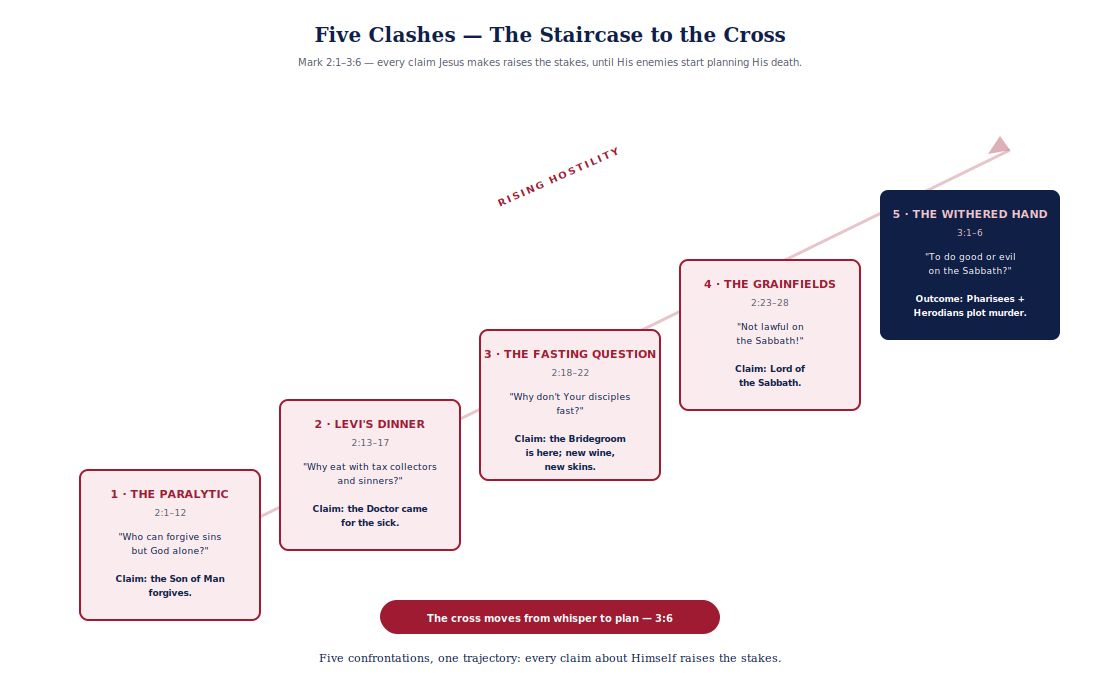
The honeymoon is over. In Lesson 02 the crowds were amazed; now the scholars start taking notes — and they don't like what they see. Across five rapid-fire confrontations, Jesus forgives sins (God's job), eats with traitors (scandalous), and treats the Sabbath like He wrote it (because He did). By the end, the Pharisees are plotting murder with their political enemies.
This is the chapter where admiration curdles into opposition — and where Jesus shows us exactly what kind of Messiah He refuses to be.
CHECK WHAT YOU THINK YOU KNOW
- ☐ "Jesus healed the paralyzed man first, then forgave him." (Mark puts it the other way around — on purpose.)
- ☐ "Tax collectors were just unpopular government workers." (They were seen as traitors — see "Dinner with the enemy.")
- ☐ "The Sabbath laws Jesus broke were God's laws." (Careful — see "What the law meant vs. what tradition added.")
- ☐ "The Pharisees and Herodians were allies." (They hated each other — which tells you how much they feared Jesus.)
Where we are in the story
Jesus is back in Capernaum — His adopted hometown — and the crowds are now so thick that no one can get through the door (2:2). But popularity has a shadow: the scribes (the Bible scholars you met in Lesson 02) are watching, and what they're about to see will turn them from critics into conspirators. Mark arranges five clashes in a rising staircase — each one sharper than the last.
Clash 1: The paralytic through the roof (2:1–12)
Four men carry a paralyzed friend to Jesus, but the crowd blocks the door. So they climb onto the flat roof, dig through the mud-and-thatch roofing, and lower the man on his mat right in front of Jesus. 37 (Scholar's Note below on how that worked.)
Jesus' first words are not what anyone expects: "Son, thy sins be forgiven thee" (2:5).
Not "rise and walk." Forgiven. Mark wants you to feel the shock: the man's obvious need is his legs, but Jesus addresses the deeper paralysis first — the one no doctor can touch.
The scribes, "reasoning in their hearts," object: "Why doth this man thus speak blasphemies? who can forgive sins but God only?" (2:7).
Their theology is exactly right — and that's the trap. If only God can forgive sins, and Jesus just forgave sins, then either He's a blasphemer... or He's God. There's no third option, and Mark won't let you take one.
Jesus reads their thoughts ("Why reason ye these things in your hearts?") and poses His own question: "Whether is it easier to say to the sick of the palsy, Thy sins be forgiven thee; or to say, Arise, and take up thy bed, and walk?" (2:9). Think about it: saying "you're forgiven" is easy — no one can verify it. Saying "walk" is falsifiable on the spot. So Jesus does the harder-to-fake thing to prove the invisible thing: "But that you may know that the Son of Man has power on earth to forgive sins" — He said to the paralytic — "I say to you, arise, take up your bed, and go to your house" (2:10–11).
The man stands up. The crowd is "amazed" and glorifies God: "We never saw anything like this!" (2:12). First clash: Jesus 1, scribes 0 — and the scribes know it.
Clash 2: Dinner with the enemy (2:13–17)
By the lakeshore, Jesus sees Levi son of Alphaeus (the traditional identification with Matthew — cf. Matthew 9:9) — "sitting at the receipt of custom." 29 And He says two words: "Follow Me." Levi gets up and follows.
To feel this, you have to know what a tax collector was. The Greek word is telonion — a toll booth, not a modern tax office. And Galilee wasn't ruled directly by Rome; it was the tetrarchy of Herod Antipas, who taxed his own territory: import and export duties, tolls on travelers and goods, taxes on what was bought and sold. 38 Capernaum sat on a border and a busy trade route — a natural customs post — and Levi was most likely the toll man there, collecting for Antipas's government, with plenty of room to skim off the top. (Rome's famous auctioning of tax contracts to private bidders was the system in provinces Rome ruled directly, like Judea — not in Antipas's Galilee.) 39 Tax collectors were collaborators with the occupying power, legalized extortionists, defiled by constant dealings with Gentiles and their goods. 40 Respectable Jews wouldn't eat with them — and rabbinic courts wouldn't accept their testimony. (Later rabbis disqualified tax-farmers as witnesses: b. Sanhedrin 25b.) 39
So when Jesus then attends a dinner at Levi's house — reclining at table with "many publicans and sinners" (2:15; "sinners" here means the openly irreligious, the morally notorious) — and when His disciples eat there too, the scribes of the Pharisees are scandalized: "How is it that He eats and drinks with tax collectors and sinners?" (2:16).
Jesus' answer is a proverb and a mission statement in one: "They that are whole have no need of the physician, but they that are sick: I came not to call the righteous, but sinners to repentance." (2:17).
Two things to notice. First, the doctor doesn't catch the disease by entering the sickroom — the Pharisees' quarantine logic is backwards. Second, "the righteous" is gentle irony: Jesus isn't saying the Pharisees are actually righteous; He's saying people who think they're well don't look for a doctor. The only people Jesus can't help are people who won't admit they're sick.
Clash 3: Why don't Your disciples fast? (2:18–22)
Now the questioners broaden: "the disciples of John and of the Pharisees used to fast" — and they ask, "Why do the disciples of John and of the Pharisees fast, but thy disciples fast not?" (2:18).
Fasting — going without food to seek God — was a mark of serious piety. John's disciples fasted; the Pharisees fasted twice a week (Luke 18:12). Jesus' crew conspicuously doesn't. It looks like spiritual laziness.
Jesus answers with a wedding: "Can the children of the bridechamber fast, while the bridegroom is with them? As long as they have the bridegroom with them they cannot fast. But the days will come, when the bridegroom shall be taken away from them, and then shall they fast in those days." (2:19–20).
Read that carefully — it's staggering. In the Old Testament, God Himself is the bridegroom of Israel (Isaiah 62:5; Hosea 2:19–20). Jesus steps into that role without blinking: He is the bridegroom. And weddings aren't for fasting — they're for feasting. His presence is the party the fasts were pointing toward.
Then two parables about new and old:
- No one sews new cloth on an old garment — the patch shrinks and tears worse (2:21).
- No one puts new wine into old wineskins — new wine is still fermenting, still giving off gas; fresh leather skins can stretch, but old ones, already stretched stiff, burst. New wine needs new skins (2:22).
The point: Jesus isn't a reform of the old system — He's something new that the old containers can't hold. You can't just add Jesus to Pharisaism like a patch. The gospel needs fresh forms.
And notice the quiet prophecy tucked inside: "the days will come, when the bridegroom shall be taken away" — the first whisper in Mark that the wedding will be interrupted by violence. The Greek verb (apairō) means snatched away by force — it's used only three times in the New Testament, every time of the Bridegroom (Matthew 9:15; Mark 2:20; Luke 5:35). 41
Clash 4: Lord of the Sabbath — the grainfields (2:23–28)
Walking through grainfields on the Sabbath, the disciples pluck heads of grain — and the Pharisees pounce: "Behold, why do they on the sabbath day that which is not lawful?" (2:24).
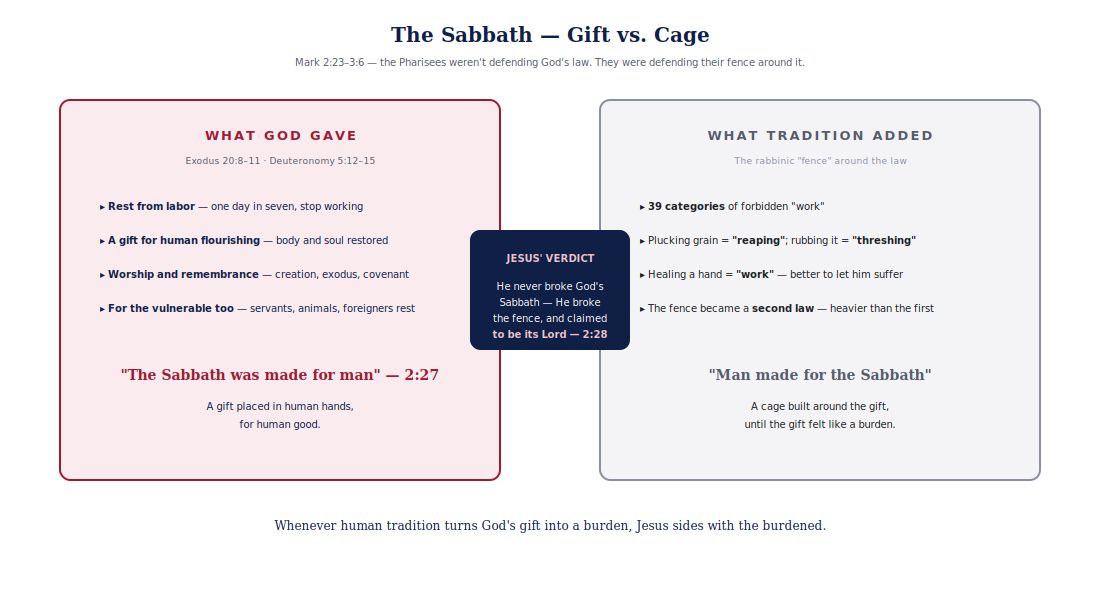
Here's where you need the backstory (see Visual 2). God's Sabbath law said: rest, don't work (Exodus 20:8–11). But the rabbis were already building a fence around the law — detailed rules about what counted as "work," to make sure no one even got close to breaking it. The full list we know today — 39 categories of forbidden "work," with endless sub-rules — comes from the Mishnah, compiled around AD 200, after Jesus' day. 4243 But the fence-building was already underway in His day (the Gospels' own Sabbath clashes are the proof), and earlier Jewish writings show strict Sabbath rules developing well before Jesus. Later rabbinic rulings spelled out applications like: plucking grain counts as "reaping"; rubbing it in your hands counts as "threshing." 42 The disciples weren't breaking God's law. They were breaking the fence.
Jesus answers with Scripture — the story of David eating the showbread (1 Samuel 21:1–6). The showbread was the sacred bread in the tabernacle, reserved for priests alone — yet David, fleeing for his life, ate it, and Scripture never condemns him. Jesus' argument: if David could set aside a ritual law for human need without guilt, how much more can the Son of David?
Then the thunderclap — two sentences that detonate the whole debate:
"The sabbath was made for man, and not man for the sabbath" (2:27)
The Sabbath is a gift, not a trap. God gave it for human flourishing — rest, worship, restoration. The Pharisees had turned the gift into a burden and the servants into slaves of the rule. And Mark alone preserves 2:27 — Matthew and Luke both leave it out of their parallel accounts (Matthew 12:1–8; Luke 6:1–5). 5 Mark wanted his readers to hear this sentence.
"Therefore the Son of man is Lord also of the sabbath." (2:28)
Therefore. Because the Sabbath was made for man, the One who is Lord over man is Lord over the Sabbath too. This is Jesus' most direct claim to divine authority so far — He doesn't just interpret the Sabbath law; He claims to own it.
Clash 5: The withered hand (3:1–6)
The next Sabbath, in the synagogue, there's a man with a withered hand — and Mark tells us the Pharisees "watched him, whether he would heal him on the sabbath day; that they might accuse him" (3:2). They're not there to worship. They're there to build a legal case.
Jesus calls the man forward — into the middle, where everyone must look — and asks the question that exposes everything: "Is it lawful to do good on the sabbath days, or to do evil? to save life, or to kill?" (3:4).
Silence. No answer — because any honest answer destroys their position.
Then Mark gives us one of the most human verses in the Gospel: "And when he had looked round about on them with anger, being grieved for the hardness of their hearts, he saith unto the man, Stretch forth thine hand. And he stretched it out: and his hand was restored whole as the other" (3:5).
Anger and grief, together. Jesus is angry at the evil — a theology that would rather protect a rule than heal a man — and grieved for the people trapped inside it. This is what righteous anger looks like: furious at the sin, heartbroken for the sinner.
The response is immediate and chilling: "The Pharisees went forth, and straightway took counsel with the Herodians against him, how they might destroy him" (3:6).
The Herodians — named only in the Gospels (Mark 3:6; 12:13; Matthew 22:16), so scholars work with thin evidence — were evidently supporters of the Herodian dynasty: the party of Herod Antipas, tetrarch of Galilee. 4445 Note the title: Antipas was a tetrarch — a governor-rank ruler under Rome — not a king. (Mark 6:14 loosely calls him "King Herod," but that's popular speech, not his official title.) His supporters were political pragmatists who cooperated with Rome's arrangement. The Pharisees were religious purists who despised Rome's collaborators. These two groups agreed on nothing — except, suddenly, that Jesus must die. When enemies unite against you, you've become dangerous. The cross just moved from whisper to plan.
WORD STUDY
Forgive — aphiemi (ah-FEE-ay-mee). Literally "to send away, release." 32 When Jesus says "your sins are forgiven," He's declaring them sent away — dismissed, released, gone. The scribes were right about one thing: only the offended party can release a debt. Jesus speaks as the offended party.
Tax collector — telones (teh-LOH-nace). A toll man at the customs booth — in Galilee, most likely collecting duties for Herod Antipas's government, with room to skim. To a 1st-century Jew, telones meant collaborator, extortionist, and traitor in one word — the moral equivalent of a mob enforcer working for an occupying army.
Sabbath — sabbaton (sah-BAH-ton). From the Hebrew shabbat, "rest, cessation." God's gift of weekly rest (Exodus 20:8–11) — which human tradition fenced with ever-growing rules (the full 39-category list comes from the Mishnah, c. AD 200) until the gift felt like a cage.
Why forgive first, heal second?
The paralytic's friends wanted legs; Jesus gave pardon. Why? Because Mark is showing you Jesus' priorities: the deepest human need isn't physical — it's spiritual. A man can walk into hell on healthy legs. And strategically, the forgiveness claim is the whole point of the scene — it forces the question Mark wants every reader to answer: who can forgive sins but God alone? The healing is the visible proof of the invisible claim. Jesus heals the body to certify what He did for the soul.
The Bridegroom claim — easy to miss, impossible to overstate
When Jesus calls Himself "the bridegroom" (2:19), modern readers hear a sweet wedding metaphor. His hearers heard a divine title. The Old Testament repeatedly pictures Yahweh as Israel's husband — "thy Maker is thine husband" (Isaiah 54:5); "I will betroth thee unto me for ever" (Hosea 2:19). And John the Baptist had already pointed at Jesus with the same title: "He that hath the bride is the bridegroom" (John 3:29). 29 For a Galilean rabbi to step into that role is either blasphemy or deity. Mark lets the claim sit there, unexploded, for the careful reader.
What the law meant vs. what tradition added
This is the key that unlocks both Sabbath clashes. God's law said: rest on the seventh day; don't do your labor (Exodus 20:8–11; Deuteronomy 5:12–15). It never defined "labor" with 39 categories — that full list was the rabbis' fence, compiled in the Mishnah around AD 200 (though the fence-building was already underway in Jesus' day), built with good intentions (keep people far from breaking the law) but calcified into a second law that crushed people. 4243
Jesus never breaks God's Sabbath. He breaks the fence — and claims the authority to say what the Sabbath is for: "made for man." The principle travels: whenever human tradition makes God's gift a burden, Jesus sides with the burdened.
Why anger? (3:5)
Mark says Jesus looked at them "with anger, being grieved." Some readers stumble — isn't anger a sin? But anger at evil isn't sin; it's love's reflex. Jesus is angry the way you'd be angry watching someone use a hospital's rulebook to justify leaving a patient bleeding. And in the same heartbeat He's grieved — the Greek suggests deep sorrow — for the hard-hearted men themselves. Anger at the sin, grief for the sinner: that's the emotional life of God.
The Christ Thread
Christ in His own story — who this passage shows Him to be. Across five clashes Jesus claims God's own prerogatives: He forgives sins (2:5–10 — "who can forgive sins but God only?"), He stands as the Bridegroom (2:19 — Yahweh's own title for Himself, Isaiah 54:5), and He is Lord of the Sabbath (2:28 — He doesn't interpret the law, He owns it). Mark is forcing the reader's hand: these are not the claims of a good teacher. They are the claims of God in flesh — the Son of Man of Daniel 7, exercising heaven's authority on earth.
OT/NT parallels — where the thread runs on. The forgiveness claim runs on Psalm 103:3 — "who forgiveth all thine iniquities" (a work David ascribes to the Lord alone). The Bridegroom title echoes Isaiah 54:5 and Hosea 2:19–20, where Yahweh is Israel's husband. The Sabbath debate will flare again in John 5:1–18 — another Sabbath healing, another murder plot. And Hebrews 4:9–10 picks up the Sabbath thread for us: "There remaineth therefore a rest to the people of God" — the rest Jesus is.
The Christian future — what this foreshadows for us. The Bridegroom claim points to the wedding that hasn't happened yet: "the marriage of the Lamb is come" (Revelation 19:7). We are the betrothed, living between the proposal and the feast — which is why we fast now (2:20): the Bridegroom has been "taken away," and we wait. And the forgiveness spoken over the paralytic is the verdict already rendered over us: "There is therefore now no condemnation to them which are in Christ Jesus" (Romans 8:1). The clashes preview the end: religion that protects rules over people crucified Him — and grace that forgives sinners will outlast it.
Where in the Covenant Story?
Three covenants collide in this passage. The Mosaic law gives the Sabbath (Exodus 20:8–11) — and Jesus shows what happens when human fences strangle God's gift: the Lawgiver's Son reclaims it. The Davidic promise surfaces twice: Jesus argues from David eating the showbread (1 Samuel 21), and claims the authority of David's greater Son. And underneath it all, the New Covenant promise — "I will forgive their iniquity, and I will remember their sin no more" (Jeremiah 31:34) — is being spoken aloud for the first time: "Son, thy sins be forgiven thee." The old covenant exposed sin; the new one, arriving in this Man, removes it.
Father, Son, and Spirit
The Trinity here is mostly the Son in action — but watch what He's doing: exercising the Father's prerogatives. Only God forgives sins (2:7 — even His enemies know this); only Yahweh is the Bridegroom; only the Law's Giver is Lord of the Sabbath. Every clash is the Son doing openly what the Father does eternally. The scribes' logic was airtight — they just couldn't accept where it led: if the Son forgives like the Father, the Son is equal with the Father (John 5:18 will make the charge explicit). Trinitarian reading means letting the Son's claims tell you who God is: a God who forgives, feasts with sinners, and refuses to let rules crush people.
WHAT THE CHURCH HAS ALWAYS BELIEVED: The Apostles' Creed confesses "the forgiveness of sins" — and here is the voice that first spoke it with authority. The creed doesn't treat forgiveness as a doctrine to admire but a gift to receive: spoken by Christ, delivered through His church, applied to sinners who repent. Every Sunday the church still says what Jesus said to the paralytic.
It's Okay to Ask
Honest questions this passage raises — bring them, don't bury them:
- Did Jesus actually break the Sabbath? Was He a lawbreaker? (No — He broke the fence, not the law. God's Sabbath was a gift of rest; the detailed rules — the full 39-category list was compiled in the Mishnah around AD 200 — were human tradition. Jesus kept the commandment and demolished the cage around it. See "What the law meant vs. what tradition added.")
- Why was Jesus angry in 3:5? I thought anger was a sin. (Anger at evil isn't sin — it's love's reflex. Jesus was furious at a theology that protected rules over people, and grieved for the people trapped in it. Ephesians 4:26: "Be ye angry, and sin not.")
- If Jesus came for sinners, were the Pharisees beyond hope? (No — and the proof is Paul: this Pharisee of Pharisees (Philippians 3:5) became the apostle to the Gentiles. Jesus' harshest words are for the self-righteous, but His invitation — "I came not to call the righteous, but sinners to repentance" — includes anyone willing to admit they're sick.)
- Mark 2:26 says "in the days of Abiathar the high priest," but 1 Samuel 21 says the priest was Ahimelech. Did Mark get it wrong? (Honest scholars read it three ways — and none of them requires Mark to be wrong. (1) Lifetime, not term: "in the days of" can mean during Abiathar's lifetime — he was alive then, likely serving alongside his father Ahimelech. But 1 Samuel 21 names only Ahimelech, so his presence at Nob is inference, not stated fact. (2) Era by its famous name: Abiathar became the great high priest of David's reign, so Mark names the era by its most prominent priest. (3) "In the passage about": the Greek construction works like Mark 12:26 — "in the burning bush passage" — pointing readers to the section of Samuel (1 Samuel 21–22) where Abiathar's story begins: his father killed, Abiathar fleeing to David. 46 The text is genuinely ambiguous; each option has solid defenders.)
FACT, INFERENCE, OR DISPUTED?
- FACT: Mark 2:7 — "Who can forgive sins but God only?" The scribes' theology was correct; the question is what follows from it.
- FACT: The Pharisees and Herodians were political and religious opposites; Mark 3:6 records them plotting together against Jesus.
- INFERENCE: Mark arranges the five clashes as an escalating staircase, ending in a death plot — the opposition's trajectory is deliberate, not accidental.
- DISPUTED: Whether "the friends of the bridegroom" implies the disciples understood Jesus' divine claim at the time. (Mark's pattern suggests they didn't — understanding comes slowly.)
- DISPUTED: Why Mark 2:26 names Abiathar as high priest when 1 Samuel 21 names Ahimelech. Three honest readings exist — lifetime, era-name, "in the passage about." (See "It's Okay to Ask.")
SCHOLAR'S NOTE: How do you lower a man through a roof? First-century Galilean houses had flat roofs of wooden beams overlaid with thatch, branches, and packed mud — with an outside stairway. 37 Mark says they "uncovered" (apestegasan) the roof and "broke through" (exorussō) — digging out the mud packing between beams, then lowering the mat through the gap. It was destructive, loud, and completely shameless. Four friends vandalizing a house because they believed Jesus could do what no one else could. Sometimes faith looks like property damage. (Luke 5:19 tells the same story as "through the tiling" — Luke, writing for Gentile readers, pictures a tiled Greco-Roman roof, while Mark's "uncovered" and "broke through" fit a Palestinian mud-and-thatch roof. Same shameless faith, two storytellers' details.)
Cross-references (explained, not just listed)
- 1 Samuel 21:1–6 — David and the showbread: the precedent Jesus cites. Human need outranks ritual regulation — even in the Old Testament.
- Exodus 20:8–11; Deuteronomy 5:12–15 — the Sabbath command itself: rest as gift, rooted in creation and the exodus.
- Isaiah 54:5; Hosea 2:19–20 — Yahweh as Israel's bridegroom: the background of Jesus' shocking self-title in 2:19.
- Luke 5:17–39; Matthew 9:1–17 — the parallel accounts, with Luke adding that the Pharisees had come "every town of Galilee, and Judaea, and Jerusalem."
Go Deeper
Hungry for more?
- Read John 5:1–18 — another Sabbath healing, another murder plot. Watch how John's Jesus makes the divine claim explicit ("My Father has been working until now, and I have been working").
- Read Hebrews 4:1–11 — the Sabbath rest that remains: what the weekly gift was always pointing to.
Theological truth (arising from the text)
Jesus claims the prerogatives of God — forgiving sins, redefining the Sabbath, standing as Bridegroom — and then proves the claims with power. But He wields divine authority for the marginalized: the paralyzed, the traitor, the hungry disciples, the disabled man. The highest claims serve the lowest people. And religion that protects its rules at the expense of people has stopped being God's religion — which is why it ends up plotting murder.
Humble — and confident
Humble, because we're capable of the Pharisees' disease: loving our fences more than people. Every tradition — even good ones — can calcify into a cage. The question isn't whether we have fences; it's whether we'd recognize it if Jesus started breaking ours.
Confident, because the One who forgives sins still says "Son... daughter" to the paralyzed — the spiritually stuck, the morally compromised, the religiously disqualified. His harshest words in this passage aren't for sinners. They're for the self-righteous.
Confess It
The Pharisees' disease is loving fences more than people — and we're all capable of it. Name one fence you've built or guarded: a rule you enforce, a person you avoid, a standard you use to feel superior. Confess it concretely now (1 John 1:9). Then ask: who has my fence been keeping out?
For discussion
- The scribes were theologically correct ("only God forgives sins") — and still wrong about Jesus. When has being right about doctrine blinded you to what God was doing?
- Jesus ate with people the religious wouldn't touch. Who are your "tax collectors" — the people you'd be embarrassed to be seen with?
- "The sabbath was made for man, and not man for the sabbath." What good gift of God have you (or your church) turned into a burden?
What He has done (the indicative)
Before one "you should," hear what He did: He looked at a paralyzed man and forgave him first — speaking the word only God can speak. He ate with traitors when the religious wouldn't. He tore down a fence around God's gift and claimed to be its Lord. He got angry at hardness and grieved over the hard-hearted in the same heartbeat. Every step below is a response to that forgiving, feasting, fence-breaking grace — not a way to earn it.
This week's practices
- The forgiveness audit. Is there a sin you've confessed but still carry — as if Jesus' "sent away" wasn't enough? Write it down, pray Mark 2:5 over it ("your sins are forgiven"), and destroy the paper.
- Eat with a "sinner." One meal or coffee this week with someone outside your usual circle — not to fix them, just to be with them. Let the Doctor's method become yours.
- Fence inspection. Ask: what rule — in your life, family, or church — might be a human fence around God's gift? Talk about it with one trusted believer.
- Pray It Back. Take Mark 2:27 into prayer: "Jesus, You said the Sabbath was made for man, not man for the Sabbath. Show me the gifts of Yours I've turned into burdens — and teach me to receive them like a child, not guard them like a Pharisee."
- Memorize Mark 2:27. "The sabbath was made for man, and not man for the sabbath."
For Us Together
Ask your small group or church: "What are our fences — the unspoken rules, the dress codes, the music wars, the 'we've never done it that way'? Which ones protect God's gift, and which ones have become the cage?" Have the conversation with compassion, not as ammunition.
Who Needs This?
Who in your life is spiritually paralyzed — stuck, ashamed, convinced they're disqualified? They don't need your advice first; they need to be carried to Jesus like the four friends carried their man. One name. One act of shameless advocacy this week.
Take It Home
At the table, ask your kids: "Jesus' friends tore a hole in someone's roof to get their sick friend to Him. What's the boldest thing you've ever done for a friend? Who needs us to be that bold for them?" Then be that bold — together.
Praise Him
Don't end with a to-do list — end with worship. Right now, finish this sentence out loud or in writing: "Jesus, I praise You because You forgive like God, feast with sinners, and _____." (Break my fences? Get angry at what crushes people? Call me friend?) Sit in it. The highest claims serve the lowest people — praise Him for it.
The bottom line
Five clashes, one revelation: Jesus forgives like God, feasts with sinners, and owns the Sabbath — because He is God, come for sinners, Lord of the gift. Religion that can't celebrate that will eventually try to kill it. Don't be that religion.