
Before You Read: Open My Eyes
Before you read a single verse, pray this — out loud if you can:
"Father, You chose twelve nobodies and called them Yours — and You've chosen me. Open my eyes to see how You build Your family, and open my heart to belong to it. In Jesus' name, amen."
(Psalm 119:18 — "Open thou mine eyes, that I may behold wondrous things out of thy law.")
Welcome
The death plot is in motion — so Jesus does something unexpected: He builds a team. From the crowds pressing in from six regions, He calls twelve nobodies up a mountain and gives them His authority. Then, in the same chapter, His own family tries to stage an intervention, Jerusalem scholars accuse Him of sorcery, and Jesus redefines family itself.
This is Mark's most human chapter: misunderstood by His relatives, slandered by the experts, and still — methodically — building the movement that would outlast Rome.
CHECK WHAT YOU THINK YOU KNOW
- ☐ "The twelve disciples were impressive, educated men." (Fishermen, a traitor-taxman, a zeal-driven man, and a future betrayer.)
- ☐ "The unforgivable sin is something you can commit by accident." (If you're worried you've committed it, read on — that worry is the proof you haven't.)
- ☐ "Jesus' family always supported His ministry." (Mark says they came to lay hold on Him — "He is beside himself.")
- ☐ "'Cananite' means Simon was from Canaan." (It doesn't — see Word Study.)
Where we are in the story
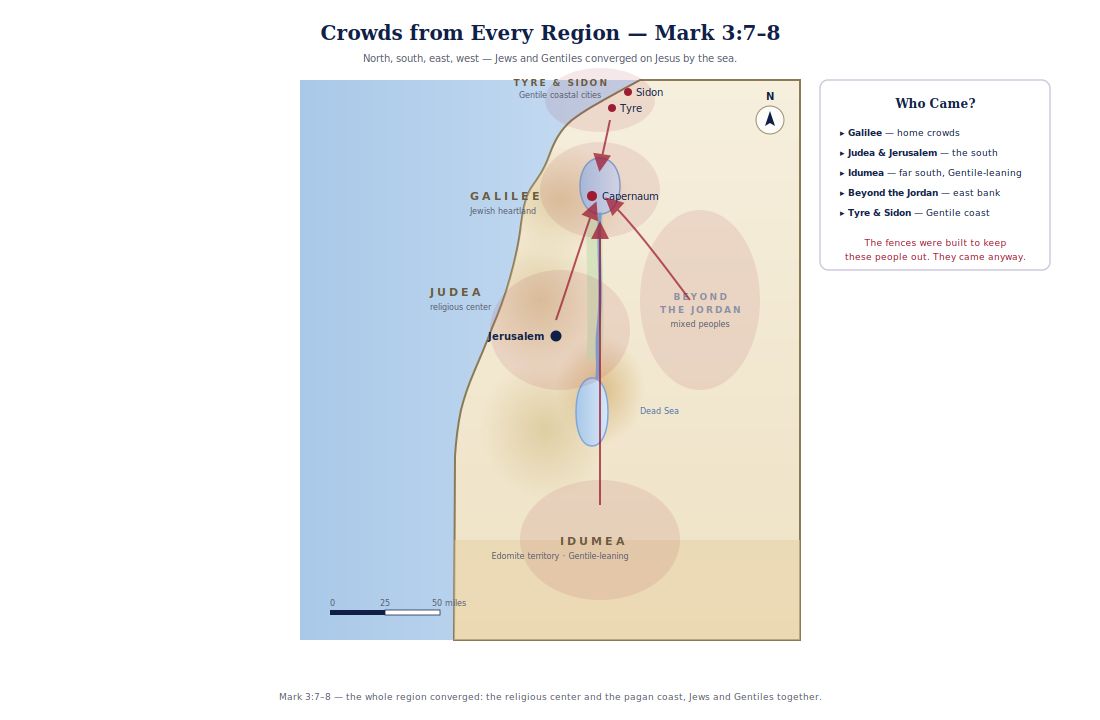
Last lesson ended with the Pharisees and Herodians plotting murder (3:6). Mark's next word is telling: Jesus "withdrew himself with his disciples to the sea" (3:7). Not fled — withdrew. The mission isn't over; it's entering a new phase. And the crowds follow Him there in staggering numbers — from six regions Mark names like a census-taker.
Scene 1: The crowds from everywhere (3:7–12)
"But Jesus withdrew himself with his disciples to the sea: and a great multitude from Galilee followed him, and from Judaea, And from Jerusalem, and from Idumaea, and from beyond Jordan; and they about Tyre and Sidon, a great multitude" (3:7–8).
Unpack that map for a second:
- Galilee — home turf, Jewish.
- Judea and Jerusalem — the south, the religious center (and the source of His critics).
- Idumea — the far south, homeland of the Edomites (descendants of Esau); conquered and forcibly brought under Jewish law by the Hasmonean ruler John Hyrcanus around 125 BC — more than a century and a half earlier — so mixed Jewish/Gentile sympathies (Herod the Great himself was an Idumean). 4719
- Beyond the Jordan — the east bank (Perea/Decapolis region), mixed Jewish and Gentile.
- Tyre and Sidon — Phoenician coastal cities to the northwest, solidly Gentile.
Jews and Gentiles. North, south, east, west. The religious center and the pagan coast. Mark is showing you something: the whole region is converging on Jesus — the very people the Pharisees' fences were built to keep out.
The pressure is so intense that Jesus tells the disciples to keep a small boat ready, "lest they should throng him" (3:9) — the crowd is literally crushing forward. He heals many; the unclean spirits fall down crying "You are the Son of God" — and again He "straitly charged them that they should not make him known" (3:11–12). The Messianic Secret continues: demons make terrible evangelists.
Scene 2: The Twelve — an impossible team (3:13–19)
"And he goeth up into a mountain, and calleth unto him whom he would: and they came unto him" (3:13).
Pause on that phrase: whom he would. In the KJV's older English, "would" means willed — the Greek is "whom He willed" (hous ēthelen). Not the qualified. Not the willing. The ones He willed to call — the wanted, by His choice, not their worth. Grace chooses before merit applies.
"And he ordained twelve, that they should be with him, and that he might send them forth to preach, and to have power to heal sicknesses, and to cast out devils" (3:14–15).
Two purposes, in order: be with Him first, sent out second. Presence before mission. Being before doing. Every burnout in ministry comes from reversing that order.
And why twelve? Because Israel had twelve tribes. Jesus is forming a new Israel around Himself — twelve apostles as the foundation stones of the renewed people of God (see Revelation 21:14).
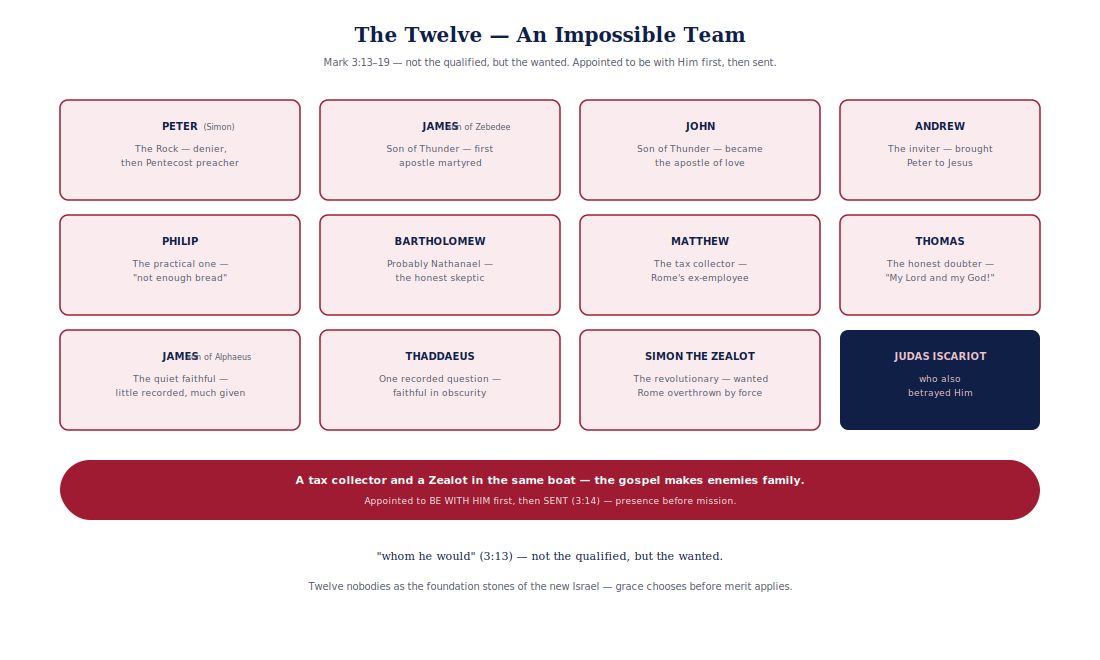
Then the list — and what a list:
| # | Name | Mark's note |
|---|---|---|
| 1 | Simon | — renamed Peter ("Rock"). The fisherman who'll deny Him and then preach at Pentecost. |
| 2 | James son of Zebedee | — with John, nicknamed Boanerges, "Sons of Thunder" (3:17). Fiery — they'll later ask to nuke a Samaritan village (Luke 9:54). |
| 3 | John | — James's brother; traditionally identified as the "beloved disciple" of the fourth Gospel. |
| 4 | Andrew | — Peter's brother; the inviter (he brought Peter to Jesus, John 1:41–42). |
| 5 | Philip | — practical, literal-minded ("Two hundred pennyworth of bread is not sufficient," John 6:7). |
| 6 | Bartholomew | — probably Nathanael ("Can there any good thing come out of Nazareth?" — John 1:46). |
| 7 | Matthew | — the tax collector from 2:14. Rome's ex-employee. |
| 8 | Thomas | — the honest doubter ("My Lord and my God!" — John 20:28). |
| 9 | James son of Alphaeus | — traditionally identified with "James the Less" (Mark 15:40), to distinguish him from Zebedee's son. Quietly faithful. |
| 10 | Thaddaeus | — traditionally identified as Judas son of James (the name Luke uses in his parallel list, Luke 6:16); asked one recorded question (John 14:22). |
| 11 | Simon the Cananite | — not from Canaan! Cananite is the Aramaic equivalent of Zealot — "zealous one." The title marks him as a man fired with revolutionary zeal (the kind that drove Judas the Galilean's uprising, Acts 5:37) — but not a card-carrying member of the later Zealot party, which only took organized shape decades afterward. 24444849 |
| 12 | Judas Iscariot | — "who also betrayed him." Mark drops it like a stone into still water. |
Now look at #7 and #11 together: Matthew the tax collector — Rome's collaborator, who profited from the occupation — and Simon the Zealot — "the zealous one," a man whose very title made Matthew's kind his natural enemies. In any other context, these two men would have been on opposite sides of a dagger. Jesus puts them on the same team, in the same boat, with the same mission. The gospel doesn't just forgive enemies; it makes them family. If your church has people who'd never share a meal outside of it, you're in apostolic company.
Scene 3: "He is beside himself" / "He hath Beelzebub" (3:20–30)
Back in a house, the crowd is so thick "they could not so much as eat bread" (3:20). And now opposition comes from two directions at once:
From His family: "And when his friends heard of it, they went out to lay hold on him, for they said, 'He is beside himself'" (3:21). "His own people" likely means His family — mother, brothers — coming to stage an intervention. They love Him; they think He's lost it. (We'll meet them again at the end of the chapter.)
From Jerusalem's scholars: "And the scribes which came down from Jerusalem said, 'He hath Beelzebub,' and, 'By the prince of the devils casteth he out devils'" (3:22).
Beelzebub — the name needs unpacking, and scholars debate its exact sense. The Hebrew Bible has Baal-zebub, "lord of the flies" — a Philistine god of Ekron (2 Kings 1:2) — which looks like a deliberate Hebrew insult of an older title, Baal-zebul, "lord of the dwelling." 15505152 Either way, it was already a sneer in the Old Testament; by Jesus' day, Jews used it as a name for Satan, the prince of demons. The scribes' accusation: Jesus' exorcisms are Satanic magic. He's not fighting the demons — He's in league with them.
Jesus answers with logic sharp enough to cut stone:
- A kingdom divided can't stand (3:24–26). If Satan is casting out Satan, Satan's kingdom is collapsing — which would be good news, not an accusation. The argument self-destructs.
- The strong man (3:27): "No man can enter into a strong man's house, and spoil his goods, except he will first bind the strong man; and then he will spoil his house." Translation: I'm not in league with Satan — I've overpowered him. Every exorcism is a burglary in progress: Jesus has tied up the strong man (Satan) and is carrying off his loot (oppressed people). Far from serving the devil, Jesus is robbing him.
Then the most sobering words in the Gospel:
"Verily I say unto you, All sins shall be forgiven unto the sons of men, and blasphemies wherewith soever they shall blaspheme: but he that shall blaspheme against the Holy Ghost hath never forgiveness, but is in danger of eternal damnation" (3:28–29) — "because they said, He hath an unclean spirit" (3:30).
The unforgivable sin. Let's be precise and pastoral, because this verse has terrified sensitive believers for centuries:
- It is not a single bad act, a stray thought, or a season of doubt. Mark defines it by the context: the scribes watched the Holy Spirit's work through Jesus — undeniable, life-giving, holy — and called it Satanic. 29 That's the sin: the settled, willful decision to call God's Spirit the devil — to look at light and name it darkness, permanently.
- Notice the direction: it's not weakness but willful inversion. The Pharisees weren't confused; they were protecting their position, and they'd rather damn the Spirit than admit Jesus.
- The pastoral test: if you're afraid you've committed it, you haven't. A heart that fears grieving the Spirit is a heart still tender toward Him. The people Jesus warns are the ones utterly untroubled by their accusation.
- A manuscript footnote: some of the oldest copies read "guilty of an eternal sin" instead of "in danger of eternal damnation" — the same verdict, in sharper wording. 53
Scene 4: Who is My family? (3:31–35)
"There came then his brethren and his mother, and, standing without, sent unto him, calling him" (3:31). The intervention has arrived. The crowd relays the message: "Behold, thy mother and thy brethren without seek for thee" (3:32).
Jesus' answer redefines the deepest human bond: "Who is my mother, or my brethren?" (3:33). Then, looking at the circle of disciples around Him: "Behold my mother and my brethren! For whosoever shall do the will of God, the same is my brother, and my sister, and mother." (3:34–35).
He's not dishonoring His mother — at the cross He'll tenderly provide for her (John 19:26–27). He's expanding family beyond blood into obedience. The family of God isn't built on DNA; it's built on doing the Father's will. For a church that would soon span every nation, this was the founding charter: in Christ, strangers become siblings.
(Note: Jesus' brothers didn't believe during His ministry — John 7:5 says so outright. But the story doesn't end there: His brother James became the leader of the Jerusalem church and is traditionally identified as the author of the epistle of James. 54 The intervention failed; grace won.)
WORD STUDY
Apostle — apostolos (ah-POS-toh-los). "One sent out" — an envoy with the sender's authority, like an ambassador. Mark uses the noun sparingly (6:30), but the job description is right here: be with Him, then be sent. Authority flows from proximity.
Beelzebub — (beh-el-zeh-BOOL). Scholars debate the etymology: the Hebrew Bible's Baal-zebub, "lord of the flies" (a Philistine god, 2 Kings 1:2), looks like an intentional Hebrew insult-version of the older title Baal-zebul, "lord of the dwelling" (found in ancient Canaanite texts). By Jesus' day, Jews used it as a title for Satan, "the ruler of the demons." When the scribes say "He has Beelzebub," they're not doing theology — they're doing character assassination.
Cananite — (kah-nah-NAY). Not "Canaanite" (a Canaanite)! It's Aramaic qanana, meaning "zealous one" — the Aramaic equivalent of "Zealot" (Luke 6:15: "Simon called the Zealot"). The title describes his zeal, not a party card: the organized Zealot party and the dagger-men (sicarii) Josephus describes belong to decades later, in the run-up to the revolt of AD 66. 394849 But "the zealous one" was clearly the kind of man who burned against Rome — the kind of fire that had already produced uprisings like Judas the Galilean's (Acts 5:37).
Why twelve?
Because Israel had twelve tribes — and Jesus is constituting a new Israel. The old people of God was founded on twelve sons of Jacob; the renewed people is founded on twelve apostles of Jesus. (Revelation pictures it literally: the New Jerusalem's twelve foundations bear "the names of the twelve apostles of the Lamb," 21:14.) Every time Mark says "the twelve," hear the echo: God is rebuilding His people around His Son.
The Zealot and the tax collector walk into a boat...
Sit with the absurdity of this team: Simon was "the zealous one" — fired with the kind of revolutionary fire that had already flared into uprisings like Judas the Galilean's (Acts 5:37); Matthew worked for Rome. Decades later, that same fire would produce the organized Zealot party and the dagger-men Josephus called sicarii, who stabbed collaborators in crowds — but in Simon's day the zeal was already real and already dangerous. 39 Jesus drafts one of each, seats them together, and sends them out together.
This isn't team-building trivia — it's the gospel's social miracle. In Christ, the categories that divide us don't just get tolerated; they get crucified. Paul would later write it as doctrine: "There is neither Jew nor Greek...for ye are all one in Christ Jesus" (Galatians 3:28). Mark shows it as biography: Matthew and Simon, sharing a boat.
"He is beside himself" — the family's intervention
Don't rush past 3:21. Jesus' own family — who'd watched Him grow up — concluded He'd lost His sanity. It reminds us that proximity isn't the same as perception: the people closest to Jesus geographically were sometimes farthest from Him spiritually. And it's tender toward anyone whose family doesn't understand their faith: Jesus knows what that meeting feels like. He lived it.
The strong man — who's who?
In the parable (3:27): the strong man is Satan; his house is this demon-oppressed world; his goods are the people he holds; the stronger one who binds him is Jesus. Every exorcism in Mark is evidence of a cosmic burglary already in progress. And notice the tense: Jesus speaks as if the binding is happening — the cross will finish it (Colossians 2:15), but the plundering has begun.
The Christ Thread
Messianic promise — Christ in His own story. Jesus constituting the Twelve is the promised King gathering His people: twelve apostles for the twelve tribes, a new Israel around Himself. And the strong man bound (3:27) is Genesis 3:15 in motion — the woman's Seed crushing the serpent's head, burglary by burglary, exorcism by exorcism.
OT/NT parallels — where the New Testament picks it up. "Beelzebub" reaches back to 2 Kings 1 (Baal-zebub, god of Ekron). The twelve tribes → the twelve apostles → the twelve foundations of the New Jerusalem bearing "the names of the twelve apostles of the Lamb" (Revelation 21:14). And "whoever does the will of God is My family" becomes the church's charter: "you are no longer strangers... but fellow citizens" (Ephesians 2:19).
The Christian future — what this foreshadows for us. The team Jesus built on a Galilean hillside becomes the architecture of the eternal city. And the family He redefined — not by blood but by obedience — is the family you were adopted into: every nation, every tribe, one table. The boat with the Zealot and the tax collector was a preview of the wedding supper.
Where in the Covenant Story?
Mark 3 stands at the hinge of the covenants. The old-covenant people — twelve tribes descended from Jacob — is being reconstituted around Jesus as twelve apostles. And the Abrahamic promise ("in thee shall all families of the earth be blessed," Genesis 12:3) is visibly advancing: the crowds pressing in from Idumea and Tyre and Sidon are Gentiles, and they're coming. The new-covenant people is no longer limited to bloodline Israel — it is expanding to all who do the Father's will (3:35). We are that people.
Father, Son, and Spirit
All three persons are at work in this chapter. The Son binds the strong man and appoints the Twelve with His own authority. The Spirit is the distinct Person whose manifest work the scribes slander — which is exactly why their sin is unforgivable: you can misunderstand the Son's methods, but to call the Spirit's holy work demonic is to cut the very rope that pulls you out. And the Father's will is the new definition of kinship: "whosoever shall do the will of God" (3:35) — family is now a Father-defined reality, not a blood-defined one.
WHAT THE CHURCH HAS ALWAYS BELIEVED: The church has always confessed herself apostolic — built on the foundation of the apostles (Ephesians 2:20). The Twelve weren't just Jesus' friends; they are the foundation stones the whole church still stands on.
It's Okay to Ask
Honest questions this passage raises — bring them, don't bury them:
- What if I've committed the unforgivable sin? (If you're afraid you have, you haven't — that fear is the proof. See "The unforgivable sin" above. A tender conscience is the Spirit's presence, not His absence.)
- Why did Jesus' own family think He was crazy? Didn't they know Him best? (Proximity isn't perception — John 7:5 says His brothers didn't believe. Sometimes the people closest to us geographically are farthest from us spiritually. Jesus knows what that meeting feels like.)
- Didn't Jesus dishonor His mother by redefining family? (He expanded family; He didn't reject her — at the cross He tenderly provides for her, John 19:26–27. Blood family isn't abolished; it's relativized under a bigger one.)
Watch Out — slander is the enemy's native language
The scribes' accusation — "He hath Beelzebub" — shows Satan's favorite tactic: inversion. Call light darkness. Call the Spirit's work the devil's. The strong man of 3:27 is real, and his house is this oppressed world — but notice his position: bound, being burglarized. The enemy in Mark is never Jesus' peer; he's a tied-up thief watching his goods carried out. Still, his lies work when we repeat them: every time God's work in someone's life gets labeled as fanaticism, emotionalism, or worse, the scribes' old slander is talking. Learn to recognize inversion — and refuse to speak it.
FACT, INFERENCE, OR DISPUTED?
- FACT: Mark lists twelve apostles including Simon the Zealot (Cananite) and Matthew the tax collector — political opposites (3:16–19).
- FACT: Jesus defines the unforgivable sin in context: attributing the Holy Spirit's manifest work to Satan (3:28–30).
- INFERENCE: "His own people" (hoi par' autou, "those from His side") in 3:21 refers to Jesus' family — the KJV's "friends" is the same Greek idiom, and the weight of the commentaries (Barnes, Ellicott) and modern translations (NRSV, TEV: "his family") lands on family, 27533714 confirmed by 3:31–35 where His mother and brothers arrive.
- DISPUTED: Which "mountain" in 3:13 — Mark doesn't name it (tradition suggests the hills above Capernaum; the exact spot is unknowable and unimportant).
SCHOLAR'S NOTE: "Boanerges" — the nickname Jesus gave James and John — is one of Mark's preserved Aramaic words (like talitha cumi and ephphatha). It likely renders bene regesh, "sons of thunder" — or possibly "sons of tumult." Either way, it fits: these are the brothers who wanted to call down fire on a Samaritan village (Luke 9:54) and who'd later ask for thrones (Mark 10:37). Jesus nicknamed their temper — and then spent three years gentling it. John, the "son of thunder," became the apostle of love. Nicknames aren't destinies.
Cross-references (explained, not just listed)
- 2 Kings 1:2–3 — Baal-zebub, god of Ekron: the origin of the sneer-name the scribes throw at Jesus.
- Revelation 21:14 — the twelve foundations of the New Jerusalem bear the apostles' names: the "new Israel" made architectural.
- John 7:5 — "even His brothers did not believe in Him": the backstory of the intervention.
- Galatians 3:28 — "neither Jew nor Greek... slave nor free... male nor female": Paul's doctrine of the social miracle Mark shows in Matthew and Simon.
- Luke 6:12–16 — Luke adds that Jesus prayed all night before choosing the Twelve. Mark shows the choice; Luke shows the prayer behind it.
Go Deeper
Hungry for more? Two doors worth opening:
- Luke 6:12–16 — the choosing of the Twelve with the detail Mark skips: a whole night of prayer first.
- Ephesians 2:11–22 — Paul's full doctrine of the social miracle: the dividing wall broken, one new humanity, "members of the household of God."
Theological truth (arising from the text)
God builds His movement not with the qualified but with the wanted — fishermen, a traitor, a revolutionary, a future betrayer — and His family isn't defined by blood but by obedience. The Spirit's work must never be called Satan's; and the gospel's power is proven when enemies become brothers. Presence before mission; grace before merit; obedience as kinship.
Humble — and confident
Humble, because there's no one on this list you'd have picked — which means there's no résumé that qualifies you either. "Whom he would" (3:13) is the whole doctrine of grace in four words. If Judas could be chosen and still betray, proximity to Jesus is no substitute for surrender to Him.
Confident, because the same Jesus who drafted a Zealot and a tax collector into one boat is still building impossible teams. Your church's oddest pairing — the people who'd never share a meal outside these walls — isn't a problem to solve. It's the gospel working.
Confess It
"Whom he would" (3:13) — grace chose you before merit applied. But proximity isn't surrender: Judas was chosen and still betrayed. Name one place where you've been near Jesus without yielding to Him — one area you've kept off-limits — and confess it now (1 John 1:9).
For discussion
- Matthew and Simon would have been enemies anywhere but in Jesus' boat. Who in your life — or your church — is your "impossible teammate"?
- Jesus' family thought He was out of His mind (3:21). When has following Jesus made you look foolish to people who love you?
- "For whosoever shall do the will of God, the same is my brother, and my sister, and mother." What would change if you treated your church family with the loyalty you give your blood family?
What He has done (the indicative)
Before one "you should," hear what He did: He wanted the unwanted — fishermen, a traitor, a revolutionary, a future betrayer — before any of them was worthy. He bound the strong man and started carrying off the loot. He took two men who would have killed each other and made them brothers in one boat. And He redefined family around Himself: obedience, not blood, is kinship now. Every step below is a response to that choosing — not a way to earn it.
This week's practices
- Presence before mission. Fifteen minutes daily, no agenda — just be with Him (3:14) before you do anything for Him. No prayer list. Just presence.
- The impossible-teammate meal. Share a meal or coffee with a believer you'd normally avoid — different politics, different tribe, different temperature. Let the boat do its work.
- The blasphemy-against-the-Spirit check. If you've ever feared you've committed it, settle it this week: read 3:28–30 slowly, thank God that your tender conscience is proof of His Spirit's presence, and rest.
- Pray It Back. Take Mark 3:14–15 into prayer: "Lord, You appointed me to be with You first, and sent second. Forgive my reversed order. Teach me presence before mission this week."
- Memorize Mark 3:35. "For whosoever shall do the will of God, the same is my brother, and my sister, and mother."
For Us Together
Ask your small group or your church family this week: "Who are our impossible teammates — the people we'd never share a boat with outside of Jesus? And what would it look like to treat them with blood-family loyalty?" Family isn't a metaphor in 3:35; it's the charter.
Who Needs This?
Who in your life is on the outside of every circle — the person the "fences" were built to keep out? One name. One invitation, one meal, one act of welcome this week.
Take It Home
At the table or at bedtime, ask your kids: "Jesus said His real family isn't just moms and dads and brothers — it's anyone who does what God wants. What does it mean to be in Jesus' family? Who else is in it with us?" Let them feel how big the family is.
Praise Him
Don't end with a to-do list — end with worship. Right now, out loud or in writing, finish this sentence: "Father, I praise You because in this passage I saw that You _____." (Chose the unwanted? Bound the strong man? Made enemies family?) Sit in it for a minute. Theology that doesn't become doxology hasn't finished its work.
The bottom line
Twelve nobodies, chosen by grace, sent with authority. A family redefined by obedience, not blood. Enemies — a Zealot and a tax collector — made brothers in one boat. And a warning never to call the Spirit's work the devil's. Mark 3 builds the team, warns the slanderers, and redefines the family — all in one breathless chapter.