
Before You Read: Open My Eyes
Before you read a single verse, pray this — out loud if you can:
"Father, Jesus said these stories hide as much as they reveal. Don't let me be a casual hearer — give me ears to hear. Open my eyes to the secrets of Your kingdom. In Jesus' name, amen."
(Psalm 119:18 — "Open thou mine eyes, that I may behold wondrous things out of thy law.")
Welcome
Jesus gets in a boat. The crowd lines the shore. And He starts telling stories — about a wasteful farmer, a lamp under a basket, a seed that grows while the farmer sleeps, and the tiniest seed in the garden. Simple stories. But Jesus says these stories hide as much as they reveal — and that the hiding is the point.
This is Mark's parable chapter: the first extended teaching block of the Gospel. Everything Jesus wants us to know about how God's kingdom works — and why some people get it and others don't — is packed into these thirty-four verses.
CHECK WHAT YOU THINK YOU KNOW
- ☐ "Parables are just simple illustrations to make things clearer." (Sometimes they do the opposite — on purpose.)
- ☐ "The sower is the hero of the parable." (He's shockingly wasteful with the seed. That's the point.)
- ☐ "Good soil means good people." (It means something more specific — see the interpretation.)
- ☐ "The mustard seed is the smallest seed in the world." (Not botanically — but that's not what Jesus meant.)
Where we are in the story
Jesus is back by the sea — the same shoreline where the crowds nearly crushed Him (3:7–9). This time He's ready: "He began again to teach by the sea side: and there was gathered unto him a great multitude, so that he entered into a ship, and sat in the sea; and the whole multitude was by the sea on the land" (4:1).
Picture it: the boat as a pulpit, the water as an amplifier, the hillside as an amphitheater. Then He begins — "Hearken; Behold, there went out a sower to sow" (4:3). The first word is a command: pay attention. What follows will sort His hearers into two groups.
A word about parables
A parable (parabole — "something placed alongside") is a story laid alongside a truth so you can see the truth in it. Parables aren't allegories where every detail is a code — they're more like windows: look through the story to the reality behind it.
But here's what shocks first-time readers: Jesus says parables don't just reveal — they conceal. More on that below. For now, hold the tension: the same story that opens one heart hardens another.
Parable 1: The sower and the four soils (4:3–9)
"Behold, a sower went out to sow. And it happened, as he sowed, that some seed fell by the wayside; and the birds of the air came and devoured it. Some fell on stony ground, where it did not have much earth; and immediately it sprang up because it had no depth of earth. But when the sun was up it was scorched, and because it had no root it withered away. And some seed fell among thorns; and the thorns grew up and choked it, and it yielded no crop. But other seed fell on good ground and yielded a crop that sprang up, increased and produced: some thirtyfold, some sixty, and some a hundred" (4:3–8).
First-century sowing helps here (see Scholar's Note): the farmer broadcast seed by hand before plowing — scattering it everywhere, including on paths, rocks, and thorn patches. 55 To modern eyes he's wasteful. To his neighbors, he was normal. To Jesus' point, he's a picture of extravagant grace: the word gets scattered everywhere, on every kind of soil, without pre-screening.
Jesus ends with the refrain: "He that hath ears to hear, let him hear!" (4:9) — which is Jesus' way of saying: this one's about you. Check your soil.
Why parables? The shocking answer (4:10–12)
When they're alone, those around Him with the Twelve ask about the parables (4:10). Jesus' answer disturbs comfortable readers:
"Unto you it is given to know the mystery of the kingdom of God: but unto them that are without, all these things are done in parables: That seeing they may see, and not perceive; and hearing they may hear, and not understand; lest at any time they should be converted, and their sins should be forgiven them" (4:11–12).
He's quoting Isaiah 6:9–10 — God's commission to Isaiah, sending him to preach to a people who wouldn't listen, so that the preaching itself would seal their hardness. Jesus is saying: parables are judgment as well as mercy. To open hearts, they reveal the kingdom's secrets. To closed hearts, they conceal — so that casual, curious hearing doesn't produce cheap, shallow "repentance."
This is hard. Sit with it rather than solving it instantly (see Interpretation). But notice the mercy inside the severity: the disciples get the explanation. "Those who are outside" hear riddles; insiders get the key. The difference isn't intelligence — it's relationship. "Unto you it is given" — grace, not IQ.
The interpretation — from Jesus Himself (4:13–20)
"Know ye not this parable? and how then will ye know all parables?" (4:13). The sower is the key to the rest. Then Jesus decodes it:
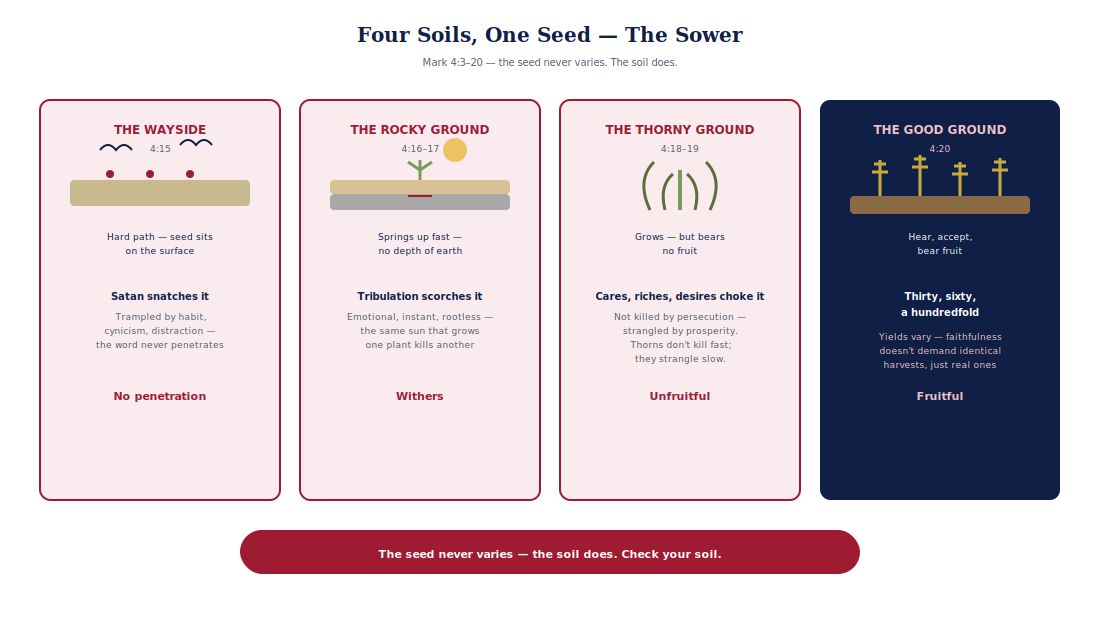
- "The sower soweth the word" (4:14). The seed is constant — it's the soil that varies. The variable is never the gospel; it's the hearer.
- The wayside (4:15): seed on the hard path — "Satan cometh immediately, and taketh away the word." Some hearts are footpaths: trampled hard by habit, cynicism, or distraction. The word never penetrates; the enemy snatches it.
- The stony ground (4:16–17): "who, when they have heard the word, immediately receive it with gladness; and have no root in themselves... afterward, when affliction or persecution ariseth for the word's sake, immediately they are offended." Emotional, instant, rootless. The sun that should grow the plant scorches it — the same tribulation that deepens one believer destroys another. The difference is depth.
- The thorny ground (4:18–19): "the cares of this world, and the deceitfulness of riches, and the lusts of other things entering in, choke the word, and it becometh unfruitful." This one stings the comfortable: the plant grows — it just never bears fruit. Choked not by persecution but by prosperity: worries, wealth, wants. Thorns don't kill quickly; they strangle slowly.
- The good ground (4:20): "such as hear the word, and receive it, and bring forth fruit, some thirtyfold, some sixty, and some an hundred." Three verbs: hear, accept, bear fruit. And note the yields vary — 30, 60, 100. Faithfulness isn't uniform; fruitfulness is. God doesn't demand identical harvests, just real ones.
The lamp — don't hide the light (4:21–25)
"Is a candle brought to be put under a bushel, or under a bed? and not to be set on a candlestick?" (4:21).
The parables conceal for now — but concealment isn't the final goal. Lamps are made for stands, not baskets. The mysteries given to the disciples in private are meant for public proclamation later. (Mark's readers, decades on, are living in the "later.")
"For there is nothing hid, which shall not be manifested" (4:22) — the secrecy has an expiration date.
Then the principle of spiritual responsiveness: "Take heed what ye hear: with what measure ye mete, it shall be measured to you: and unto you that hear shall more be given. For he that hath, to him shall be given: and he that hath not, from him shall be taken even that which he hath" (4:24–25).
This is the economy of the kingdom: responsiveness compounds. The more you receive the word, the more capacity you gain to receive. The less you respond, the duller you become — until even what you had fades. Spiritual hearing is like a muscle: use it or lose it.
Parable 2: The growing seed — only in Mark (4:26–29)
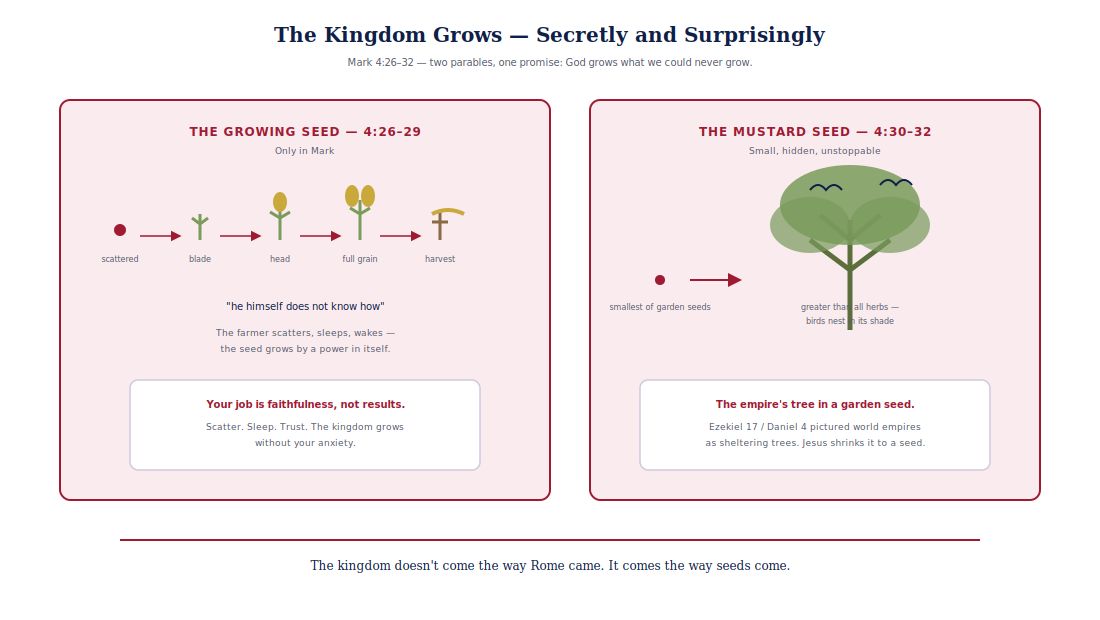
"So is the kingdom of God, as if a man should cast seed into the ground; and should sleep, and rise night and day, and the seed should spring and grow up, he knoweth not how. For the earth bringeth forth fruit of herself: first the blade, then the ear, after that the full corn in the ear. But when the fruit is brought forth, immediately he putteth in the sickle, because the harvest is come" (4:26–29).
Only Mark records this one — the early church believed Mark wrote down Peter's preaching (Papias, c. AD 110, quoted by Eusebius), so this may be one of Peter's stories the other Gospels missed. 56 And it's quietly revolutionary: the farmer doesn't make the seed grow. He scatters, he sleeps, he wakes — and "he himself does not know how" it happens. The kingdom grows by a power in the seed, not in the sower.
For anxious servants of God, this is pure mercy: your job is faithfulness, not results. You scatter; God grows. You sleep; the kingdom doesn't. Paul would later say it as doctrine: "I have planted, Apollos watered; but God gave the increase" (1 Corinthians 3:6). Mark gives it as a bedtime story.
Parable 3: The mustard seed (4:30–32)
"Whereunto shall we liken the kingdom of God?... It is like a grain of mustard seed, which, when it is sown in the earth, is less than all the seeds that be in the earth; but when it is sown, it groweth up, and becometh greater than all herbs, and shooteth out great branches; so that the fowls of the air may lodge under the shadow of it" (4:31–32).
Objection: the mustard seed isn't botanically the smallest seed on earth (orchid seeds are smaller). But Jesus says "than all the seeds that be in the earth" — in context, the seeds a Galilean farmer would sow. It was proverbially tiny: rabbis used "mustard-seed-sized" the way we say "a speck" — the Talmud itself uses mustard-seed smallness the same way (Hastings' Dictionary, citing Buxtorf's lexicon). 57 The plant — black mustard — grew wild on the shores of the Sea of Galilee, right where Jesus was teaching, and in gardens it shot up ten to twelve feet, with birds lodging in its branches. 57 Don't miss the forest for the botany.
The point is disproportion: tiny beginning, enormous outcome. And the birds nesting in its branches echo the Old Testament's great tree visions — Daniel 4:12, where a mighty tree sheltering the birds pictures Babylon's empire — and Ezekiel 17:23, where God reappropriates the image for His own planting. 1 Jesus takes empire-imagery and applies it to... a seed. The kingdom won't come as Rome came — with legions. It'll come as a seed comes: small, hidden, unstoppable — until the nations find shelter in its shade.
"Without a parable spake he not unto them" (4:33–34)
Mark closes the chapter: "And with many such parables spake he the word unto them, as they were able to hear it. But without a parable spake he not unto them: and when they were alone, he expounded all things to his disciples" (4:33–34).
Two mercies: He speaks "as they were able to hear" — Jesus calibrates to capacity; and the disciples get the private tutorial. Outsiders get stories; insiders get explanations. The question Mark leaves hanging over every reader: which are you?
WORD STUDY
Parable — parabole (pah-rah-boh-LAY). "Something placed alongside" — a story laid next to a truth so you can see it. Not a code where every detail means something secret; a window to look through. In the Greek Old Testament the word translates the Hebrew mashal, which covers proverbs, riddles, and prophetic oracles (Psalm 78:2) — so a parable can be a riddle as well as an illustration.
Mystery — mysterion (moos-TAY-ree-on). Not a puzzle to solve but a secret now revealed — God's plan, hidden for ages, now disclosed to insiders (4:11). 58 In Mark, the "mystery of the kingdom" is that the promised kingdom has arrived in Jesus — present in unexpected, hidden form now, to be consummated in glory.
Stumble / fall away — skandalizo (skahn-dah-LID-zo). The rocky-soil hearers "stumble" when persecution comes (4:17) — literally "are scandalized," tripped up. The root gives us our word scandal: the obstacle that makes you fall.
By itself — automate (ow-toh-mah-TAY). The earth "bringeth forth fruit of herself" (4:28) — automate, "of its own accord," apart from the farmer's effort or understanding. The root of our word automatic.
Why would Jesus hide the truth?
This is the chapter's hardest question, and it deserves an honest answer. Three things held together:
- Judgment is real. Isaiah 6 (which Jesus quotes) shows a pattern: persistent rejection eventually becomes judicial hardening — God confirms the choice people have already made. The parables don't create hardness; they reveal it. (Matthew 13:13 frames the same saying with "because" rather than "so that," stressing the hardness was already theirs: "they have closed their eyes," 13:15.)
- Mercy is inside the judgment. If the hard-hearted fully understood and then rejected, their guilt would be greater. Concealment is also protection — "lest at any time they should be converted, and their sins should be forgiven them" carries the terrible logic that some "turning" would be shallow and temporary.
- Relationship is the key. "Unto you it is given" — the disciples get explanations because they're with Him. The parables reward following: stay close to Jesus, and the stories open. Keep your distance, and they stay shut. The same sun melts wax and hardens clay.
The prodigal sower
Don't miss how wasteful the sower is. He throws precious seed on paths, rocks, and thorns — anywhere, everywhere, without soil-testing first. If this is a picture of God (and it is), then grace is extravagantly indiscriminate. The gospel goes to the hard, the shallow, and the choked — not just the promising. Some churches sow only where the soil looks good. The Sower sows everywhere and lets the harvest sort it out.
Which soil am I? — the parable as mirror
Jesus ends with "He that hath ears to hear, let him hear" — the parable is a diagnostic, not just a description. And here's the searching part: soils can change. The path can be plowed. Rocks can be cleared. Thorns can be weeded. The question isn't "which soil were you?" but "which soil are you now — and what needs to happen next?" A thorny heart this year can be good ground next year. That's what repentance is for.
The empire in a seed
The mustard seed's birds-nesting imagery (Ezekiel 17, Daniel 4) would have made Jewish hearers sit up: Daniel 4's tree pictures Babylon's empire as a great tree sheltering the nations; Ezekiel 17 reappropriates the image for God's own planting. Jesus takes the empire's own metaphor and shrinks it to a garden seed. The claim is subversive: God's kingdom will do what empires do — shelter the nations — but the way a seed does it: small, hidden, organic, unstoppable. Rome conquered by the sword; the kingdom conquers by growth.
The Christ Thread
Messianic promise — Christ in His own story. Jesus is the Sower — the promised King scattering the word of the kingdom. And the mustard seed's birds-nesting imagery reaches back to the Old Testament's great tree visions (Ezekiel 17, Daniel 4), where a mighty tree sheltering the birds pictured Babylon's empire (Daniel 4) — and where God reappropriated the image for His own planting (Ezekiel 17). Jesus takes empire-imagery and applies it to Himself: the nations will find shelter not in Rome's branches, but in His.
OT/NT parallels — where the New Testament picks it up. Jesus Himself quotes Isaiah 6:9–10 to explain the parables (4:12) — the Old Testament's hardening commission, now fulfilled in His ministry. Paul turns the growing seed into doctrine: "I have planted, Apollos watered; but God gave the increase" (1 Corinthians 3:6–7). And the lamp (4:21) becomes the church's mission pattern: mysteries given in private, proclaimed in public.
The Christian future — what this foreshadows for us. The harvest scene — "immediately he putteth in the sickle, because the harvest is come" (4:29) — is the coming judgment in miniature (Revelation 14:14–16). The mustard tree sheltering the birds is the nations streaming into the kingdom (Revelation 21:24). And the thirty/sixty/hundredfold yield is the future breaking into the present: fruitfulness now is the firstfruits of the harvest to come.
Where in the Covenant Story?
The parables assume the whole covenant story and then surprise it. The "mystery of the kingdom" (4:11) is this: the promised Davidic kingdom has arrived — but not the way anyone expected. No legions, no throne in Jerusalem yet; instead, a Sower, a seed, a harvest. The Abrahamic promise ("all nations blessed") advances not by conquest but by scattering. We live between the sowing and the harvest — the already of the seed, the not-yet of the full grain.
Father, Son, and Spirit
The Son sows the word and decodes it for His own. The Spirit is the difference between hearing and hearing — "you it is given to know" (4:11): understanding is the Father's gift, not the student's achievement. And the growth itself — "he knoweth not how" (4:28) — is divine agency: the Father grows what the Son sows through the Spirit's hidden work. Every harvest has all three persons in it.
It's Okay to Ask
Honest questions this passage raises — bring them, don't bury them:
- Does God really harden people on purpose? Is that fair? (See "Why would Jesus hide the truth?" above — the parables reveal hardness more than they create it. And human responsibility for rejection is never removed, even where God's judgment is real.)
- Am I one of the "outsiders"? How do I know? (The difference was never IQ — it was relationship. "Unto you it is given." If you're following Jesus closely enough to ask the question, you're an insider asking an insider's question.)
- I've been thorny soil for years — is it too late for me? (Soils change. Paths get plowed, rocks get cleared, thorns get weeded. That's what repentance is for. Today's soil report isn't your final grade.)
Watch Out — the word-snatcher is real
Don't skip 4:15: "Satan cometh immediately, and taketh away the word." The enemy's first move isn't temptation — it's distraction. He doesn't need you to reject the sermon; he just needs you to forget it by lunch. Hard hearts aren't born; they're trampled — by habit, cynicism, hurry. The warfare in this chapter is quiet: a snatched word here, a choked word there. Guard the hearing: take notes, pray it back, tell someone. What gets repeated gets rooted.
FACT, INFERENCE, OR DISPUTED?
- FACT: Jesus quotes Isaiah 6:9–10 to explain why He teaches in parables (4:12); the disciples receive private explanations (4:34).
- FACT: The growing-seed parable (4:26–29) appears only in Mark.
- INFERENCE: The mustard seed's "birds nesting" echoes Ezekiel 17:23 and Daniel 4:12 — kingdom-as-empire imagery, subverted.
- DISPUTED: What force does "lest at any time they should be converted, and their sins should be forgiven them" carry — God's purpose in the parables, or the tragic result of hardness? Mark's "so that" (Greek hina) reads as purpose — concealment as divine judgment, the Isaiah 6 pattern (Robertson) — 59 while Matthew 13:13 frames the same saying with "because" (hoti), stressing the people's self-hardening: "they have closed their eyes" (13:15). Others argue purpose and result are one in Semitic thought (UBS handbook), 60 or that concealment is protective mercy — sparing the hard-hearted greater guilt. (Scholars divide; either way, human responsibility for rejection is never removed.)
SCHOLAR'S NOTE: Why would a farmer sow before plowing? In first-century Palestine, broadcast hand-sowing was standard practice: the sower scattered seed from a fold of his garment or a jar, and the seed was plowed in afterward — before the birds could take it (ISBE, "Agriculture"). 55 That order explains the parable's details: footpaths crossing the field were left unplowed, so seed falling there became "the food of the birds"; and limestone ledges hidden just under the surface are exactly the "rocky places" where seed sprouts fast and scorches faster. 55 Scholars note the sequence could vary with season and soil, but this was normal farming, not careless farming — Jesus' hearers weren't puzzled by the agriculture; they were puzzled by what it meant. Which is exactly the response He wanted.
Cross-references (explained, not just listed)
- Isaiah 6:9–10 — the hardening commission Jesus quotes: preaching that seals rejection. The background of 4:12.
- Ezekiel 17:22–24; Daniel 4:10–12 — the great tree sheltering birds: empire-imagery Jesus borrows for the mustard seed.
- Joel 3:13 — "Put ye in the sickle, for the harvest is ripe": the Old Testament's Day-of-the-Lord harvest image behind 4:29.
- 1 Corinthians 3:6–7 — "I have planted, Apollos watered; but God gave the increase": Paul's doctrine of the growing-seed parable.
- Matthew 13:1–52; Luke 8:4–18 — the parallel parable chapters; Matthew adds the wheat and weeds, the pearl, the net.
Go Deeper
Hungry for more? Two doors worth opening:
- Matthew 13 — the full parable discourse, with the wheat and weeds, the pearl, and the net that Mark doesn't include.
- Isaiah 6 — the chapter Jesus quotes in 4:12. Read the prophet's whole commission and feel its weight before you judge it.
Theological truth (arising from the text)
The kingdom comes the way seeds come: scattered extravagantly, growing mysteriously, starting invisibly small. God does the growing; we do the scattering and the soil-tending. And hearing is never neutral — the same word that opens one heart confirms another's hardness. Sow everywhere, sleep in peace, expect a harvest disproportionate to the seed.
Humble — and confident
Humble, because the parable is a mirror before it's a lesson. Every one of us has been each soil — the hard path of distracted seasons, the rocky ground of emotional highs, the thorns of busy prosperity. "Check your soil" isn't a one-time diagnosis; it's a spiritual discipline.
Confident, because the Sower keeps sowing — extravagantly, indiscriminately, even on us. And the growing seed promises what our anxiety denies: the kingdom doesn't depend on our wakefulness. We scatter; God grows. We sleep; the harvest comes.
Confess It
"Check your soil" isn't a diagnosis — it's an invitation. Name your current soil honestly — path, rocky, thorny — and the one thing choking or hardening it. Confess it specifically (1 John 1:9): not "forgive my sins," but "forgive my _____." Then name the plowing, clearing, or weeding, and do it this week.
For discussion
- Which soil best describes your heart right now — and what's one thing that could change it?
- "He that hath, to him shall be given" (4:25). Where have you seen spiritual responsiveness compound — in your life or someone else's?
- The Sower wastes seed on bad soil. Where might God be calling you to sow extravagantly — without pre-screening the soil?
What He has done (the indicative)
Before one "you should," hear what He did: the Sower scattered extravagantly — on paths, rocks, thorns, and you. He gave insiders the key to the mysteries ("unto you it is given"). He grows the kingdom while we sleep — "he knoweth not how." Understanding, growth, harvest: all gift before they're ever task. Every step below is a response to that extravagance — not a way to earn it.
This week's practices
- Soil inspection. Fifteen minutes with 4:14–20. Name your current soil honestly — path, rocky, thorny, or good. Then name the one thing that would change it (plow a habit, clear a rock, weed a thorn) and do it this week.
- Sow somewhere "wasteful." Share the gospel — or an act of kingdom kindness — with someone you'd normally write off as bad soil. Let the Sower's extravagance rebuke your selectivity.
- Practice "he knoweth not how." Identify one area where you're anxiously trying to produce growth (a child, a ministry, a habit) — and deliberately rest from engineering it. Pray, scatter, sleep.
- Pray It Back. Take Mark 4:9 into prayer each morning: "Lord, give me ears to hear today. Plow what's hard, deepen what's shallow, weed what's choking — and let Your word bear fruit in me."
- Memorize Mark 4:9. "He that hath ears to hear, let him hear!"
For Us Together
Ask your small group this week: "What kind of soil are we together? Are we a field where the word gets scattered, discussed, and obeyed — or a path where Sunday's sermon is forgotten by lunch?" Consider one shared practice: texting each other one "word received" after every gathering.
Who Needs This?
Who in your life has heard the gospel a hundred times without ever hearing it — the hard path, the distracted hearer? One name. Sow one extravagant seed this week: the verse, the invitation, the kindness — without pre-screening the soil.
Take It Home
At the table, ask your kids: "Jesus told a story about four kinds of dirt. Which kind of dirt is your heart today — the hard path, the rocky place, the thorny patch, or the good soil? What would help it grow better?" Let them answer honestly. Then pray over their soil together.
Praise Him
Don't end with a to-do list — end with worship. Right now, out loud or in writing, finish this sentence: "Father, I praise You because in this passage I saw that You _____." (Sow extravagantly on people like me? Grow Your kingdom while I sleep? Make tiny beginnings enormous?) Sit in it for a minute. Theology that doesn't become doxology hasn't finished its work.
The bottom line
The kingdom comes like seed: scattered everywhere by a wasteful Sower, growing mysteriously while we sleep, starting smaller than anyone would bet on — and ending with birds nesting in its branches. Our job: keep the soil soft, sow extravagantly, and trust the growth to God.