
Before You Read: Open My Eyes
Before you read a single verse, pray this — out loud if you can:
"Father, Your Spirit breathed out these words. Before I read about clean and unclean, show me my own heart — the thirteen evils, not just my washed hands. And open my eyes to the borders You're still crossing: in the nations, and in me. In Jesus' name, amen."
(Psalm 119:18 — "Open thou mine eyes, that I may behold wondrous things out of thy law.")
Welcome
Up to now, Jesus' ministry has stayed close to home — Jewish Galilee, Jewish crowds, Jewish synagogues. In this lesson, the borders start to break. Jesus redefines what makes a person "clean" (spoiler: it isn't hand-washing), then walks straight into Gentile territory — and meets a desperate mother whose faith stops Him in His tracks.
This is one of Mark's most important lessons, and one of its most delicate: it contains the Bible's hardest conversation about insiders and outsiders, a second miraculous feeding, and a healing that happens in two blurry stages — a living parable of the disciples themselves.
CHECK WHAT YOU THINK YOU KNOW
- ☐ "Jesus abolished the Old Testament food laws in Mark 7." (Jesus' closing words in 7:19 point that way — but read them carefully.)
- ☐ "Jesus called the Syrophoenician woman a dog because He was being rude." (The Greek word He uses changes everything — see "Crumbs from the table.")
- ☐ "The feeding of the 4,000 is just Mark repeating the 5,000 story." (Different crowd, different numbers, different meaning.)
- ☐ "The disciples were just slow learners." (Mark's diagnosis is sharper than that.)
Where we are in the story
Jesus has been ministering around the Sea of Galilee — teaching, healing, feeding, confronting. Now two things happen at once: the religious establishment escalates its attack (Pharisees travel up from Jerusalem to investigate), and Jesus' ministry spills across the borders into Gentile territory — non-Jewish lands where most Jews wouldn't go. Mark is showing us that the kingdom is bigger than Israel.
Check What You Think You Know
Many sincere Christians have heard the exchange with the Syrophoenician woman (7:27) as Jesus being harsh — even prejudiced — toward a desperate mother. But look at the actual word: the Greek is kynarion, little household dogs, not the street curs the Jews spat as an insult. And His "first" keeps the mission order in view, not her worth. The text corrects the record: this is a test of persistent faith, and the woman passes it so decisively that Jesus grants her request on the spot. What sounds like rejection is an invitation to press in.
Scene 1: Hands vs. hearts (7:1–23)
Pharisees — the strict religious party devoted to the law — come down from Jerusalem with some scribes (Bible scholars). Their charge: "Why walk not thy disciples according to the tradition of the elders, but eat bread with unwashen hands?" (7:5).
Mark pauses to explain for his readers (7:3–4) — most scholars think a largely Roman, Gentile audience: the Pharisees — "and all the Jews" — wouldn't eat without ceremonially washing their hands, "holding the tradition of the elders." This wasn't hygiene. It was ritual purity: a complex system of washings for hands, cups, pitchers, and even dining couches, built up over generations as a "fence" around God's law. 39 The idea was holy — keep impurity far away. But somewhere along the way, the fence became more important than the field it protected.
Jesus answers with a prophet's bluntness, quoting Isaiah 29:13:
"Well hath Esaias prophesied of you hypocrites, as it is written, This people honoureth me with their lips, but their heart is far from me. Howbeit in vain do they worship me, teaching for doctrines the commandments of men" (7:6–7)
Then He gives a concrete example — Corban (7:9–13). Corban is a Hebrew word meaning "offering" — something devoted to God. Here's how the loophole worked: under the vow laws (the whole tractate Nedarim — "Vows" — in the Mishnah is built on this 8660), a man could declare his money or property "Corban" — devoted to God — and the declaration functioned like a religious lockbox. He kept the property; but the vow legally barred him from using it for his parents. No temple donation ever had to change hands — the vow's power was in what it forbade, not what it gave. 8786 The vow sounded pious. Its effect was to dodge the plain commandment "Honour thy father and thy mother" (Exodus 20:12). Jesus' verdict: "making the word of God of no effect through your tradition" (7:13). Human tradition was being used to cancel divine command.
Then Jesus turns to the crowd with the revolutionary principle (7:14–15):
"There is nothing from without a man, that entering into him can defile him: but the things which come out of him, those are they that defile the man."
Defilement — koinoō, being made "common," ritually unfit — doesn't come from unwashed hands or forbidden foods. It comes from the heart. Alone with the disciples, Jesus spells it out with a chilling list (7:21–23): "evil thoughts, adulteries, fornications, murders, thefts, covetousness, wickedness, deceit, lewdness, an evil eye, blasphemy, pride, foolishness" — thirteen evils, all born inside.
And Jesus closes His explanation with the words "purging all meats?" (7:19) — the last words of His own sentence about food passing through the body. Read as His declaration, they signal where this principle leads: if defilement is a heart matter, the whole system of clean/unclean meats is relativized. (See Interpretation for the careful version.)
Scene 2: Crumbs from the table (7:24–30)
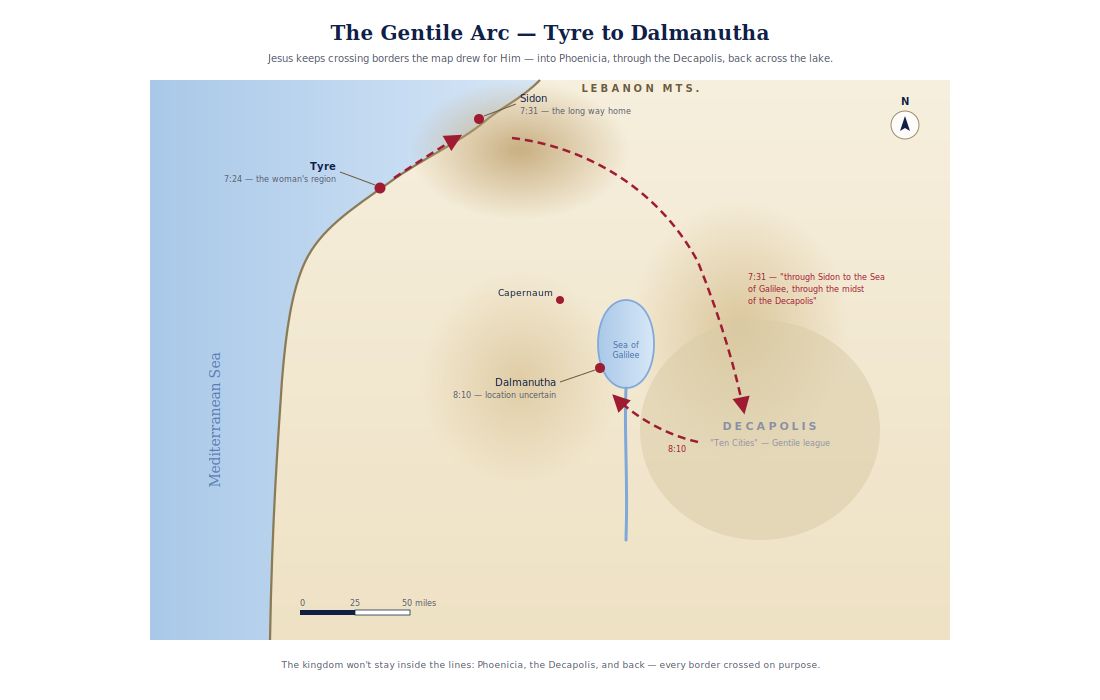
"From thence he arose, and went into the borders of Tyre and Sidon" (7:24) — Phoenician coastal cities, thoroughly Gentile territory. Jesus "would have no man know it" — another flash of the secrecy motif — "but he could not be hid."
A woman hears He is there. Mark describes her three ways, each one widening the distance: she was Greek (a Gentile, not a Jew), a Syrophoenician by birth (from Syrian Phoenicia — doubly an outsider), and she had a little daughter with an unclean spirit. She begs Jesus to cast the demon out.
And then comes the exchange that has troubled readers for 2,000 years:
"Let the children first be filled: for it is not meet to take the children's bread, and to cast it unto the dogs." (7:27)
Read it slowly, because the details matter enormously:
- "Children" = Israel. "First" = priority, not exclusivity. Jesus is stating His mission order (see Romans 1:16: "to the Jew first, and also to the Greek"), not slamming a door.
- "Little dogs" — the Greek is kynaria, the diminutive: not wild street curs (kyōn) but household pets, the little dogs under the family table. 88 In Jesus' parable, Israel is the children at the table; Gentiles are the beloved pets in the same house — not yet fed, but belonging to the household.
- Many hearers detect a testing in His voice — a challenge meant to draw out her faith, the way He tested others (think of "how many loaves have ye?" at the feedings).
Her answer is one of the great moments in the Gospels:
"Yes, Lord: yet the dogs under the table eat of the children's crumbs." (7:28)
She doesn't argue the parable — she completes it. Grant everything, Lord: Israel first, children at the table. But even pets get crumbs — and Your crumbs are more than enough. Jesus' response is immediate: "For this saying go thy way; the devil is gone out of thy daughter" (7:29). She goes home and finds the child lying peacefully on the bed.
What just happened? A Gentile woman, in Gentile territory, received what Israel's leaders were refusing: mercy through faith. The borders are opening. And notice — Jesus didn't go to her; she came to Him. The kingdom goes to the nations, but here the nations come to the kingdom.
Scene 3: "Ephphatha" — be opened (7:31–37)
Jesus takes the long way home — Mark's route (7:31) runs north toward Sidon, then southeast through the Decapolis — the "Ten Cities," a league of Greco-Roman cities east of the Jordan, largely Gentile — back to the Sea of Galilee. It's a deliberate detour through the nations.
There they bring Him a man who is deaf and has a speech impediment. What Jesus does is strikingly physical and private: He takes the man aside away from the multitude, puts His fingers in the man's ears, spits and touches his tongue, looks up to heaven, sighs, and says — in Aramaic, which Mark preserves — "Ephphatha," that is, "Be opened" (7:33–34).
Immediately the man's ears open, his tongue loosens, "and his speech was plain." The crowd — Gentiles, remember — is "astonished beyond measure," saying, "He hath done all things well: he maketh both the deaf to hear, and the dumb to speak" (7:37). (There's an echo here of Genesis 1:31 — "God saw everything... and indeed it was very good." The new creation is doing what the first creation did: well.)
Scene 4: Bread for the nations — the 4,000 fed (8:1–10)
Days later, in the Decapolis region, another vast crowd — 4,000 — has been with Jesus three days with nothing to eat. "I have compassion on the multitude," Jesus says (8:2) — the same gut-churning compassion (splanchnizomai) He felt for Israel's crowds.
The disciples ask the practical question: "From whence can a man satisfy these men with bread here in the wilderness?" (8:4). (Readers want to shout: you've seen this movie before! — which is exactly Mark's point about their dullness.) Jesus asks, "How many loaves have?" — seven. He gives thanks, breaks them, and the disciples distribute — plus "a few small fishes." All eat and are filled, and they take up seven large baskets (spyris — big hamper-baskets) of leftovers.
Then He sends them away, gets into the boat, and comes to Dalmanutha (8:10) — a place we can't identify with certainty; Mark names it, and honesty requires us to say the location is unknown. 28
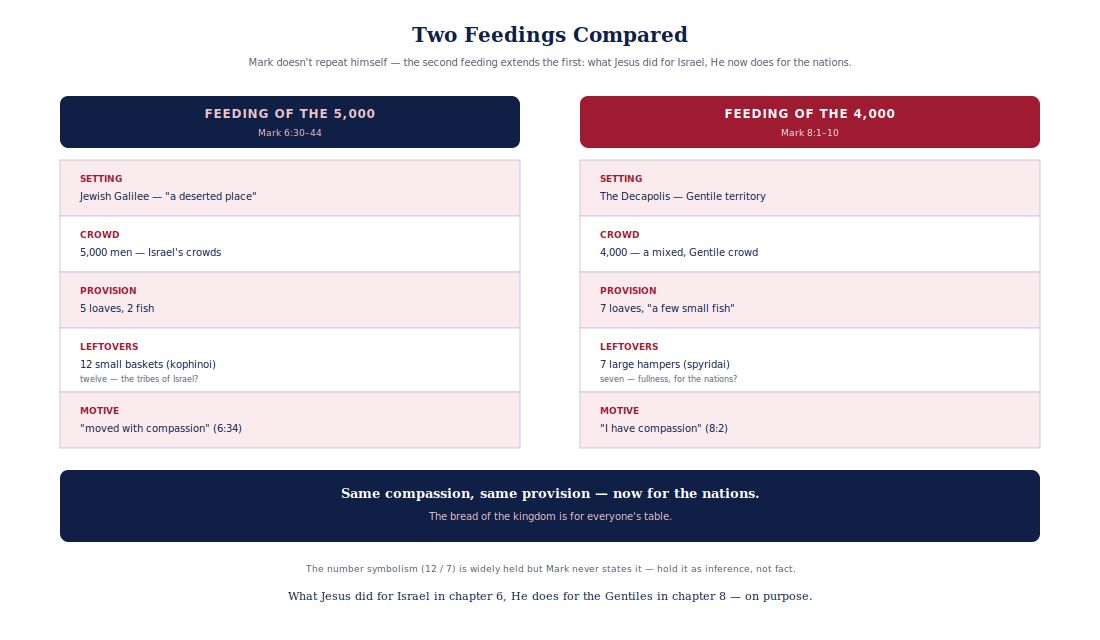
Why a second feeding? This isn't a rerun — it's an expansion. Compare:
| Feeding of the 5,000 (ch. 6) | Feeding of the 4,000 (ch. 8) | |
|---|---|---|
| Where | Jewish Galilee | Decapolis — Gentile territory |
| Crowd | 5,000 men (Jews) | 4,000 (mixed/Gentile crowd) |
| Loaves | 5 | 7 |
| Baskets left | 12 kophinoi (small) — one for each tribe of Israel? | 7 spyridai (large) — seven, the number of fullness, for the nations? |
| Motive | "He was moved with compassion" (6:34) | "I have compassion" (8:2) |
The same compassion, the same provision — now for the nations. The bread of the kingdom is for everyone's table.
Scene 5: "No sign be given" (8:11–13)
Back in Jewish territory, the Pharisees come out "and began to question with him, seeking of him a sign from heaven, tempting him" (8:11). After healings, exorcisms, two feedings — they want one more sign.
Jesus "sighed deeply in his spirit" (8:12) — the groan of a heart grieving unbelief — and answers: "Why doth this generation seek after a sign? verily I say unto you, There shall no sign be given unto this generation" Then He leaves them, gets back in the boat, and departs.
The demand for a sign wasn't curiosity; it was resistance wearing curiosity's clothes. Signs don't create faith — the Pharisees had watched signs for months. Jesus refuses to perform on command.
Scene 6: "How is it that ye do not understand?" (8:14–21)
In the boat, the disciples realize they've brought only one loaf of bread. Jesus warns: "Take heed, beware of the leaven of the Pharisees, and of the leaven of Herod" (8:15). "Leaven" — yeast — is His metaphor for a permeating influence: the Pharisees' hypocrisy (external religion, hard hearts) and Herod's worldliness (power-hungry compromise). A little yeast works through the whole batch.
The disciples miss it completely: "It is because we have no bread" (8:16). They think He's talking about lunch.
What follows is Mark's most stinging rebuke of the Twelve:
"Why reason ye, because ye have no bread? perceive ye not yet, neither understand? have ye your heart yet hardened? Having eyes, see ye not? and having ears, hear ye not? and do ye not remember? When I brake the five loaves among five thousand, how many baskets full of fragments took ye up?" (8:17–19)
"Twelve," they answer. "And the seven for the four thousand?" "Seven." Then the question that hangs over the whole Gospel: "How is it that ye do not understand?" (8:21).
The language is deliberate — "eyes but not seeing, ears but not hearing" is how the prophets described Israel's spiritual dullness (Isaiah 6:9–10; Jeremiah 5:21; Ezekiel 12:2). Mark's devastating point: the disciples, who've had front-row seats to everything, are going blind in the same way.
Scene 7: Seeing, but blurry (8:22–26)
At Bethsaida, they bring Jesus a blind man. What happens next is unique in all the Gospels — a healing in two stages:
- Jesus takes him by the hand, leads him out of the town, spits on his eyes, lays hands on him, and asks, "If thou see any thing?"
- The man looks up: "I see men as trees, walking" (8:24) — sight, but blurry, distorted.
- Then Jesus puts His hands on his eyes again — and the man sees clearly, "and was restored and saw everyone clearly."
Then: "He sent him away to his house, saying, Neither go into the town, nor tell it to any in the town" (8:26) — the secrecy motif once more.
Why two stages? Mark places this story as a living parable of the disciples. They see who Jesus is — partially, blurrily, "like trees walking." They need a second touch. And it's coming: in the very next scene (Lesson 10), Peter will confess, "Thou art the Christ" — sight getting clearer. Mark the storyteller is showing us, in a blind man's eyes, exactly where his disciples are.
WORD STUDY
Corban — korban (kor-BAHN). A Hebrew word meaning "offering" — something devoted to God. 4439 Saying "Corban" over your property was like putting it in a religious lockbox: God gets it (someday), and meanwhile you can't be asked to use it for your parents. Piety as a tax dodge — which is why Jesus is furious.
Defile — koinoō (koy-no-OH). Literally "to make common" — to render something ritually unfit, profane. The Pharisees' whole system was about avoiding koinoō. Jesus' bombshell: uncleanness isn't contracted from the outside; it's manufactured on the inside.
Little dogs — kynarion (koo-NAR-ee-on). The diminutive of "dog" — not the wild street scavenger (kyōn) but, on the best reading, the household pet, the little dog under the family table. One suffix changes the whole exchange: Jesus isn't calling the woman a cur; He's placing her inside the house — not yet served, but belonging. (A note of honesty: in Koine Greek, diminutives sometimes lose their diminutive force, so a few scholars caution against pressing "pet" too hard. The tender reading remains the best one — "under the table" does the work even if the suffix is bleached.) 88
Ephphatha — (ef-fa-THA). Aramaic for "be opened." Mark preserves Jesus' actual word — the way a witness remembers the exact sound of the moment. It's one of several Aramaic phrases Mark keeps (Talitha cumi, Abba, Eloi), each one a fingerprint of Peter's memory.
Did Jesus abolish the food laws here?
Mark 7:19 is the verse in question. The KJV reads: "...because it entereth not into his heart, but into the belly, and goeth out into the draught, purging all meats?" Notice where those last words sit in the KJV: inside Jesus' own sentence. Verses 18–19 are one question from Jesus to His disciples, and the KJV prints no parenthesis and no narrator's aside. On that sentence structure, the closing phrase can be read as Jesus' own declaration: the food is purged — carried out of the body — and the meats themselves are pronounced purged by His word. Either way, His principle stands at full strength: defilement comes from within, not from what you eat, and the clean/unclean food system is relativized by the very Lord who gave it.
Scholars divide on how far to press the phrase. Some read it as plain physiology — the body "purging all meats" through the draught, a simple description of digestion. Others read it as Jesus declaring all meats clean — the reading many modern translations make explicit by printing the clause as the narrator's comment, "thus purifying all foods." The Greek participle (katharizon, "purging, cleansing") can carry either sense, and honest readers land on both sides 899091 — so FIRM labels the declaration reading an INFERENCE from the KJV's sentence structure, not a certainty. What is FACT is the principle Jesus states outright in 7:15 and 7:20–23: nothing entering a man defiles him; what comes out of the heart does. Handle this with care (and it's why the checkbox said "read it carefully"): Jesus isn't staging a protest against Moses. He's revealing what the food laws were for — they were object lessons in holiness, teaching Israel that sin contaminates. Now the Lesson-Giver has arrived in person, and He presses past the shadow to the substance: it's the heart that needs washing. The early church worked out the full implications later (Acts 10 — Peter's vision; Acts 15 — the Jerusalem council). Mark plants the seed here.
The "dogs" exchange — was Jesus harsh?
This is the question your group will ask, so answer it head-on and with gentleness:
- The word is tender, not cruel. Kynaria — little household dogs, pets under the table. In a culture where dogs were despised scavengers, the diminutive is startling. Jesus puts her in the house. (Scholars debate how much weight the diminutive ending carries in Koine Greek — but "under the table," inside the house, is tender on any reading.)
- "First" is the key. "Let the children be filled first" states mission order, not mission limits. Israel first — then the nations (Romans 1:16 says exactly this).
- It draws out her faith. Notice what happens: challenged, she doesn't retreat or rage — she answers with wit and trust. Jesus rewards the answer instantly. Tests in the Gospels are invitations, not insults (compare His testing of Philip in John 6:5–6).
- She wins the exchange. This is the only person in Mark's Gospel who argues with Jesus and wins. He honors her for it: "For this saying go thy way."
The pastoral payoff: Jesus meets honest, persistent faith — even outsider faith, even arguing faith — with mercy. If she got crumbs that healed, what will He give those who come as children?
Why two feedings? Why does it matter that the second is for Gentiles?
Because Mark is telling the story of a widening kingdom. The first feeding happens on Jewish soil for Jewish crowds, with twelve baskets left — the number of Israel's tribes. The second happens in the Decapolis for a mixed crowd, with seven baskets — seven, Scripture's number of fullness/completeness. Whether Mark intends precise symbolism in the numbers (inference — hold it lightly), the direction is unmistakable: the compassion of Jesus doesn't stop at the border. Matthew's Gospel will end with "teach all nations" (28:19); Mark is already walking there.
The disciples' dullness — why is Mark so hard on them?
Because we are them. Mark's readers — then and now — have the whole story and still go blurry. The rebuke in 8:17–21 uses the prophets' language for Israel's hardness of heart, and Mark aims it at the Twelve deliberately: privilege doesn't prevent dullness. If Peter needed his eyes opened twice, so do we. That's not discouragement — it's an invitation to keep asking for the second touch.
The Christ Thread
Messianic promise — Christ in His own story. Jesus does here what only God can do: redefine holiness. The purity system was God's own law — and Jesus relocates it from hands to heart with a word, the way the prophets said the Messiah would bring the reality the shadows pointed to. "He hath done all things well" (7:37) echoes Genesis 1:31 ("very good") — the new creation breaking in through Him, doing again what God did at the first.
OT/NT parallels — where the New Testament picks it up. The church spent a decade working out Mark 7:19: Peter's rooftop vision (Acts 10 — "What God hath cleansed, that call not thou common") and the Jerusalem council (Acts 15) are this lesson's aftershocks. Paul gives the theology: "to the Jew first, and also to the Greek" (Romans 1:16) — Jesus' "first" to the woman, systematized. And Ephesians 2:11–22 unpacks the whole chapter: Christ Himself is our peace, "who has broken down the middle wall of separation" between Jew and Gentile.
The Christian future — what this foreshadows for us. The open table points to the final feast: "a great multitude, which no man could number, of all nations, and kindreds, and people, and tongues" (Revelation 7:9). And the two-stage healing is the pattern of our sight right now — "we see through a glass, darkly" (1 Corinthians 13:12) — with a promised second touch: "then face to face." Blurry today; clear forever.
Where in the Covenant Story?
The purity laws were old-covenant object lessons — Leviticus' clean/unclean system taught Israel that sin contaminates and holiness separates. Jesus doesn't trash the lesson; He graduates it: the shadows give way to the substance (Colossians 2:17). Meanwhile the Abrahamic promise walks: "in thee shall all families of the earth be blessed" (Genesis 12:3) — and here the blessing lands on a Syrophoenician mother and a Decapolis crowd. Under the New Covenant, God's people are defined by circumcised hearts (Deuteronomy 30:6; Romans 2:29), not washed hands.
Father, Son, and Spirit
Watch how the Son works here: He speaks with the Father's own authority — "Hearken unto me every one of you, and understand" (7:14) — redefining what God Himself had commanded. Yet before the deaf man's healing, He "looking up to heaven, he sighed" (7:34): the Son who commands like God depends like a man. The Father's will, the Son's word, and — as the church would discover at Pentecost and Peter's rooftop — the Spirit carrying it to the nations. One mission, three Persons, no borders.
WHAT THE CHURCH HAS ALWAYS BELIEVED: The church has always confessed that in Christ "there is neither Jew nor Greek" (Galatians 3:28) — one new humanity, not two tiers. Mark 7–8 is that confession walking: the table already opening before the theologians caught up.
It's Okay to Ask
Honest questions this passage raises — bring them, don't bury them:
- Was Jesus being harsh — even prejudiced — calling her a "dog"? (The word is kynarion: household pet, not street cur. And "first" states mission order, not mission limits. See "The 'dogs' exchange" above — then watch Him reward her instantly.)
- Does Mark 7:19 mean Christians can ignore the Old Testament law? (No. Jesus relativizes the shadow — food laws as purity markers — because the substance has arrived. The moral law He intensifies, not relaxes: read the thirteen evils again.)
- Why did the blind man need two touches? Does Jesus sometimes fail the first time? (He didn't need two tries — the disciples did. It's a living parable of their blurry sight. And of ours.)
- The disciples look hopeless here. Is there hope for dull people like me? (That's exactly who Mark wrote for. Peter's confession is one chapter away — the second touch is coming.)
Watch Out — beware the leaven
Jesus names the threat plainly: "the leaven of the Pharisees, and of the leaven of Herod" (8:15). Leaven is Scripture's picture of a small compromise working through the whole batch — the Pharisees' hypocrisy (holy on the outside, hard on the inside) and Herod's worldliness (truth sacrificed to image). Watch out: you don't have to become a Pharisee or a Herod to be leavened by them. You just have to stop noticing the drift. The disciples missed it while sitting in the boat with Jesus — proximity is no protection. Only honesty is.
FACT, INFERENCE, OR DISPUTED?
- FACT: Kynarion is the diminutive of "dog" — on the best reading, household pet, not street scavenger (a few scholars caution that Koine diminutives can lose their force).
- FACT: In the KJV, Mark 7:19 ends Jesus' own sentence with the clause "purging all meats?" — the words stand inside His speech (7:18–19), with no parenthesis or narrator's aside.
- INFERENCE: Read as Jesus' own declaration, "purging all meats" pronounces the meats cleansed and points where His heart-principle leads — the reading modern translations print as "thus purifying all foods." Others read the clause as plain physiology (the body purging food through the draught). The Greek allows either; the heart-principle of 7:15 is FACT either way.
- FACT: The two feedings differ in location, crowd size, loaf count, and basket count/word (kophinos vs spyris).
- INFERENCE: The numbers 12 and 7 symbolize Israel and the nations/completeness — plausible, widely held, but Mark doesn't say so explicitly.
- INFERENCE: "He hath done all things well" (7:37) echoes Genesis 1:31 ("very good") — the new creation motif.
- DISPUTED: The exact location of Dalmanutha (8:10) — unknown; honest maps say so.
SCHOLAR'S NOTE: The Pharisees' hand-washing wasn't about germs — it was about holiness. The "tradition of the elders" was an oral law built up over centuries, later written down as the Mishnah (c. AD 200). Observant Jews believed these washings kept them ritually fit for a holy God. Jesus doesn't mock the desire for holiness — He relocates it: from hands to heart. The most scrupulous hand-washer in Jerusalem could have a heart full of the thirteen evils of 7:21–23.
Cross-references (explained, not just listed)
- Isaiah 29:13 — quoted in 7:6–7: lips-near, heart-far worship. Jesus applies to the Pharisees what Isaiah said of his own generation.
- Exodus 20:12 — "Honour thy father and thy mother" — the commandment Corban was used to dodge.
- Genesis 1:31 — "it was very good" — the possible echo behind "He hath done all things well" (7:37).
- Matthew 15:21–28 — the fuller account of the Canaanite/Syrophoenician woman, including her worship and Jesus' "lost sheep of the house of Israel" statement.
- Acts 10; Acts 15 — where the church works out what Mark 7:19 started: the gospel fully crosses to the Gentiles.
- Isaiah 6:9–10; Jeremiah 5:21 — "eyes but not seeing" — the prophetic background of Jesus' rebuke in 8:17–18.
Go Deeper
Hungry for more? Two doors worth opening:
- Read Acts 10 — Peter's rooftop vision: the church working out Mark 7:19 a decade later, with all the wrestling that entailed.
- Read Ephesians 2:11–22 — Paul's theological unpacking of the dividing wall coming down: the why behind this lesson's what.
Theological truth (arising from the text)
Holiness is a heart condition, not a hand condition — and the kingdom is a house with room under the table. Jesus relativizes human religious systems that major on externals, dignifies outsider faith that persists, and keeps pressing His dull disciples toward clear sight. The borders — of ritual, of nation, of understanding — keep falling before Him.
Humble — and confident
Humble, because the Syrophoenician woman — a Gentile outsider with zero religious credentials — showed more faith in one exchange than the disciples had shown in eight chapters. Proximity to Jesus never guaranteed perception. If she could see clearly from outside the house, those of us inside should tremble a little.
Confident, because Jesus rewards the faith that argues. She didn't come with polished theology; she came with desperate persistence and quick wit, and He called it faith. You don't need the right pedigree or the right vocabulary — you need to come, and keep coming.
Confess It
Read the thirteen evils of 7:21–23 once more — slowly. Circle (mentally) the one that's been most at home in you lately, and confess it by name (1 John 1:9). Then pray Psalm 51:10 over it: "Create in me a clean heart, O God." Holiness relocated means holiness personal — start there.
For discussion
- The Pharisees majored on hand-washing while their hearts nursed the thirteen evils of 7:21–23. Where do you tend to major on externals while neglecting the heart?
- The woman accepted Jesus' "first" — Israel's priority — and claimed the crumbs anyway. What does her persistence teach you about praying when heaven seems to say "wait"?
- The disciples saw two feedings and still worried about bread. What's your "one loaf" — the shortage you're anxious about despite all you've seen God do?
What He has done (the indicative)
Before one "you should," hear what He did: Jesus looked at a system of washings that couldn't wash anyone and said, "It's the heart." He crossed into Gentile territory for a desperate mother and a deaf man — and rewarded the faith that argued with Him. He fed 4,000 strangers in the Decapolis with the same compassion He'd shown Israel. And He keeps patiently opening blurry eyes — including yours. Every step below is a response to that widening mercy, not a way to earn it.
This week's practices
- Heart audit. Read Mark 7:21–23 slowly. Circle the two or three that most describe your inner life lately. Confess them specifically — not "forgive my sins" but naming each one — and ask for the clean heart of Psalm 51:10.
- Cross one border. One concrete step toward someone outside your usual circle — different background, different politics, different story. A meal, a conversation, a prayer. The kingdom doesn't stay inside the lines.
- Pray like the woman. Bring one persistent, specific request to Jesus this week — daily, boldly, refusing to be put off. Keep a one-line journal of what happens.
- Pray It Back. Pray Mark 7:15 as surrender: "Jesus, nothing outside me can defile me — so I stop blaming my circumstances. Show me what's coming out of my heart today, and wash it."
- Memorize Mark 7:15. The revolution in one sentence: "There is nothing from without a man, that entering into him can defile him: but the things which come out of him, those are they that defile the man."
For Us Together
Ask your small group or family: "Where do we major on externals together — our traditions, our preferences, our 'we've always done it this way'? What would holiness relocated to the heart change about us?" Don't just audit yourself; audit us.
Who Needs This?
Who's outside your lines — the person you'd never think to bring to the table? One name. One meal, one conversation, one prayer this week. The kingdom doesn't stay inside the lines, and neither should you.
Take It Home
At the table or at bedtime, ask your kids: "The woman asked Jesus for crumbs — just crumbs — and He healed her daughter. What 'crumb' would you ask Jesus for? Let's ask Him together right now." Teach them that small faith, persistently brought, moves Him.
Praise Him
Don't end with a to-do list — end with worship. Right now, out loud or in writing, finish this sentence: "Father, I praise You because in this passage I saw that You _____." (Relocate holiness to the heart? Reward arguing faith? Feed the nations?) Sit in it for a minute. Theology that doesn't become doxology hasn't finished its work.
The bottom line
Clean isn't about washed hands — it's about a washed heart. And the table isn't only for the children of Israel — there's room underneath it for persistent Gentile faith, and bread enough for 4,000 more. Mark 7–8 opens the borders: of holiness, of the nations, and (prayerfully) of our own dull eyes.