
Before You Read: Open My Eyes
Before you read a single verse, pray this — out loud if you can:
"Father, before I meet You on this mountain, open my eyes. Peter confessed with his mouth before he understood with his heart — don't let me do the same. Show me who Jesus really is, and give me grace to follow Him back down the mountain too. In His name, amen."
(Psalm 119:18 — "Open thou mine eyes, that I may behold wondrous things out of thy law.")
Welcome
Everything in Mark has been driving toward one question: Who is Jesus? Demons know. Crowds wonder. Disciples squint. In this lesson, the question gets asked out loud — and answered. Then, six days later, three disciples see the answer with their own eyes, blazing on a mountaintop.
This is the hinge of the whole Gospel: confession, then glory. And tucked between them, the hardest call Jesus ever issued — and the most honest prayer ever prayed.
CHECK WHAT YOU THINK YOU KNOW
- ☐ "Peter figured out Jesus was the Messiah because he was the most spiritual disciple." (Matthew says the Father revealed it — and Mark shows Peter misunderstanding it within minutes.)
- ☐ "Jesus called Peter 'Satan' because Peter was demon-possessed." (No — something subtler and scarier.)
- ☐ "'Some standing here will not taste death' means Jesus expected to return within their lifetime." (The fulfillment comes six days later.)
- ☐ "The Transfiguration was just a vision the disciples had." (Mark presents it as an event — with two very real guests.)
Where we are in the story
We've reached the exact middle of Mark — the hinge the whole book turns on (see the Lesson 00 structure diagram). Part 1 asked Who is Jesus? through mighty works in Galilee. Now, at Caesarea Philippi, Peter answers — and Part 2 begins: what the Christ must do.
Check What You Think You Know
Many sincere Christians have heard "take up your cross" as advice for enduring life's annoyances — a difficult boss, a chronic illness, a hard season. But to first-century ears, the cross wasn't a metaphor for a bad day. It was Rome's obscene instrument of torture-execution; criminals carried their crossbeam to the execution site. Jesus meant: walk the road to your own execution — death to self-rule, and potentially death itself. The call isn't to endure hardships; it's to die to yourself and follow.
Scene 1: The hinge question (8:27–30)
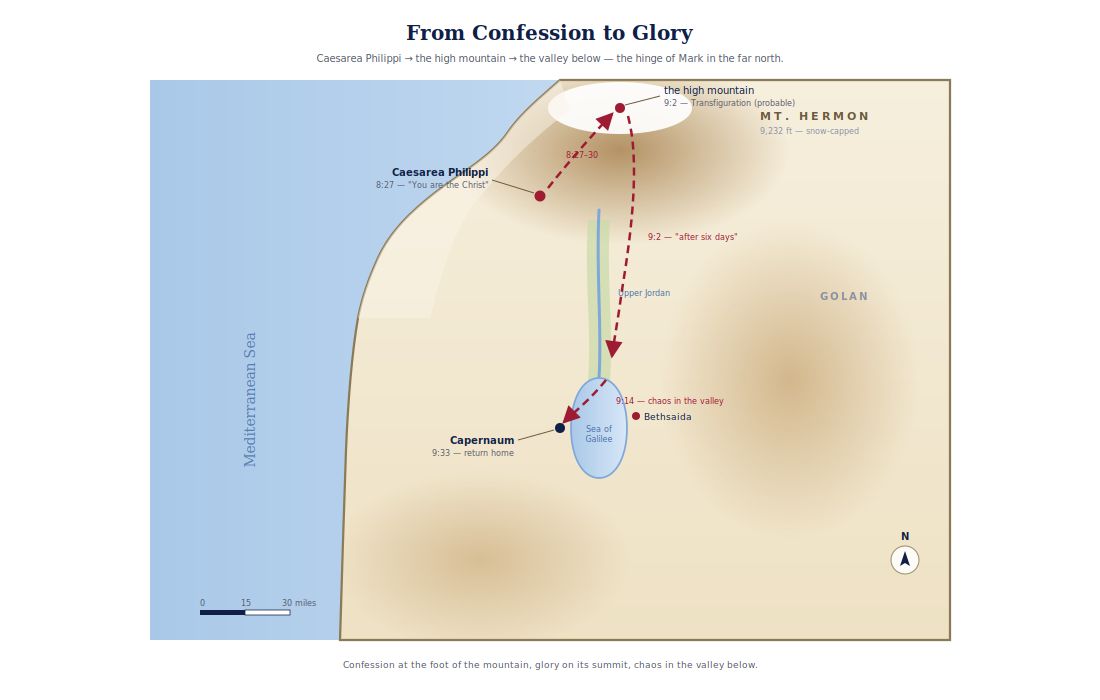
Jesus takes the Twelve north to Caesarea Philippi — a city at the foot of Mount Hermon, built around a grotto dedicated to the god Pan, with a gleaming marble temple to Caesar Augustus nearby. 1945 It was a showcase of pagan worship and imperial power. And here, of all places, Jesus asks the question:
"Whom do men say that I am?" (8:27)
The disciples report the rumors: "John the Baptist; but some say, Elias; and others, one of the prophets" (8:28). Respectful guesses — and every one of them safe. A prophet is admirable. A prophet doesn't demand your life.
Then the question narrows to a knife's point: "But whom say YE that I am?" (8:29).
Peter answers for them all: "Thou art the Christ."
Christos — the Anointed One, the promised King. After eight chapters of blurry sight, one disciple finally sees clearly. (Matthew adds that Jesus called Peter blessed and said "for flesh and blood hath not revealed it unto thee, but my Father which is in heaven" — the confession is given, not achieved.)
And then — verse 30 — the now-familiar move: "He charged them that they should tell no man of him." 926093 The Messianic Secret again: the right confession at the wrong time, in the wrong terms, would ignite the wrong revolution.
Scene 2: The confessor becomes the corrector (8:31–33)
The instant the identity is confessed, Jesus redefines it:
"And he began to teach them, that the Son of man must suffer many things, and be rejected of the elders, and of the chief priests, and scribes, and be killed, and after three days rise again." (8:31)
This is the first passion prediction — the first of three (8:31; 9:31; 10:33–34). Notice the word "must" (dei — divine necessity). Suffering isn't a tragic accident in Mark's Gospel; it's the assignment.
Peter's response is breathtaking: "And Peter took him, and began to rebuke him" (8:32). The same verb (epitimaō) Jesus used to muzzle demons. The confessor grabs the Messiah by the arm to set Him straight: No cross. Not You. Not like this.
Jesus turns — Mark says He looked at His disciples when He said it, making Peter an object lesson — and fires back:
"Get thee behind me, Satan: for thou savourest not the things that be of God, but the things that be of men." (8:33)
Peter isn't possessed. He's something more ordinary and more dangerous: he's voicing Satan's agenda — the same agenda from the wilderness temptation (Matthew 4:8–9): glory without the cross, a crown without suffering. Satan doesn't always show up with a pitchfork; sometimes he shows up with a friend's well-meaning advice. "Get behind Me" is also, pointedly, where a disciple belongs — behind, following, not out front leading.
Scene 3: The hardest call (8:34–9:1)
Jesus calls the crowd with His disciples and lays down the terms — the most demanding invitation in the Gospels:
"Whosoever will come after me, let him deny himself, and take up his cross, and follow me." (8:34)
To first-century ears, this was not a metaphor for enduring annoyances. The cross was Rome's obscene instrument of torture-execution — criminals carried their crossbeam to the execution site. "Take up your cross" meant: walk the road to your own execution. Jesus is saying: discipleship is a death march — death to self-rule, and potentially death itself. (Mark's likely Roman readers — many scholars think facing persecution in Rome — would hear this with ice in their veins.)
Then three paradoxes that turn the world's wisdom inside out:
- "For whosoever will save his life shall lose it; but whosoever shall lose his life for my sake and the gospel's, the same shall save it." (8:35)
- "For what shall it profit a man, if he shall gain the whole world, and lose his own soul?" (8:36)
- "Whosoever therefore shall be ashamed of me... of him also shall the Son of man be ashamed, when he cometh in the glory of his Father with the holy angels" (8:38) — loyalty now determines welcome then.
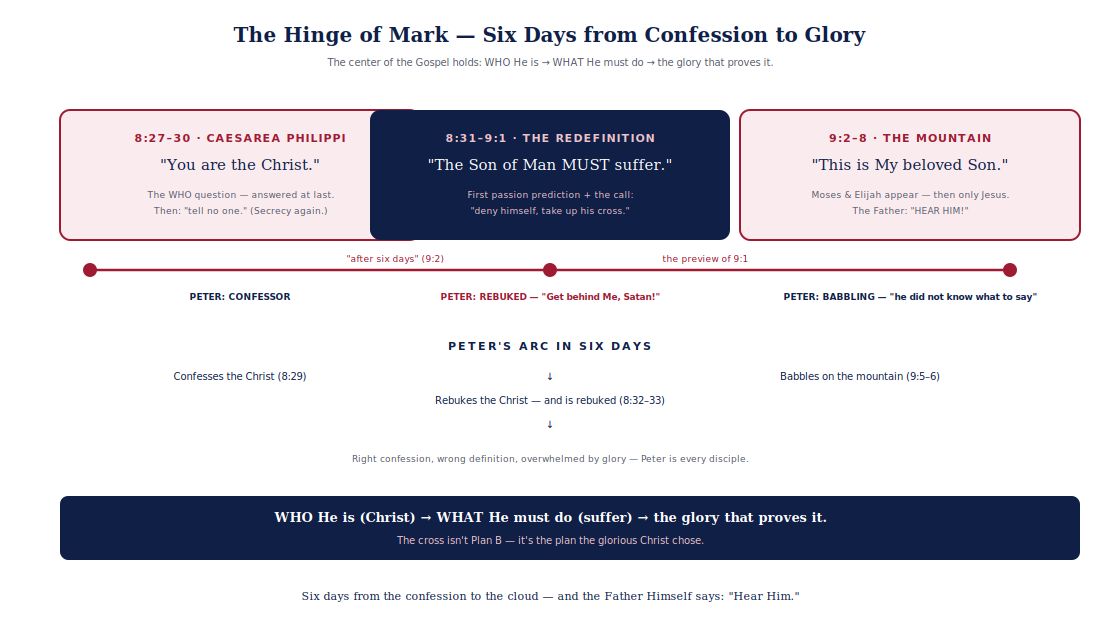
And the promise that closes the scene: "Verily I say unto you, That there be some of them that stand here, which shall not taste of death, till they have seen the kingdom of God come with power" (9:1). What does He mean? Mark answers in the very next verse: "after six days" — the Transfiguration. Three of them are about to see the kingdom's glory with their own eyes.
Scene 4: Glory on the mountain (9:2–13)
Six days later, Jesus takes Peter, James, and John — the inner three — "up into an high mountain apart by themselves" (9:2). Tradition names Mount Tabor; many scholars favor Mount Hermon, looming right by Caesarea Philippi 5 — either way, a mountain apart, the biblical place of God's presence (Sinai!).
"And he was transfigured before them" (9:2). The Greek is metamorphoō — metamorphosed, the word behind our "metamorphosis" (Paul uses it in Romans 12:2, "be transformed"). For a blazing moment, the veil lifts: "His raiment became shining, exceeding white as snow; so as no fuller on earth can white them" (9:3).
Then the guests: "And there appeared unto them Elias with Moses, and they were talking with Jesus" (9:4). Moses — the Law, the giver of the covenant, who met God on Sinai. Elijah — the Prophets, who never died but was taken up. Together they are the whole Old Testament, appearing to bear witness: this is the One we were pointing to.
Peter, terrified and babbling — "for he wist not what to say" (9:6) — blurts out: "Master, it is good for us to be here: and let us make three tabernacles; one for thee, and one for Moses, and one for Elias" (9:5). Tabernacles — booths, tents: Peter wants to freeze the glory, build shrines, stay on the mountain. (It's the Feast of Tabernacles instinct — celebrate the presence and never come down.)
Heaven interrupts him. A cloud overshadows them — the cloud of God's presence, the Shekinah that led Israel — and the voice:
"This is my beloved Son: hear him" (9:7)
The Father's second verdict in Mark (the first was at the baptism, 1:11). Note what's missing this time: at the Jordan He added "in whom I am well pleased" (the Servant); here the command is "Hear Him!" — listen to the One who just predicted His suffering. The glory authenticates the cross-talk.
"Suddenly, when they had looked round about, they saw no man any more, save Jesus only with themselves" (9:8). Moses and Elijah are gone. The Law and Prophets have done their job — now it's Jesus only. Coming down, He charges them to "tell no man... till the Son of man were risen from the dead" (9:9) — and they "kept that saying with themselves, questioning one with another what the rising from the dead should mean" (9:10). They'd just seen glory; resurrection was still unthinkable.
On the way down they ask about Elijah: the scribes teach that Elijah must come first (Malachi 4:5–6). Jesus answers: "Elias is indeed come, and they have done unto him whatsoever they listed, as it is written of him" (9:13) — John the Baptist, the Elijah-figure, already came and was executed (6:14–29). The pattern is set: the forerunner suffered; so will the Son.
Scene 5: "I believe; help thou mine unbelief!" (9:14–29)
They descend from glory into chaos: a great crowd, scribes disputing with the disciples. A man explains: his son has "a mute spirit" — seizures that throw him into fire and water, foaming, grinding teeth, rigidity. "I spake to thy disciples that they should cast him out; and they could not" (9:18).
Jesus' response is anguished: "O faithless generation, how long shall I be with you? how long shall I suffer you?" (9:19). Then to the father: the boy convulses, and the father pleads the most desperate conditional in Scripture: "But if thou canst do any thing, have compassion on us, and help us" (9:22).
Jesus catches the "if" and throws it back: "'If you can believe,' all things are possible to him who believes" (9:23). The issue was never Christ's power — it's the father's trust.
And then — the most honest prayer in the Bible:
"And straightway the father of the child cried out, and said with tears, 'Lord, I believe; help thou mine unbelief!'" (9:24)
Faith and doubt in the same breath. Trust with trembling hands. Jesus doesn't rebuke the contradiction — He answers it: He rebukes the "deaf and dumb spirit," the boy convulses violently and lies "as one dead" (the crowd whispers, "He is dead"), and Jesus takes him by the hand, lifts him — and "he arose" (9:27; the Greek is anestē — the resurrection word).
Alone later, the disciples ask the burning question: "Why could not we cast him out?" (9:28). Jesus: "This kind can come forth by nothing, but by prayer and fasting" (9:29). Some battles aren't won by technique or authority-formulas — only by desperate dependence. (A textual note: some early manuscripts omit "and fasting" — see Fact/Inference/Disputed. Either way, the point is prayer: the disciples tried to minister on yesterday's power.)
WORD STUDY
Christ — Christos (khris-TOS). Greek for "Anointed One" — the translation of Hebrew Mashiach (Messiah). In Israel, prophets, priests, and kings were anointed with oil. Peter's confession means: You are the promised King — the One the whole story was waiting for. (The tragedy of 8:32 is that Peter had the title right and the job description wrong.)
Cross — stauros (stow-ROSS). An upright stake or crossbeam — Rome's instrument for the slow, public, shameful execution of rebels and slaves. When Jesus says "take up his cross" (8:34), no one hears a metaphor for traffic jams. They hear: shoulder the beam and walk to your death.
Transfigured — metamorphoō (meh-tah-mor-FOH-oh). Changed in form — the word behind "metamorphosis." Paul uses it for the Christian's inner transformation (Romans 12:2). On the mountain, Jesus' outside briefly matched His inside: the glory that was always there became visible.
Tabernacles — skēnē (skay-NAY). Tents, booths — the shelters of the Feast of Tabernacles, when Israel camped in booths to remember the wilderness. Peter's instinct is worshipful but wrong: you don't enshrine glory, you follow it back down the mountain.
"Get thee behind me, Satan" — what was happening to Peter?
Not possession — Peter's will is his own. What's happening is alignment: Peter is speaking the devil's platform. Go back to the wilderness (1:13): Satan's offer was glory without the cross. Peter's rebuke — no suffering, Lord — is the same offer in a friend's voice. That's why Jesus answers so violently: He recognizes the old temptation wearing a disciple's face.
The pastoral weight is enormous: our most dangerous moments aren't when we deny Christ but when we try to edit Him — a Christ of comfort without a cross, of glory without suffering. "Get behind Me" is both rebuke and invitation: get back where disciples belong — behind, following — and let Me define the mission.
"Some of them that stand here, which shall not taste of death" — a failed prophecy?
Skeptics have claimed 9:1 predicts Jesus' return within the disciples' lifetime — and that its non-fulfillment embarrasses the Gospel. But Mark himself supplies the fulfillment: "after six days" (9:2). Peter, James, and John — "some standing here" — see "the kingdom of God come with power" on the mountain: the glorified Christ, the saints of the old age, the Father's voice. It's a preview, not the premiere — the trailer before the film. (Peter later writes about it as an eyewitness: "we...were eyewitnesses of his majesty" — 2 Peter 1:16–18.)
Why Moses and Elijah?
Because they are the Old Testament in two persons: Moses the Law (and the one who met God on Sinai in cloud and glory), Elijah the Prophets (who never died). Their presence says: the Law and the Prophets converge here — they talked with Jesus (Luke adds: about "His decease which he should accomplish at Jerusalem," Luke 9:31 — even on the mount of glory, the topic is the cross). And then they're gone — "only Jesus." The witnesses step aside for the One they witnessed to.
"Prayer and fasting" — the textual footnote
The KJV reads: "This kind can come forth by nothing, but by prayer and fasting" (9:29). A few early manuscripts read simply "by prayer." Which is original? Scholars divide — and honesty requires saying so. But notice: the point survives either reading. The disciples had been casting out demons successfully (6:13); now they fail, and the difference isn't technique — it's dependence. Whether or not "fasting" was in Mark's original ink, the lesson stands: some victories come only to those who pray like they mean it.
The Christ Thread
Messianic promise — Christ in His own story. This passage is the hinge where Jesus' identity is confessed and defined. Peter's "You are the Christ" claims the whole Old Testament promise line — the anointed King of Psalm 2, the Son of David of 2 Samuel 7. But Jesus immediately redefines the title: the Christ must suffer (8:31), fusing Daniel 7's glorious Son of Man with Isaiah 53's suffering Servant. Then the Transfiguration: Moses (the Law) and Elijah (the Prophets) appear to bear witness — the entire Old Testament showing up to point at Him — and the Father speaks the verdict: "This is my beloved Son: hear him!"
OT/NT parallels — where the New Testament picks it up. Matthew's fuller account adds "for flesh and blood hath not revealed it unto thee, but my Father which is in heaven" (Matthew 16:17) — the confession is given, not achieved. Peter himself later writes as an eyewitness: "we... were eyewitnesses of his majesty... and this voice which came from heaven we heard" (2 Peter 1:16–18). Paul takes the Transfiguration word (metamorphoō) and applies it to us: "be ye transformed by the renewing of your mind" (Romans 12:2). And Philippians 2 traces the same arc as 8:31–9:8: humiliation, then exaltation.
The Christian future — what this foreshadows for us. "Some of them that stand here, which shall not taste of death, till they have seen the kingdom of God come with power" (9:1) — fulfilled six days later on the mountain. The Transfiguration is the trailer: the kingdom's glory, previewed. Our future runs the same pattern — cross now, glory then: "we shall be like him" (1 John 3:2), transformed into His image. And the Father's command stands over every generation: "Hear Him!"
Where in the Covenant Story?
The Davidic covenant (2 Samuel 7:12–16) is the claim underneath "You are the Christ" — the promised King from David's line. But Jesus redefines the kingship through Isaiah's Servant and the coming New Covenant: the King reigns by suffering. On the mountain, Moses — mediator of the old covenant — appears, talks with Jesus, and steps aside: "they saw no man any more, save Jesus only" (9:8). The old covenant's greatest figures bear witness to its fulfillment and exit. The New Covenant Mediator remains.
Father, Son, and Spirit
The Transfiguration is Trinitarian: the Son transfigured in glory, the Father's voice from the cloud, the Spirit's cloud of presence overshadowing them — the Shekinah that led Israel. And at Caesarea Philippi, the confession itself is Trinitarian in origin: "for flesh and blood hath not revealed it unto thee, but my Father which is in heaven" (Matthew 16:17) — the Father reveals, the Son is revealed, and the Spirit empowers the "Hear Him!" obedience. When glory shows up in Mark, all three Persons are in the frame.
WHAT THE CHURCH HAS ALWAYS BELIEVED: Peter's "You are the Christ" became the church's foundational confession. The Apostles' Creed opens "I believe in... Jesus Christ" — every creed since is the church saying Peter's sentence back, with two thousand years of reflection on what "Christ" actually means. Your confession today joins that unbroken line.
It's Okay to Ask
Honest questions this passage raises — bring them, don't bury them:
- Did Jesus really call His best friend "Satan"? (Yes — but it wasn't possession, it was alignment. Peter was voicing Satan's oldest offer: glory without the cross. See "Get behind Me, Satan" above.)
- If "take up your cross" means dying, is Jesus asking me to want death? (He's asking for death to self-rule — allegiance, not self-harm. Martyrdom is possible for some; surrender is required of all.)
- I pray "help my unbelief" all the time. Does that mean my faith is fake? (It means your faith is honest. Jesus didn't correct the father's grammar — He healed his son. Trembling faith is still faith.)
Watch Out — the enemy's playbook
Mark shows Satan's strategy plainly in 8:33: he doesn't always come with a pitchfork — sometimes he comes with a friend's protective advice. His oldest offer never changes: glory without the cross (Eden, the wilderness in 1:13, Caesarea Philippi). Watch for it in well-meaning voices — including your own — that counsel you away from obedience when obedience costs. "Get behind Me" is where disciples belong: behind, following, letting Jesus define the mission.
FACT, INFERENCE, OR DISPUTED?
- FACT: Metamorphoō (9:2) is the same word Paul uses in Romans 12:2 ("be transformed").
- FACT: The Father's verdict comes twice in Mark — 1:11 (baptism) and 9:7 (Transfiguration) — with different emphases (delight / "Hear Him!").
- FACT: "After six days" (Mark 9:2); Luke says "about eight days" (Luke 9:28) — ancient inclusive counting explains the difference (counting partial days at both ends).
- INFERENCE: The mountain is Mount Hermon (near Caesarea Philippi) rather than the traditional Mount Tabor — plausible geography, unprovable.
- INFERENCE: "Some standing here" (9:1) is fulfilled by the Transfiguration six days later.
- DISPUTED: Whether "and fasting" belongs in 9:29 — some early manuscripts omit it.
SCHOLAR'S NOTE: Caesarea Philippi sat at one of the great springs of the Jordan, in front of a cliff honeycombed with shrines to Pan — the Romans called it the grotto of Pan. Herod's son Philip rebuilt the town and named it for Caesar. 4519 So picture the scene: Jesus asks "Whom say ye that I am?" with Pan's grotto on one side and Caesar's temple on the other — the gods of pleasure and the gods of power flanking the question. Peter's answer — "You are the Christ" — is a direct challenge to both. (One caution: Mark says they were in "the towns of Caesarea Philippi" and asked "on the road" — he doesn't tell us the exact spot where the question fell. The grotto and the temple are solid history (Josephus, Antiquities 15.10.3); 19 picturing the question between them is plausible staging, not text.)
Cross-references (explained, not just listed)
- Malachi 4:5–6 — "I will send you Elijah the prophet" — the prophecy behind the disciples' question (9:11) and Jesus' answer about John (9:13).
- Matthew 16:13–28 — the fuller confession account, including "flesh and blood has not revealed this" and the "keys of the kingdom."
- Deuteronomy 18:15 — the prophet like Moses — part of why Moses' presence at the Transfiguration matters.
- 2 Peter 1:16–18 — Peter's own later testimony: "we were eyewitnesses of His majesty... we heard this voice."
- Romans 12:2 — "be ye transformed [metamorphoō] by the renewing of your mind" — the Transfiguration word applied to us.
Go Deeper
Hungry for more? Two doors worth opening:
- Read Matthew 16:13–17:13 — the fuller confession and Transfiguration accounts, including "flesh and blood has not revealed this to you."
- Read 2 Peter 1:16–21 — Peter, decades later, looking back on the mountain: "we were eyewitnesses of his majesty."
Theological truth (arising from the text)
Right confession must be followed by right definition: the Christ is the suffering Son of Man, and following Him means a cross-shaped life. Glory doesn't cancel the cross — it authenticates it: the Father's voice on the mountain says "Hear Him!" precisely about the One who just predicted His death. And honest, trembling faith ("help my unbelief") is still faith — Jesus answers it.
Humble — and confident
Humble, because Peter got the biggest question right and the next sentence wrong. Confessing "You are the Christ" took about ten seconds; learning what "Christ" means took a lifetime. If the rock of the church could pivot from confession to correction in one verse, we should hold our own understanding loosely and keep listening.
Confident, because the Father put His own voice behind the suffering Messiah: "This is my beloved Son: hear him" The cross isn't Plan B — it's the plan the glorious Christ chose, announced on a mountain of light. And the father who prayed "help my unbelief" went home with a healed son. Trembling faith counts.
Confess It
Peter tried to edit Jesus — a Christ without a cross. Before you move on, name one way you've been editing Him: the command you've softened, the suffering you've dodged, the "good advice" you've followed instead of obedience. Confess it plainly (1 John 1:9) — the same Jesus who rebuked Peter restored him.
For discussion
- Peter tried to edit Jesus — a Christ without a cross. Where are you tempted to edit Him? What would "get behind Me" sound like in that area?
- "Take up his cross" meant walking to your execution. What's the most concrete "death to self" Jesus is asking of you right now?
- The father prayed "I believe; help thou mine unbelief!" — faith and doubt in one breath. What would you pray if you let both be true out loud?
What He has done (the indicative)
Before one "you should," hear what He did: the Father revealed the Christ to Peter — confession is given, not achieved. The Son set His face toward the cross and named it "must." On the mountain, glory broke through to prove the suffering was the plan all along. You follow a revealed, crucified, glorified Lord — every step below is response to that, not a way to earn it.
This week's practices
- Answer the question in writing. "Whom say YE that I am?" (8:29). Write your answer — one paragraph, your own words, no clichés. Then write one sentence on what "Christ" requires of you this week.
- Name your cross. Identify one concrete "death to self" — a comfort, a grudge, an ambition — and take one practical step of laying it down. Tell one trusted believer what you're doing.
- Pray It Back. Take Mark 9:24 into prayer each morning this week: "Lord, I believe; help my unbelief — especially about _____. Name the specific doubt; don't pray around it."
- Memorize Mark 8:34. The call in one verse.
For Us Together
Ask your small group or one friend this week: "Where are we tempted to edit Jesus as a group — softening His hard words to keep everyone comfortable?" Confession is easier in company; so is courage.
Who Needs This?
Who in your life is praying "help my unbelief" in secret — faking certainty while trembling inside? One name. One conversation where you go first with your own honest faith.
Take It Home
At the table or at bedtime, ask your kids: "Peter told Jesus He was wrong about the cross — can you imagine telling God He's wrong? Peter did, and Jesus corrected him, and still loved him. Is there something you've been wanting to argue with God about? You can tell Him."
Praise Him
Don't end with a to-do list — end with worship. Right now, out loud or in writing, finish this sentence: "Lord Jesus, I praise You because You are the Christ who _____." (Chose the cross? Answered trembling faith? Let Your glory prove Your love?) Sit in it for a minute. Theology that doesn't become doxology hasn't finished its work.
The bottom line
Who is He? The Christ. What must He do? Suffer, die, rise. What must we do? Deny ourselves, take up the cross, follow — and when faith trembles, pray the most honest prayer in the Bible. Six days from confession to glory: Mark's hinge holds, and the Father Himself says so.