
Before You Read: Open My Eyes
Before you read a single verse, pray this — out loud if you can:
"Father, this chapter has started a thousand arguments. Keep me from both speculation and sleep — make me steady, not scared, and awake, not anxious. Show me the returning King, and keep me at my post. In Jesus' name, amen."
(Psalm 119:18 — "Open thou mine eyes, that I may behold wondrous things out of thy law.")
Welcome
They're leaving the temple when a disciple blurts out what they're all thinking: "Master, see what manner of stones and what buildings are here!" (13:1). Herod's temple — 35 acres of white limestone and gold, one of the wonders of the ancient world. Jesus' reply stops them cold: "Seest thou these great buildings? there shall not be left one stone upon another, that shall not be thrown down" (13:2).
What follows — on the Mount of Olives, facing that doomed temple — is the longest teaching block in Mark: wars and earthquakes, persecution and betrayal, cosmic darkness and the Son of Man coming in clouds. Christians have argued about this chapter for 2,000 years. Our job in this lesson is humbler and harder: hear what Mark 13 actually says, distinguish what we know from what we guess, and catch the command Jesus repeats four times: watch.
CHECK WHAT YOU THINK YOU KNOW
- ☐ "Mark 13 is entirely about the end of the world." (Part of it already happened — in AD 70.)
- ☐ "Jesus predicted the exact date of His return." (He said the opposite — twice.)
- ☐ "'This generation will not pass away' means Jesus was wrong." (Only if you assume what "this generation" means.)
- ☐ "The point of prophecy is to decode the future." (Mark 13's point is to steady the present.)
Where we are in the story
It's Tuesday of Passion Week (by tradition). Jesus has silenced every debater in the temple courts. Now He walks out — and won't return until He's arrested. Across the Kidron Valley sits the Mount of Olives, where Peter, James, John, and Andrew ask privately: "Tell us, when shall these things be? and what shall be the sign when all these things shall be fulfilled?" (13:3–4). Two questions — when? and what sign? — and Jesus answers both, in His own way.
Check What You Think You Know
Many sincere Christians have treated Mark 13 as a puzzle to decode — matching headlines to verses, setting dates, predicting the end. But Jesus closes the discourse by forbidding exactly that: "of that day and that hour knoweth no man, no, not the angels which are in heaven, neither the Son, but the Father" (13:32). The chapter isn't a timetable; it's a call to watchfulness — "Watch!" is the whole application in one word (13:37). The point was never to calculate the end, but to be ready for it.
The setting: a temple that couldn't fall (13:1–2)
Picture what the disciples saw: the temple platform's retaining walls built of stones up to 44 feet long and weighing hundreds of tons (the largest known, the "Western Stone," measures 44.5 feet); the sanctuary overlaid with plates of gold that flashed in the sun. Josephus, the Jewish historian, wrote that where there wasn't gold, the white marble looked from a distance like a snow-covered mountain. 116 The temple had stood on that mount for centuries — though Herod's grand rebuild had only begun in 19 BC and wasn't finished until AD 63, seven years before the end. It couldn't fall.
Within forty years, its buildings would be rubble. In AD 70, the Roman general Titus besieged Jerusalem; the temple burned — a fire Josephus says was started by a single soldier against Titus's own orders (he tried to stop it), after which Titus ordered the whole city and temple demolished. 1178 The sanctuary and its courts were dismantled stone by stone — fulfilling "not be left one stone upon another" with terrible literalness. (A popular retelling says the Romans pried the stones apart to recover melted gold that had run into the cracks; that detail comes from later storytellers, not from Josephus.) 8 Note the scope: the prophecy addressed the buildings, not the platform's retaining walls — those still stand today (the Western Wall is one of them). The disciples lived to see some of this chapter come true.
The discourse, movement by movement
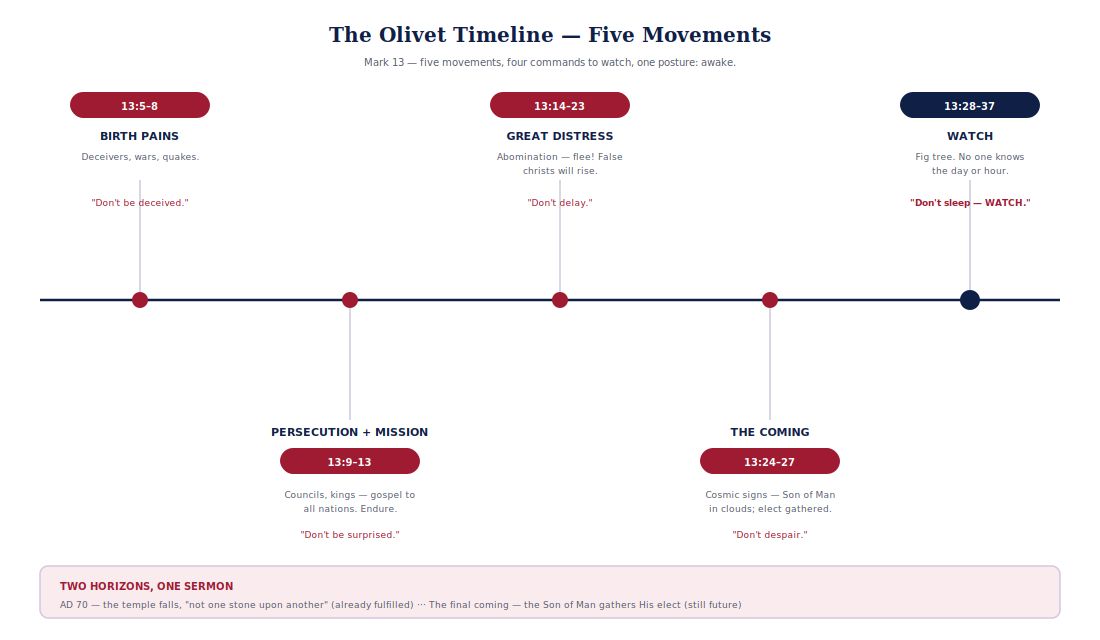
1. Don't be deceived — the birth pains (13:5–8). "Take heed lest any man deceive you: For many shall come in my name, saying, I am Christ; and shall deceive many" (13:5–6). Then wars, rumors of wars, nation against nation, earthquakes, famines — "These are the beginnings of sorrows" (13:8). 61 The Greek is ōdin — birth pains — birth pains. Pains mean the birth is coming, but no one sets their watch by the first contraction. And crucially: "be ye not troubled" (13:7). Upheaval is expected, not alarming.
2. Don't be surprised — persecution and mission (13:9–13). "But take heed to yourselves: for they shall deliver you up to councils; and in the synagogues ye shall be beaten... and ye shall be brought before rulers and kings for my sake, for a testimony against them" (13:9). Notice: persecution becomes pulpit — suffering is evangelism. "And the gospel must first be published among all nations" (13:10) — the mission goes global before the end. Don't pre-script your defense: "the Holy Spirit" will speak (13:11). Then the cost in full: family betrayal, hatred by all — "but he that shall endure unto the end, the same shall be saved" (13:13). Endurance, not escape, is the promise.
3. Don't delay — the great distress (13:14–23). "when ye shall see the abomination of desolation, spoken of by Daniel the prophet, standing where it ought not...then let them that be in Judaea flee to the mountains" (13:14). The phrase comes from Daniel (9:27; 11:31; 12:11) — where a pagan power defiles the temple. Its prototype: Antiochus IV Epiphanes, who in 167 BC erected a pagan altar in the temple (the horror behind Hanukkah). Jesus warns of a coming repeat — urgent, practical flight instructions follow (don't go back for your cloak, pray it's not winter, woe to nursing mothers). History's candidate for the AD 70 horizon: the Roman armies surrounding Jerusalem in AD 66–70 (Luke's parallel makes it explicit — "when ye shall see Jerusalem compassed with armies," Luke 21:20). After the temple burned, Josephus reports the Romans carried their idolatrous military standards into the temple court and offered sacrifices before them (Wars 6.6.1) — pagan worship standing where only God's holiness belonged. 117 (One caution from historian F. F. Bruce: Josephus himself never calls this an "abomination" — the identification is ours, not his.) 8
Then the warning against sensationalism: "false Christs and false prophets shall rise, and shall shew signs and wonders, to seduce, if it were possible, even the elect" (13:22). In a crisis, the market for messiahs booms. "Behold, I have foretold you all things" (13:23) — forewarned is forearmed.
4. Don't despair — the coming of the Son of Man (13:24–27). "But in those days, after that tribulation, the sun shall be darkened, and the moon shall not give her light, And the stars of heaven shall fall..." (13:24–25). This is the prophets' language for the fall of powers (Isaiah 13:10 against Babylon; Ezekiel 32:7 against Egypt) — cosmic imagery for earth-shaking judgment. Then: "they see the Son of man coming in the clouds with great power and glory" (13:26) — Daniel 7:13, Jesus' favorite title, now in full glory. "And then shall he send his angels, and shall gather together his elect from the four winds" (13:27). Whatever the shaking, the ending is a gathering — God's people collected, not scattered.
5. Don't sleep — the fig tree and the command to watch (13:28–37). "Now learn a parable of the fig tree" (13:28) — tender branches, leaves out: summer is near. (The illustration was standing in front of them: the Mount of Olives was famous for its fig trees, and at Passover season the branches were doing exactly this.) "So ye in like manner, when ye shall see these things come to pass, know that it is nigh, even at the doors!" (13:29). Then the most debated verse in Mark: "Verily I say unto you, that this generation shall not pass, till all these things be done" (13:30). (See Interpretation.)
"Heaven and earth shall pass away, but my words shall not pass away" (13:31) — the most audacious claim in the discourse: Jesus puts His words on the far side of the universe's expiration date.
"But of that day and that hour knoweth no man, no, not the angels which are in heaven, neither the Son, but the Father" (13:32). Read that again. The Son Himself — in His incarnate mission — names a limit to His knowledge. Anyone selling you a date for the return is claiming to know what Jesus said He didn't.
So the closing command, four times over: "Watch!" (13:33, 34, 35, 37). The parable: a master leaves his house, gives each servant work, tells the doorkeeper to watch — "lest, coming suddenly, he find you sleeping" (13:36). The sermon ends where Christian living begins: not with a chart, but with a post.
WORD STUDY
Birth pains — ōdin (oh-DEEN). The form in 13:8 is ōdinōn, "of birth pains," from the noun ōdis — the pain of childbirth. 61118 The prophets used it for the anguish before God's decisive acts (Isaiah 26:17; Micah 4:9). Pains are terrible and hopeful at once — they hurt, but they mean something is being born. Jesus chooses the metaphor deliberately: history's convulsions are not the end of the story but the labor before it. (Note the echo: "nation shall rise against nation" is Isaiah's own language — Isaiah 19:2.) 118
Abomination of desolation — bdelugma tes eremoseos (bdeh-LYOOG-mah tess eh-ray-MOH-seh-ohs). "Abomination" is the Old Testament's strongest word for idolatry — what makes God sick. "Desolation" is what it leaves behind: emptiness, ruin. Daniel's phrase for the ultimate sacrilege: pagan defilement standing where only God's holiness belongs.
Watch — gregoreo (gray-goh-REH-oh). Stay awake, be alert — the opposite of spiritual sleep. Jesus uses it in 13:34, 35, 37. In 13:33 He uses the near-synonym agrypneo (ah-groop-NEH-oh) — literally "be sleepless," a word drawn from sentries standing guard. The shade of difference: agrypneo pictures a wakeful frame of mind (not drifting); gregoreo pictures someone roused to alertness by effort — the doorkeeper shaking himself awake and standing his post. 119 It's the whole application of the discourse in one word.
Generation — genea (geh-neh-AH). Can mean (1) the people alive at one time, (2) a kind of people (as in "this wicked generation"), or (3) the Jewish people as a continuing entity. Which one Jesus means in 13:30 is the most debated question in the chapter — see Interpretation.
Two horizons, one sermon
Here's the interpretive framework most readers use to unlock Mark 13 — offered honestly as a framework, not as a verse in the text itself: Jesus is describing two events at once — like mountain peaks seen from a distance, appearing as one ridge though miles apart:
- Horizon 1: AD 70 — the temple's destruction. The disciples asked about the temple (13:1–4); much of the discourse fits Jerusalem's siege with chilling precision: false messiahs (Josephus reports false prophets during the siege promising divine deliverance, Wars 6.5.2), 117 wars (Rome's), Christians fleeing to the mountains (an early but debated tradition — the historian Eusebius, writing in the early 300s some 240 years later, says the Jerusalem believers fled to Pella across the Jordan before the war; scholars disagree on how historical the account is) 120, the abomination (Roman standards in the temple court, Wars 6.6.1).
- Horizon 2: The final coming — 13:24–27's cosmic signs and the Son of Man "coming in the clouds" go beyond anything AD 70 contained. The gathering of the elect "from the uttermost part of the earth to the uttermost part of heaven" is still future.
This "already / not yet" shape is how prophecy often works (see Joel 2, quoted at Pentecost in Acts 2 as fulfilled yet still awaiting fullness). Christians disagree on exactly where AD 70 ends and the future begins — and that's okay. What Mark insists on is not a timeline but a posture: don't be deceived, don't panic, endure, watch.
"This generation shall not pass" — the honest options
Mark 13:30 is the verse skeptics cite and believers wrestle with. The honest readings:
- "Generation" = the people alive then. On this reading, "all these things" refers to the AD 70 horizon — which did happen within a generation (about 40 years). 29 The final coming (13:24–27) stands beyond, addressed but not dated. (Some add a wrinkle: the Greek verb for "take place" can mean "come into existence" — on that nuance, the fulfillment began in that generation even if it completes later.) 24
- "Generation" = the Jewish people. The nation will survive until all is fulfilled — a reading with deep Old Testament resonance.
- "Generation" = the generation that sees the signs. When the birth pains begin in earnest, the end follows within a lifetime. 121
Each has defenders; none requires Jesus to be "wrong." What is certain: Jesus immediately adds that no one knows the day or hour (13:32) — so whatever 13:30 means, it isn't a date. Anyone who turns Mark 13 into a prediction calendar has missed the chapter's own guardrails.
Why prophecy? — the purpose question
Ask what Mark 13 does to its first readers — Christians facing persecution, then Jerusalem's fall — and you find its purpose: steadiness, not speculation. Every movement carries a pastoral command: don't be deceived (false christs), don't be troubled (wars), don't be surprised (persecution), don't delay (flee), don't despair (He is coming), don't sleep (watch). The discourse is a survival manual for turbulent times, not a puzzle for prophecy charts. If your study of Mark 13 makes you anxious or arrogant, you're reading it backwards — it's meant to make you awake and steady.
The Christ Thread
Christ in His own story. This discourse is the Messiah describing His own return. The title He uses — "Son of man coming in the clouds" (13:26) — is Daniel 7:13, the vision of one who approaches the Ancient of Days and receives an everlasting kingdom. Jesus takes Daniel's figure and says, in effect: that's Me, and you've seen My face. The most audacious line in the chapter isn't about the future at all — it's 13:31: "Heaven and earth shall pass away, but my words shall not pass away." He places His own words on the far side of the universe's expiration date.
OT/NT parallels. Mark 13 is woven from the prophets: Daniel 7:13 (the Son of Man), Daniel 9–12 (the abomination), Isaiah 13:10 and Ezekiel 32:7 (cosmic darkness as judgment language), Joel 2 (quoted at Pentecost in Acts 2 as both fulfilled and still coming). The New Testament keeps preaching from this sermon: Matthew 24 and Luke 21 give the parallel accounts, 1–2 Thessalonians answer churches confused about the timing, and Revelation expands the canvas. Read them with Mark 13, never over it.
The Christian future. This angle is the passage: the future of every Christian is a gathering, not a scattering — "then shall he send his angels, and shall gather together his elect from the four winds" (13:27). Whatever the birth pains, the last movement of history is God collecting His people. And the mission comes first: "the gospel must first be published among all nations" (13:10) — the end waits on evangelism, which means every act of witness is pulling the future closer.
WHAT THE CHURCH HAS ALWAYS BELIEVED: The Nicene Creed (A.D. 325, in the form finalized at Constantinople in 381) confesses what Mark 13 teaches: "He will come again in glory to judge the living and the dead, and His kingdom will have no end." For 2,000 years, Christians facing every empire's collapse have anchored here — the return is not speculation, it's creed.
Where in the Covenant Story?
Mark 13 announces the end of the Old Covenant's geographic center: the temple — the place where heaven touched earth under Moses' covenant — will fall, and with it the sacrificial system. But the covenant people don't end; they expand. "The gospel must first be published among all nations" (13:10) is the Abrahamic promise ("in thee shall all families of the earth be blessed," Genesis 12:3) reaching its full width. We live between the horizons: the old covenant's shadows have passed, the new covenant's people are being gathered from the four winds, and the King is coming to finish it.
Father, Son, and Spirit
All three persons are at work in this discourse. The Spirit speaks through the persecuted — "it is not ye that speak, but the Holy Ghost" (13:11) — God putting His own words in suffering mouths. The Son narrates the future and claims Daniel's throne-vision for Himself. And the Father holds the one secret even the Son, in His incarnate mission, does not open: "of that day and that hour knoweth no man, no, not the angels which are in heaven, neither the Son, but the Father" (13:32). The Trinity is not just a doctrine to defend here — it's the shape of our hope: the Father plans, the Son returns, the Spirit sustains us until then.
It's Okay to Ask
Honest questions this passage raises — bring them, don't bury them:
- "This generation shall not pass" (13:30) — was Jesus wrong? (Only if "this generation" must mean the final coming's generation. See "the honest options" above — three faithful readings, none requiring Jesus to be mistaken.)
- If Jesus is fully God, how could He not know the day or hour (13:32)? (In the incarnation, the Son truly took on human limits 27 — including, in His earthly mission, a limit on this knowledge. Mystery, not contradiction: fully God, truly man, genuinely not-knowing as man what the Father had not revealed. Textual side note: some old copies of Matthew 24:36 omit "nor the Son," but in Mark 13:32 the phrase isn't textually disputed — Mark really wrote it.)
- Is studying prophecy pointless, then? (Studying it to decode dates is pointless — Jesus forbids it. Studying it to become steady, watchful, and missional is the whole point. Ask of every prophecy text: "What posture does this produce in me?")
Watch Out — the deceiver loves a crisis
Mark 13:22 warns that "false Christs and false prophets shall rise, and shall shew signs and wonders, to seduce, if it were possible, even the elect." Notice the enemy's end-times strategy: not mainly persecution — deception. In every crisis, the market for messiahs booms, and the claims come with "signs and wonders" attached. Jesus' defense is blunt: know the real thing so well the counterfeit can't fool you — "Behold, I have foretold you all things" (13:23). Forewarned is forearmed. If a teaching about the future makes you anxious, arrogant, or date-obsessed instead of watchful and steady, it's not from this chapter — no matter whose name is on it.
FACT, INFERENCE, OR DISPUTED?
- FACT: The temple buildings were destroyed in AD 70 by Rome under Titus — "not be left one stone upon another," literally fulfilled (the prophecy addressed the buildings; the platform's retaining walls, like the Western Wall, still stand).
- FACT: Jesus says no one knows the day or hour — "no, not the angels which are in heaven... neither the Son, but the Father" (13:32).
- INFERENCE: The discourse addresses two horizons (AD 70 and the final coming) — the mountain-peaks reading most scholars adopt.
- DISPUTED: The exact referent of "this generation" (13:30); the precise identity of the "abomination of desolation"; where AD 70 ends and the future begins. Honest Christians — including serious scholars — land in different places. Hold your view; hold it loosely.
SCHOLAR'S NOTE: The "abomination of desolation" had a previous fulfillment seared into Jewish memory: in 167 BC, the Seleucid king Antiochus IV Epiphanes erected a pagan altar over the temple's altar of burnt offering and sacrificed a pig on it — the outrage that sparked the Maccabean revolt (celebrated at Hanukkah, which Jesus Himself attended, John 10:22). When Jesus invokes Daniel's phrase, every listener hears Antiochus — and understands: it's happening again. Prophecy works by pattern: what Antiochus did in shadow, Rome would do in substance, and the final rebellion will do in full. (One textual clue: the NET Bible notes take Mark's aside — "(let him that readeth understand)" — as the evangelist's own whisper to his readers, not part of Jesus' spoken sermon: go read Daniel for yourself.) 28
Cross-references (explained, not just listed)
- Daniel 9:27; 11:31; 12:11 — the "abomination of desolation" source texts; Daniel's seventieth week and the temple's defilement.
- Daniel 7:13 — "One like the Son of man came with the clouds of heaven" (KJV) — the title behind 13:26, now in glory.
- Isaiah 13:10; Ezekiel 32:7; Joel 2:31 — cosmic darkness as the prophets' language for the fall of powers; Jesus speaks their dialect.
- Matthew 24; Luke 21 — the parallel discourses; Luke adds the practical note that Jerusalem would be "trampled by Gentiles" (Luke 21:24).
- 2 Thessalonians 2; Revelation — the New Testament's other "end" texts; read with Mark 13, not over it.
Go Deeper
Hungry for more? Two doors worth opening:
- Read Daniel 7 in full — the chapter behind "Son of man coming in the clouds." See the Ancient of Days, the beasts, and the one like a Son of Man receiving the kingdom — then read Mark 13:26 again.
- Read 2 Thessalonians 2 — Paul answering a church that thought they'd missed the return. Notice his pastoral aim is identical to Mark 13's: steadiness, not speculation.
Theological truth (arising from the text)
God is not surprised by history's convulsions — He narrated them in advance, so His people would be steady, not scared. The future belongs to the returning Son of Man, who gathers His elect; the present belongs to watchful servants doing their assigned work. Prophecy's purpose is perseverance: endure to the end, keep the lamp lit, stay at your post.
Humble — and confident
Humble, because Jesus puts a fence around our curiosity: no one knows. Every date-setter in church history has been wrong, and Mark 13 tells us why in advance. If the Son in His incarnate mission named this limit, our charts should tremble. Hold your end-times views the way you'd hold a bird: firmly enough to keep, loosely enough not to crush.
Confident, because the ending is a gathering, not a scattering. Whatever the birth pains, the last movement is the Son of Man coming in glory and the angels collecting the elect "from the four winds." History is going somewhere — and it's going toward Him.
Confess It
Prophecy has a way of exposing where our trust really lives. Is your steadiness built on understanding the future — or on the One who holds it? Confess the specific temptation: the anxious need to know, or the sleepy refusal to watch. Name it to God now (1 John 1:9) — and ask Him for the doorkeeper's alertness instead.
For discussion
- Jesus' repeated command is "watch" — not "decode." What does spiritual watchfulness look like in an ordinary week (as opposed to prophecy-chart study)?
- "The gospel must first be published among all nations" (13:10) sits in the middle of the tribulation passage. How does mission reframe the way you think about "the end times"?
- Where are you most tempted — toward date-setting curiosity, or toward sleepy indifference? What would "awake and steady" look like for you?
What He has done (the indicative)
Before one "you should," hear what He did: the returning King narrated the future in advance — not to feed our curiosity but to steady our hearts. He promised the Spirit's words in persecution, the gospel's advance to all nations, and a final gathering of His elect from the four winds. He even named the limit of His own incarnate knowledge to protect us from date-setters. Every step below is a response to that foresight and care — not a way to earn readiness.
This week's practices
- The doorkeeper's examen. Each night, ask: "Was I awake today — alert to God, to people, to my post? Or asleep?" One line in a journal. Watchfulness is a habit, not a mood.
- One act of endurance. Identify one hard obedience you've been avoiding (a conversation, a confession, a commitment) — and do it this week. "He that endureth to the end" starts with enduring today.
- Pray It Back. Take Mark 13:33 into prayer: "Lord, You said 'take heed, watch and pray.' Show me where I've been asleep — and wake me up to the people and the post You've given me today."
- Pray for the nations. "The gospel must first be published among all nations" — pick one unreached people group or one missionary, learn their name, and pray daily this week.
- Memorize Mark 13:33. "Take ye heed, watch and pray: for ye know not when the time is."
For Us Together
Ask your small group or family this week: "What would it look like for us to be 'awake and steady' together — not anxious, not asleep? Is there one way we can watch out for each other?"
Who Needs This?
Who in your life is either terrified of the future or completely indifferent to it? One name. Bring them Mark 13's steadiness this week — a conversation, a text, or a prayer: "History is going somewhere, and it's going toward Him."
Take It Home
At the table or at bedtime, ask your kids: "Jesus told His disciples to 'watch' — like a doorkeeper staying awake for the master to come home. What does a doorkeeper do? What would it look like for our family to 'stay awake' for Jesus — loving people, doing our work, not being surprised?"
Praise Him
Don't end with a to-do list — end with worship. Right now, out loud or in writing, finish this sentence: "Coming King, I praise You because in this passage I saw that You _____." (Narrated the future to steady me? Promised a gathering, not a scattering? Put Your words beyond the universe's expiration date?) Sit in it for a minute. Theology that doesn't become doxology hasn't finished its work.
The bottom line
The temple fell, exactly as He said. He will return, exactly as He said — though no one knows when, not even the angels. Between those two certainties lies our assignment: don't be deceived, don't panic, endure, and watch. The Master is coming; be found at your post.