
Before You Read: Open My Eyes
Before you read a single verse, pray this — out loud if you can:
"Father, tonight Your Son walks toward the cross with His eyes open. Don't let me rush past Gethsemane — show me a Savior who prayed 'not what I will' and meant it, and teach my own heart to surrender the same way. In Jesus' name, amen."
(Psalm 119:18 — "Open thou mine eyes, that I may behold wondrous things out of thy law.")
Welcome
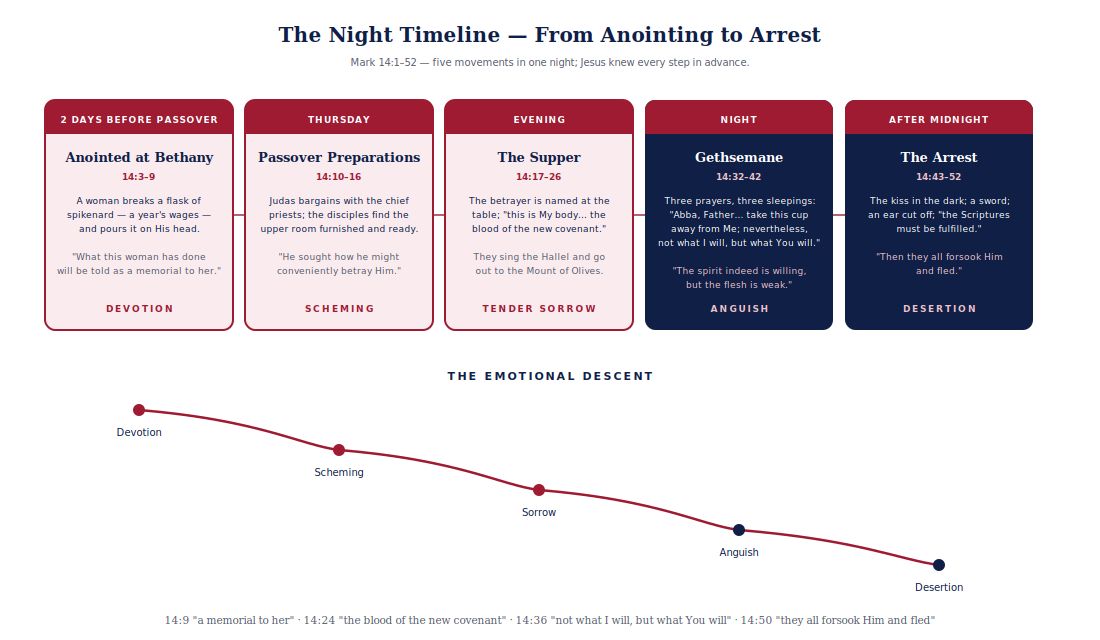
Mark has been sprinting for thirteen chapters. Now he slows to a walk — and it's the longest night in human history. In fifty-two verses we get an anointing that smells like a funeral, a betrayal sealed with a kiss, a supper that becomes a sacrament, a prayer in a garden of olive presses, and an arrest in the dark. Jesus knows everything that's coming. He goes anyway.
Read Mark 14:1–52 slowly, scene by scene — and watch a King walk toward His cross with His eyes wide open.
CHECK WHAT YOU THINK YOU KNOW
- ☐ "Judas betrayed Jesus for thirty pieces of silver." (That's Matthew's number — Mark never names a price. See Scene 3.)
- ☐ "Jesus said caring for the poor doesn't matter as much as worship." (He said no such thing — see Interpretation.)
- ☐ "At the Last Supper, Jesus was caught off guard by the betrayal." (He named the betrayer at the table — see Scene 5.)
- ☐ "The disciples stayed with Jesus through the arrest." (Read 14:50 again — see Scene 9.)
Where we are in the story
Palm Sunday is behind us (chapter 11), the temple debates are finished (chapter 12), and the Olivet Discourse — Jesus' teaching about the end — has been delivered (chapter 13). It is now Wednesday or Thursday of Passion Week. Passover is two days away, and most of this chapter unfolds over a single night — though the anointing at Bethany (Scene 2) was almost certainly placed here for effect, not chronology: John dates the same anointing "six days before the passover" (John 12:1), and Mark has moved it next to Judas's bargain for dramatic contrast (see Fact/Inference/Disputed). Mark, who rushes everywhere else, suddenly moves in slow motion: this night deserves every verse.
Check What You Think You Know
Many sincere Christians have pictured Jesus in Mark 14 as a victim of unfolding events — betrayed, arrested, swept along by forces beyond His control. But Mark shows the opposite: Jesus predicts the betrayal (14:18), names the betrayer, shares the meal knowing what the bread and cup mean, and walks into Gethsemane to choose the Father's will over His own dread (14:36). Nothing ambushed Him. The cross wasn't something that happened to Jesus; it was something He did — deliberately, for us.
Scene 1: The plot (14:1–2)
"After two days was the feast of the passover, and of unleavened bread: and the chief priests and the scribes sought how they might take him by craft, and put him to death. But they said, Not on the feast day, lest there be an uproar of the people"
Passover was the great Jewish feast remembering the exodus — when God struck Egypt's firstborn and "passed over" the houses of Israel marked with lamb's blood (Exodus 12). Families ate a lamb, unleavened bread, and bitter herbs, and told the story again. It ran together with the week-long Feast of Unleavened Bread.
The chief priests (the temple aristocracy) and the scribes (experts in the law) — together with the elders they formed the Sanhedrin, the Jewish ruling council — want Jesus dead but are afraid of the crowds. Jerusalem at Passover was a powder keg: the city's population swelled enormously with pilgrims, and Rome watched festivals for any spark of revolt. "Trickery" and timing are everything to them. They are not debating whether to kill Him — only how to do it quietly.
Scene 2: Anointed at Bethany (14:3–9)
"And being in Bethany in the house of Simon the leper, as he sat at meat, there came a woman having an alabaster box of ointment of spikenard very precious; and she brake the box, and poured it on his head."
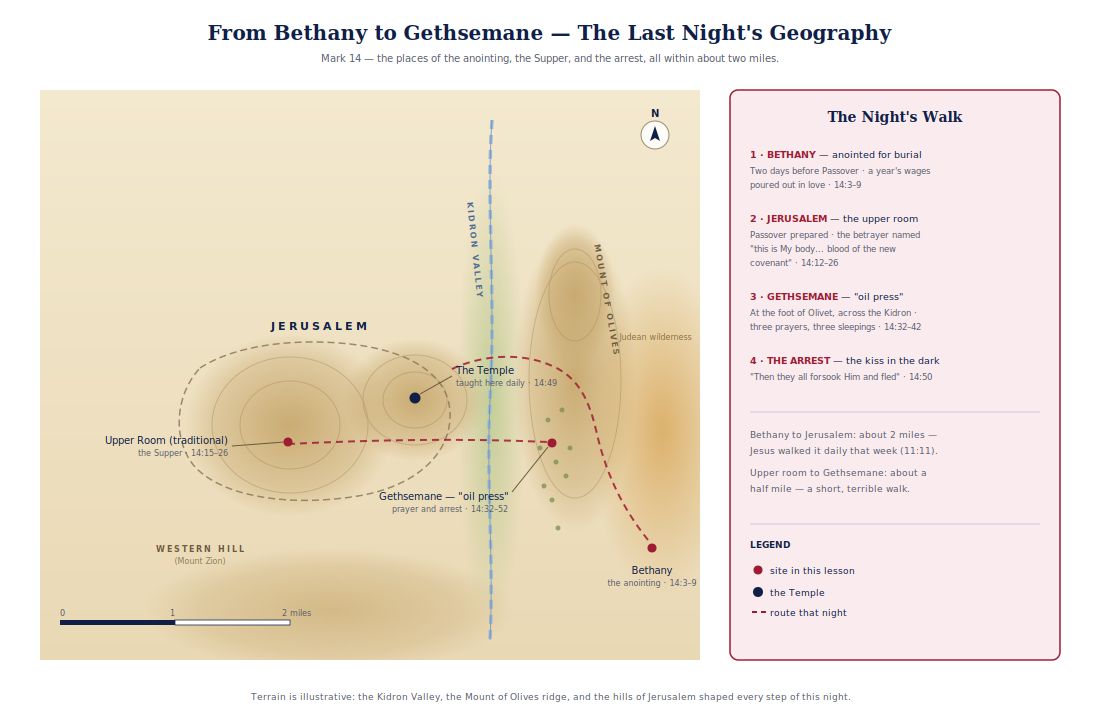
Picture it: a dinner in Bethany, a village on the far slope of the Mount of Olives where Jesus had been lodging each night. Simon the leper — we know nothing else about him; "the leper" may be his old label from a healed past (see Fact/Inference/Disputed). 61 A woman enters — Mark doesn't name her — carrying an alabaster flask (a soft, translucent stone carved into a sealed vial) of spikenard, a perfume pressed from a plant grown in the Himalayas and imported at enormous cost.
She breaks the neck of the flask — this is a one-way act; you can't re-cork it — and pours it all on Jesus' head.
"There were some that had indignation within themselves, and said, Why was this waste of the ointment made? For it might have been sold for more than three hundred pence, and have been given to the poor"
A denarius was a day's wage for a laborer. Three hundred denarii is nearly a full year's pay — imagine someone pouring a year's salary onto the floor in one gesture. "Wasted" is their word: apoleia — destruction, loss. (Chilling footnote: the same Greek word describes Judas himself in John 17:12 — "the son of perdition." They called her perfume wasted; Jesus' word for the betrayer was the same root.) 8 The math is right, and the cause is noble. But Jesus reframes the whole scene:
"Let her alone. Why do you trouble her? She has done a good work for Me. For you have the poor with you always, and whenever you wish you may do them good; but Me you do not have always. She has done what she could. She has come beforehand to anoint My body for burial. Assuredly, I say to you, wherever this gospel is preached in the whole world, what this woman has done will also be told as a memorial to her."
She understood what the Twelve kept missing: He was going to die. While they argued about waste, she was anointing a living man for burial — and Jesus says her act will be preached wherever the gospel is, forever. Two thousand years later, here we are — proving Him right.
(John 12:1–8 tells the same story and names the woman as Mary of Bethany — see Fact/Inference/Disputed.)
A NOTE ON TIMING: Mark frames this dinner within the plot "two days" before Passover (14:1), but John's account dates the same anointing "six days before the passover" (John 12:1) — before Palm Sunday. Mark almost certainly arranged it here on purpose, not by chronology: the woman's extravagance (14:3–9) sits next to Judas's treachery (14:10–11) so you can't miss the contrast.
Scene 3: Judas bargains (14:10–11)
"And Judas Iscariot, one of the twelve, went unto the chief priests, to betray him unto them. And when they heard it, they were glad, and promised to give him money. And he sought how he might conveniently betray him."
Fresh from the anointing, the contrast is brutal: one disciple pours out everything; another sells out everything. Judas Iscariot — one of the twelve, treasurer of the group — walks to the very men plotting in Scene 1 and offers them what they couldn't get themselves: an arrest away from the crowds, at night, guided by an insider.
What was his motive? Scripture doesn't say plainly. John notes that Judas stole from the money box (John 12:6) — greed is in the mix. Some suggest disillusionment: a Messiah who talks about dying wasn't the revolution Judas wanted. Luke says "Satan entered Judas" (Luke 22:3). Mark, characteristically, gives no motive at all — just the deed. Be suspicious of any preacher who tells you exactly why Judas did it; the Bible leaves the door closed.
Scene 4: Preparing the Passover (14:12–16)
"The first day of unleavened bread, when they killed the passover, his disciples said unto him, Where wilt thou that we go and prepare that thou mayest eat the passover"
Jesus sends two disciples into Jerusalem with strange, precise instructions: follow "a man bearing a pitcher of water" — in that culture, carrying water in a jar was ordinarily women's work (men normally carried liquids in animal-skin containers); 8 a man with a water jar would stand out like a flag — and ask the master of the house he enters for the guest room. There they find "a large upper room furnished and prepared."
The Passover meal was eaten after sunset: roast lamb (slaughtered that afternoon in the temple courts — Josephus says the lambs were slain "from the ninth hour till the eleventh," about 3 to 5 p.m.), 117 unleavened bread, and bitter herbs — the three elements Exodus 12:8 names — plus cups of wine shared around the table, with the exodus story retold as they ate. (Later Jewish tradition describes four cups of wine in the meal, tied to God's four "I will" promises of deliverance in Exodus 6:6–7 — but the formal four-cup ceremony is a later development; Mark only tells us they shared the cup.) For a group of Galileans in a crowded festival city, securing a room was no small thing. Jesus has arranged it all in advance — another quiet sign that nothing tonight is catching Him by surprise.
Scene 5: The betrayer named (14:17–21)
"In the evening He came with the twelve. Now as they sat and ate, Jesus said, 'Assuredly, I say to you, one of you who eats with Me will betray Me.'"
In the ancient world, sharing a table was a covenant of trust — to eat with someone and then harm them was the deepest treachery (the psalmist felt it: "mine own familiar friend, in whom I trusted, which did eat of my bread, hath lifted up his heel against me," Psalm 41:9). The disciples are horrified: "Surely not I?" — one by one.
"It is one of the twelve, that dippeth with me in the dish." He doesn't name Judas outright — not yet. Then the verse that has stopped readers cold for two thousand years:
"The Son of man indeed goeth, as it is written of him: but woe to that man by whom the Son of man is betrayed! good were it for that man if he had never been born."
Here are the two rails of the whole Bible running side by side: God's sovereign plan ("as it is written") and human responsibility ("woe to that man"). Jesus holds both without blinking, and so must we. The cross was God's plan from eternity — and Judas still chose it, and is still guilty. Don't try to resolve the tension cheaply; the Bible never does.
Scene 6: The Supper (14:22–26)
"And as they did eat, Jesus took bread, and blessed, and brake it, and gave it to them, and said, Take, eat: this is my body."
Then the cup: "This is my blood of the new testament, which is shed for many."
At the Passover table, every element pointed backward to the exodus — the lamb's blood on the doorposts, the unleavened bread, the "bread of affliction" eaten in haste (Deuteronomy 16:3). Jesus now points the bread and the cup at Himself. The old covenant was sealed with the blood of sacrifices (Exodus 24:8); Jesus announces a new covenant — the one God promised through Jeremiah, where sins would be forgiven and the law written on hearts (Jeremiah 31:31–34) — sealed with His blood, "shed for many."
Luke notes that Jesus took the cup "after supper" (Luke 22:20) — and Paul calls it "the cup of blessing" (1 Corinthians 10:16). Many scholars see here the meal's closing cup, the one drunk in blessing once the food was finished — the cup Jesus now re-points at the cross. 8 (An inference, not stated in the text — but it fits the Passover shape.)
Then a vow of longing: "Verily I say unto you, I will drink no more of the fruit of the vine, until that day that I drink it new in the kingdom of God." He will not taste wine again until the kingdom comes in fullness — the next cup He drinks will be the celebration cup, with His people, at the end of the story.
"And when they had sung an hymn, they went out into the mount of Olives." The hymn was almost certainly the Hallel — Psalms 113–118, the traditional Passover psalms (an inference, but a strong one: every Jewish family sang them that night; the Mishnah describes Psalms 113–114 sung before the meal and 115–118 after it). 8 Imagine it: Jesus singing "the stone which the builders refused is become the head stone of the corner" (Psalm 118:22) on His way out to die.
(On "this is my body": Christians have understood these words differently — as memorial, as spiritual presence, as the Catholic teaching of transubstantiation. Mark's own emphasis is on covenant and sacrifice: His body broken, His blood poured out, for many. Honor the range; don't pick a fight here.)
Scene 7: Peter's denial predicted (14:27–31)
"And Jesus saith unto them, 'All ye shall be offended because of me this night: for it is written: "I will strike the Shepherd, and the sheep will be scattered."' " — quoting Zechariah 13:7.
Then a promise inside the prediction: "But after that I am risen, I will go before you into Galilee." Even in the darkest prophecy, Jesus is already planning the reunion.
Peter — bold, loyal, certain Peter — pushes back: "Although all shall be offended, yet will not I." Jesus answers with devastating precision: "Assuredly, I say to you that today, even this night, before the rooster crows twice, you will deny Me three times." Peter doubles down — "he spake the more vehemently, If I should die with thee, I will not deny thee in any wise!" — and all the rest chime in: "Likewise also said they all."
Mark wants you to feel the overconfidence. Every one of them means it. Every one of them is wrong.
Scene 8: Gethsemane (14:32–42)
They cross the Kidron Valley to a garden on the Mount of Olives called Gethsemane — the name means "oil press" in Aramaic: an olive grove with a press where the neighborhood's olives were crushed for their oil — a fitting name for the place where Jesus will be crushed. Leaving the rest of the disciples at the entrance, He takes Peter, James, and John — the same three who saw the Transfiguration — further in, and says words no one expected from Him:
"My soul is exceeding sorrowful, even unto death: tarry ye here, and watch."
Then, alone: "Abba, Father, all things are possible unto thee; take away this cup from me: nevertheless not what I will, but what thou wilt."
"Abba" is the Aramaic word for father — the family word, intimate like "Papa" (though scholars note it wasn't a child's "Daddy": adults used it for their fathers too, and the New Testament never translates it with a diminutive) — and Mark translates it for his Gentile readers ("Abba, Father"), one of his habits. "The cup" is Old Testament shorthand for God's judgment and wrath poured out on sin (Isaiah 51:17, Jeremiah 25:15). Jesus isn't dreading pain in the abstract; He's staring at the cup of divine wrath He is about to drink for us — and asking if there's any other way. There isn't. And He knows it: "nevertheless, not what I will, but what You will." This is not weakness. Hebrews says He "offered up prayers and supplications, with vehement cries and tears" (Hebrews 5:7) — this is what perfect obedience looks like from the inside.
Three times He returns to find them sleeping. Twice He wakes them; the third time He announces, "It is enough!" To Peter: "Simon, sleepest thou? couldest thou not watch one hour? Watch ye and pray, lest ye enter into temptation. The spirit truly is ready, but the flesh is weak." The man who vowed to die with Jesus can't stay awake one hour.
The third time, the tone changes — resolve, not reproach: "It is enough, the hour is come; behold, the Son of man is betrayed into the hands of sinners. Rise up, let us go; lo, he that betrayeth me is at hand." He doesn't wait to be found. He walks out to meet it.
Scene 9: The arrest (14:43–52)
"And immediately, while he yet spake, cometh Judas, one of the twelve, and with him a great multitude with swords and staves, from the chief priests and the scribes and the elders."
The arresting party is a mob with weapons — "as against a thief," Jesus will say. Judas's signal: "Whomsoever I shall kiss, that same is he; take him, and lead him away safely." In the dark, among olive trees, they need the kiss to identify Him. He walks up: "Rabbi, Rabbi!" — and kisses Him. Mark even changes the Greek word: the signal was arranged with a plain kiss (phileō, 14:44), but Judas delivers an intensive one (kataphileō, 14:45) — a warmer, more demonstrative kiss. 7460 Affection weaponized.
A bystander draws a sword and cuts off the ear of the high priest's servant (John names him: Malchus — John's detail, not Mark's). Jesus is calm in the chaos: "Are ye come out, as against a thief, with swords and with staves to take me? I was daily with you in the temple teaching, and ye took me not: but the scriptures must be fulfilled." They arrested Him by night with weapons because they feared the people — yet He had been teaching openly in the temple every day. Cowardice, armed.
Then Mark's starkest sentence: "And they all forsook him, and fled." All of them. The vows of Scene 7 last about an hour.
And one strange, haunting footnote: "And there followed him a certain young man, having a linen cloth cast about his naked body. And the young men laid hold on him: and he left the linen cloth, and fled from them naked." A young man — roused from sleep, grabbing a fine linen cloth (sindon, an expensive garment, suggesting he came from a family of means) 122 — follows the commotion, gets grabbed, and runs off naked into the night. Ancient tradition says this young man was Mark himself, the Gospel's author, slipping his signature into the story (see Fact/Inference/Disputed). If so, it's a signature of shame: I ran too.
WORD STUDY
Spikenard — nardos (NAR-dos). A perfume pressed from the root of a plant that grows only in the Himalayas — imported across thousands of miles, which is why it cost a year's wages. When Mark says "very costly," he's understating it for effect: this was the ancient equivalent of liquid gold, the kind of thing a family saved for a dowry or a burial.
Covenant — diatheke (dee-ah-THAY-kay). The Greek word for a negotiated contract between equals was syntheke — and the New Testament never uses it for God's covenants. Diatheke is different: an arrangement ordered by the stronger party, whose terms the other side can accept or refuse but cannot renegotiate. 123124 That's why the Septuagint translators chose it to render Hebrew berith: God's covenants aren't deals struck between equals — they're declared by God and received by people. The old covenant (Exodus 24) was sealed with animal blood sprinkled on the people. The new covenant (Jeremiah 31:31–34) promised forgiven sins and God's law written on hearts. When Jesus lifts the cup and says "the new covenant," He's announcing that Jeremiah's promise is being signed — in His own blood.
Abba — abba (AH-bah). Aramaic for "father" — the family word: warm, personal, intimate. Joachim Jeremias popularized the "Daddy" reading in the 1960s, but scholars since James Barr's famous 1988 correction have pushed back: abba was the normal word adults used for their fathers too, not baby talk 125 — and all three New Testament uses (Mark 14:36; Romans 8:15; Galatians 4:6) pair it with the ordinary Greek word for father (ho pater), never a diminutive. Think "Papa" — close, but with adult dignity. Mark keeps the Aramaic and then translates it ("Abba, Father") because his Gentile readers in Rome wouldn't know it. Only Mark records Jesus praying this word — and Paul later says the Spirit puts this same cry in our mouths (Romans 8:15, Galatians 4:6). In His darkest hour, Jesus reaches for the most intimate name He knows.
Betray / hand over — paradidomi (pah-rah-DID-oh-mee). Mark's word for what Judas does is simply "to hand over, deliver up." It's the same word Paul uses when he says God "spared not his own Son, but delivered him up for us all" (Romans 8:32). Judas handed Jesus over to the priests; the priests handed Him over to Pilate; Pilate handed Him over to be crucified — and behind it all, the Father handed over His Son for us. One word, two depths: human treachery, divine generosity.
Why anoint a living man "for burial"?
Because she was the only one listening. Jesus had predicted His death three times (8:31, 9:31, 10:33–34); the disciples deflected every time. This woman — who had simply paid attention — understood that the cross was coming, and she did the only thing love could think of: she gave Him the burial honor while He could still receive it. Jesus' verdict reframes the whole scene: what looked like waste was worship. Worship is measured by love, not efficiency. The critics did the math; she did the devotion. The math was right and the devotion was righter.
"Ye have the poor with you always" — is Jesus dismissing the poor?
No — He's quoting Deuteronomy 15:11 ("the poor shall never cease out of the land"), and the quote cuts the other way: in Deuteronomy, that sentence is the reason to be generous — because the need never ends, your giving should never stop either ("you shall open your hand wide to your brother"). Jesus isn't canceling compassion; He's making a priority claim about an unrepeatable moment. There will always be opportunities to give to the poor. There will never be another chance to anoint the incarnate Son before His burial. Urgency isn't the enemy of mercy — it's the recognition that some moments only come once.
The Christ Thread
Messianic promise — the promises converging tonight. This is the night the Old Testament has been aiming at. The Passover lamb of Exodus 12 becomes the Lamb at the table. The suffering Servant of Isaiah 53 stands behind "the cup" Jesus dreads. Zechariah 13:7 — "Strike the Shepherd, and the sheep will be scattered" — is quoted by Jesus Himself and fulfilled within the hour. Psalm 41:9 — the friend who "ate my bread" lifting his heel — is fulfilled in Judas's kiss. Promise after promise, made centuries apart, all landing on one night.
Christ in His own story. And Mark shows us the Messiah living it: anointed for burial by a woman who understood what the Twelve didn't; naming His betrayer and still giving him bread; instituting the meal that explains His death before He dies; praying "Abba" through the dread and choosing the Father's will anyway. This is what the Servant of Isaiah 42 looks like from the inside — no flinching, no surprise, love all the way down.
OT/NT parallels. Exodus 12 (the first Passover) → the upper room: every element of the old meal re-pointed at Jesus. Jeremiah 31:31–34 (the promised new covenant) → the cup: "This is my blood of the new testament." John 12:1–8 gives the anointing's fuller account (Mary named, Judas objecting); John 13–17 gives the upper-room discourse Mark passes over; 1 Corinthians 11:23–26 is Paul's received account of the same Supper — the meal the whole church has eaten ever since.
The Christian future. Jesus ends the Supper looking forward: "I will drink no more of the fruit of the vine, until that day that I drink it new in the kingdom of God" (14:25). The next cup He drinks will be the celebration cup — the marriage supper of the Lamb (Revelation 19:9), with His people, at the end of the story. Every communion since has been a rehearsal dinner: "ye do shew the Lord's death till he come" (1 Corinthians 11:26). The night that began with betrayal ends, ultimately, in a feast.
WHAT THE CHURCH HAS ALWAYS BELIEVED: The creeds pass over Jesus' entire public ministry in a single breath — "suffered under Pontius Pilate, was crucified, died and was buried" — because the cross is the center of everything. Mark does the same thing in reverse: he sprints through three years of ministry, then slows to a walk for the Passion. The church has always read the Gospels the way Mark wrote them: everything before is prologue, everything after is proclamation, and this night is the hinge of history.
Where in the Covenant Story?
This night is the hinge of the covenants. At the table, Jesus takes the old covenant's memorial meal — the Passover, sealed with lamb's blood under Moses (Exodus 24:8) — and transforms it into the New Covenant's inaugural supper, sealed with His own blood. Jeremiah's promise (31:31–34) — forgiven sins, the law written on hearts — is signed tonight. The old covenant had its last Passover; the new covenant has its first Supper. We who eat the bread and drink the cup stand on the far side of that table, under the covenant His blood enacted.
It's Okay to Ask
Honest questions this passage raises — bring them, don't bury them:
- Was Judas predestined to betray Jesus — and if so, is God fair? (Jesus holds both rails without blinking: "the Son of man indeed goeth, as it is written of him: but woe to that man by whom the Son of man is betrayed" (14:21). God's sovereign plan and Judas's real guilt are both true. The Bible never resolves the tension cheaply — and neither should we.)
- "This is my body" — what did Jesus actually mean? (Christians have understood these words differently across the centuries — memorial, spiritual presence, transubstantiation. Mark's own emphasis is covenant and sacrifice: His body broken, His blood poured out, for many. Start there; honor the range.)
- Why did Jesus let Judas stay at the table? (He named the betrayer and still gave him bread. The offer of grace extended to the very end — which makes the refusal all the more terrible, and the grace all the more stunning.)
Watch Out — the enemy works closest at the holiest moments
Luke tells us "Satan entered Judas" (Luke 22:3) — the betrayal wasn't just human greed or disillusionment; there was a personal evil behind it. And notice where it happens: at the Passover table, during the holy meal, among the Twelve. The enemy doesn't only attack in the wilderness (Mark 1:13) — he works at the communion table too. The defense is the same one Jesus gave Peter: "Watch ye and pray, lest ye enter into temptation" (14:38). Holiness of setting is no protection; watchfulness is. If it could happen at that table, it can happen at ours.
FACT, INFERENCE, OR DISPUTED?
- FACT: Mark never names the woman, never names a price for Judas's bargain, and never explains Judas's motive.
- INFERENCE (strong): The woman is Mary of Bethany — John 12:1–8 describes the same anointing (same flask, same spikenard, same objection about the poor) and names her Mary, in Bethany, days before Passover. Same event, fuller identification.
- DISPUTED: Why Judas betrayed Jesus — greed (John 12:6), disillusionment with a non-revolutionary Messiah, Satanic influence (Luke 22:3). Scripture gives threads, not a verdict.
- INFERENCE (strong): Mark arranged the anointing here for effect, not by chronology — John 12:1 dates the same anointing "six days before the passover," days before Palm Sunday. Mark moved it next to Judas's bargain (14:10–11) to sharpen the contrast: extravagant devotion, then treachery.
- INFERENCE (broadly agreed): Luke 7:36–50 describes a different anointing — an earlier one, in Galilee, by "a woman in the city, which was a sinner." Different city, different woman, different meal. Don't merge the two.
- INFERENCE: "Simon the leper" is most likely an old label from a healed past — a leper could not host a dinner under the purity laws, so Simon was presumably cleansed (perhaps by Jesus Himself) and the name stuck.
- TRADITION (not provable): The naked young man of 14:51–52 was Mark himself, the Gospel's author, signing his work with a memory of his own cowardice. Church fathers and most modern commentators have favored this identification — but as Constable notes, there is no solid evidence for it. 24 The text doesn't say.
- INFERENCE (strong): The "hymn" of 14:26 was the Passover Hallel (Psalms 113–118) — every Jewish household sang these psalms at the meal.
SCHOLAR'S NOTE: Two background details make the chapter hit harder. First, the spikenard trade: nard came from the Himalayan foothills of India, traveling thousands of miles by caravan to reach Judea — which is exactly why a single flask could cost 300 denarii. 8 This wasn't expensive perfume; it was an imported fortune in a stone jar. Second, Passover Jerusalem: the city's normal population swelled enormously with pilgrims — Josephus (Jewish War 6.9.3) counted 256,500 lambs slain between the ninth and eleventh hour at one Passover, with at least ten people to a lamb — his own math gives some 2.7 million participants (almost certainly exaggerated, but it shows the scale the ancients imagined). 117 That's why the Sanhedrin feared "an uproar of the people" (14:2): arresting a popular teacher during the festival risked a riot, and a riot risked Rome. Every move in this chapter is shadowed by soldiers.
Cross-references (explained, not just listed)
- Exodus 12 — the first Passover: lamb's blood, unleavened bread, deliverance from Egypt. The meal Jesus transforms in the upper room.
- Jeremiah 31:31–34 — God's promise of a new covenant: forgiven iniquity, the law written on hearts. Jesus announces its arrival over the cup.
- Psalm 41:9 — "own familiar friend...my bread, hath lifted up his heel against me" The psalm of table-betrayal, fulfilled at the Supper.
- Zechariah 13:7 — "I will smite the shepherd, and the sheep shall be scattered." Jesus quotes it to predict the disciples' flight — and it happens within the hour.
- Isaiah 51:17, Jeremiah 25:15 — "the cup" of God's wrath/judgment. This is the cup Jesus begs to have taken away in Gethsemane.
- Hebrews 5:7 — Jesus in Gethsemane "offered up prayers and supplications with strong crying and tears" — the agony behind "not what I will, but what thou wilt."
- Amos 2:16 — "he that is courageous among the mighty shall flee away naked in that day" — a prophetic echo of the young man's naked flight in 14:52. (An inference — but an arresting one.)
- John 12:1–8 — John's fuller account of the anointing: the woman is Mary, the objector is Judas, and the price is named.
Go Deeper
Hungry for more? Two doors worth opening:
- Read Exodus 12 in full — the first Passover: the lamb, the blood, the unleavened bread, the haste. Then read Mark 14:22–25 again and watch Jesus re-point every element at Himself.
- Read John 13–17 — the upper-room discourse Mark passes over in a verse (14:26, "when they had sung an hymn"). Four chapters of Jesus' final teaching: foot-washing, the promise of the Spirit, the vine and the branches, the high-priestly prayer.
Theological truth (arising from the text)
Jesus goes to the cross willingly and knowingly — not trapped, not surprised, not outmaneuvered. He arranges the room, names the betrayer, institutes the meal that explains His death, predicts the denials, prays through the dread, and walks out to meet the mob. Mark's Christ is no victim of circumstance; He is the Shepherd who lays down His life (John 10:18) — and the measure of worship is not efficiency but love poured out without calculating the cost. And behind the Son's "nevertheless" stands the Father whose will He embraces — the Trinity's eternal plan of redemption (Ephesians 1:4–6) being worked out in a garden at midnight: the Father giving the cup, the Son drinking it, for us.
Humble — and confident
Humble, because Peter's story is our story. "Even if all are made to stumble, yet I will not" — every one of us has a version of that sentence, an area where we're sure we'd stand and sure we'd never fall. The disciples' confidence wasn't fake; it was just untested. Before you judge Peter, ask where your own untested confidence lives.
Confident, because Jesus knew everything — the bargain, the kiss, the denials, the flight — and went anyway. He named the betrayer and still gave him bread. He predicted the denials and still promised, "after that I am risen, I will go before you into Galilee." Nothing that night surprised Him, and nothing about you surprises Him either. The One who walked into Gethsemane on purpose walks with you on purpose.
Confess It
Peter's overconfidence is the mirror: "Even if all are made to stumble, yet I will not." Name your own untested confidence concretely — the "I'd never" you haven't actually faced — and confess it to God now (1 John 1:9). Ask Him to build your standing on Him, not on your vows.
For discussion
- The woman's "waste" looked foolish to everyone counting the cost. When has following Jesus ever looked wasteful — to others, or to you? What did love see that math couldn't?
- Jesus held God's sovereignty ("as it is written") and Judas's guilt ("woe to that man") together without resolving the tension. Where in your own life do you need to hold two true things that don't neatly fit?
- Peter was sure about himself; Jesus was honest about Peter. Is there an "even if all... yet I will not" area in your life — a confidence that has never actually been tested?
What He has done (the indicative)
Before one "you should," hear what He did: the Son walked into the longest night knowing every step — the bargain, the kiss, the denials, the flight — and went anyway. He let Himself be anointed for burial, named His betrayer and still gave him bread, signed the new covenant in His own blood, prayed "not what I will" and meant it, and walked out to meet the mob. Nothing that night was done to Him that He had not first chosen. Every step below is a response to that willing Savior — not a way to repay Him.
This week's practices
- One act of "wasteful" worship. Do something costly for Jesus that makes no practical sense — a generous gift given secretly, an hour of prayer you "don't have time for," extravagant thanks spoken out loud. Break the flask; don't calculate the denarii.
- Examine one Peter-area. Name one place where you're confident you'd stand firm ("I'd never..."). Tell it to God honestly, and ask Him to show you whether that confidence is built on Him or on you. Then make one practical safeguard — accountability, a boundary, a habit.
- Pray It Back. Take Mark 14:36 into prayer over one specific dread: "Abba, Father, all things are possible unto thee. Take away this cup from me — [name it]. Nevertheless, not what I will, but what thou wilt." Write the surrender down.
- Memorize Mark 14:36 or 14:38. "Abba, Father, all things are possible unto thee... nevertheless not what I will, but what thou wilt." Or: "Watch ye and pray, lest ye enter into temptation. The spirit truly is ready, but the flesh is weak." Pick the one you need more.
For Us Together
Ask your small group or family this week: "Who among us is in a Gethsemane right now — dreading something, needing prayer to stay awake? How do we watch with them the way Jesus asked the three to watch with Him?"
Who Needs This?
Who in your life needs to hear that Jesus chose the cross — that no one took His life, He laid it down? One name. One conversation, one text, or one prayer for them this week.
Take It Home
At the table or at bedtime, tell your kids the anointing story in your own words: "A woman poured a whole year's pay worth of perfume on Jesus' head — and some people said it was a waste. But Jesus said she did a beautiful thing, and that people would tell her story everywhere. What beautiful, 'wasteful' thing could we do for Jesus this week?"
Praise Him
Don't end with a to-do list — end with worship. Right now, out loud or in writing, finish this sentence: "Lord Jesus, I praise You because in this passage I saw that You _____." (Walked into the night knowing everything? Gave bread to Your betrayer? Prayed "not what I will" and meant it?) Sit in it for a minute. Theology that doesn't become doxology hasn't finished its work.
The bottom line
The longest night begins with worship poured out like perfume and ends with everyone running — and through it all, Jesus is never the victim of the story. He is anointed for burial, betrayed at the table, denied by His friends, crushed in the garden, and arrested in the dark — knowing it all, choosing it all, because the new covenant had to be signed in blood. Wasteful worship. Honest weakness. A willing Savior. That's the night — and that's the gospel.