
Before You Read: Open My Eyes
Before you read a single verse, pray this — out loud if you can:
"Father, the tomb is empty and the angel is speaking — 'He is risen!' Open my eyes to see the risen Jesus the way the women saw the empty place: with trembling wonder that turns into telling. Don't let fear have the last word today. In Jesus' name, amen."
(Psalm 119:18 — "Open thou mine eyes, that I may behold wondrous things out of thy law.")
Welcome
Every story Mark has told — the healings, the storms stilled, the bread multiplied, the blind man seeing — was building toward a grave. And now the grave is empty. This is the final lesson of our journey through Mark: frightened women, an angel's announcement, the most tender two words in the Gospel ("and Peter"), and then — silence. Mark's ending is the most argued-about ending in all of Scripture, and we're going to face it honestly. Humble confidence: the tomb is empty in every manuscript, and fear was the honest first response of the very first witnesses.
Read Mark 16:1–20 slowly, then walk through it with us — scene by scene.
CHECK WHAT YOU THINK YOU KNOW
- ☐ "Mark's Gospel ends with Jesus appearing to His disciples." (Not in the earliest copies — see "The abrupt ending.")
- ☐ "Mary Magdalene was the sinful woman who anointed Jesus' feet." (Tradition says so; Scripture never does — see Scene 1.)
- ☐ "The longer ending (16:9–20) means the resurrection is doubtful." (The tomb is empty in every copy — see Fact / Inference / Disputed.)
- ☐ "Christians worship on Sunday because it's the Sabbath." (The Sabbath is Saturday — Sunday is the day He rose. See Scene 1.)
Where we are in the story
Friday evening: Jesus died, and Joseph of Arimathea buried Him in a hurry before sundown (15:42–46). Then the Sabbath came — Saturday, the Jewish day of rest, running from Friday sundown to Saturday sundown — and by God's own law, no work could be done, not even finishing a burial. So the body of Jesus rested in the tomb on the Sabbath — and rose on the morning after. Sixteen chapters of Mark, and everything comes down to a sunrise.
Check What You Think You Know
Many sincere Christians have heard that because Mark's Gospel has a disputed ending (16:9–20), the resurrection itself is somehow in doubt. But the resurrection is proclaimed in verse 6 — inside the undisputed text: "He is risen; he is not here." No manuscript question touches the angel's announcement, the empty tomb, or the promise of Galilee. The debate is about twelve later verses, not about Easter morning. The foundation isn't the footnote; it's the empty place where the body had been.
Scene 1: The women come (16:1–4)
"When the sabbath was past, Mary Magdalene, and Mary the mother of James, and Salome, had bought sweet spices, that they might come and anoint him. And very early in the morning the first day of the week, they came unto the sepulchre at the rising of the sun" (16:1–2).
Three women — and Mark has been preparing us for them. They watched the crucifixion from a distance (15:40) and watched where He was laid (15:47). While the eleven disciples scattered, these women stayed. Now, the moment the Sabbath ends — Saturday evening, when shops could open again — they buy burial spices, and at dawn on Sunday they walk to the tomb to finish anointing the body. Jewish burial custom: the dead were washed, wrapped, and anointed with spices. Joseph's burial was rushed; these women came to do it properly, as an act of love. 24
Two things to know:
- Who are they? Mary Magdalene — a woman from whom Jesus had cast seven demons (Luke 8:2); she became one of His most devoted followers. She is not the "sinful woman" who anointed Jesus' feet in Luke 7 — that identification is later tradition, not Scripture. The merger traces to a famous sermon by Pope Gregory the Great in 591, which fused Mary Magdalene, Mary of Bethany, and Luke 7's unnamed "sinful woman" into one person. 141 The Bible never says it — and the Eastern church never accepted the merger. Mary the mother of James (James the Less) and Salome — faithful followers, named with honor in a world that rarely named women at all.
- Why Sunday? "The first day of the week" is Sunday — and this is why Christians have gathered on Sunday ever since. Not because the Sabbath moved (the Sabbath is Saturday), but because the resurrection made Sunday "the Lord's Day" (Revelation 1:10) — the day death was defeated.
All the way there they worried about the one practical problem: "Who shall roll us away the stone from the door of the sepulchre?" (16:3). A great stone sealed the entrance — and then: "And when they looked, they saw that the stone was rolled away — for it was very great" (16:4). The obstacle they'd dreaded was already gone.
Scene 2: The young man in white (16:5–7)
They step inside — and "they saw a young man sitting on the right side, clothed in a long white garment; and they were affrighted" (16:5).
Mark calls him a "young man." Matthew, telling the same story, names what Mark describes: "the angel of the Lord" (Matthew 28:2) — a messenger from God, radiant in white, seated where the body should have been. Mark lets the strangeness breathe; Matthew gives the explanation. Both are telling the truth.
The angel's message is the hinge of human history, in two movements:
- The news: "Be not affrighted: Ye seek Jesus of Nazareth, which was crucified: he is risen; he is not here: behold the place where they laid him" (16:6). "He is risen" — the tomb is empty, and the empty place is offered as evidence. Look for yourself.
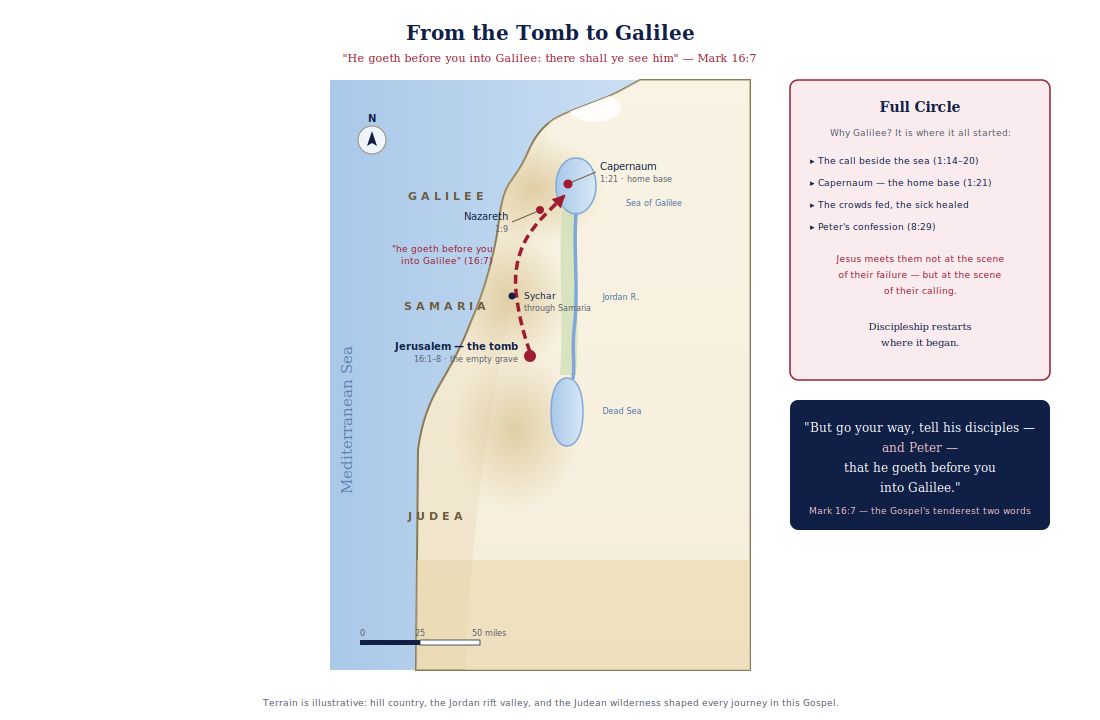
- The commission: "But go your way, tell his disciples and Peter that he goeth before you into Galilee: there shall ye see him, as he said unto you" (16:7).
Linger on those two words: "and Peter." Peter denied Him three times, fled into the night, and wept bitterly (14:72). Is he still a disciple? Does the resurrection message include him? The angel answers before Peter can ask: his name is on the guest list. Restoration is already beginning. If you've ever failed badly and wondered whether there's still a place for you — the Gospel's tenderest two words are for you.
And Galilee — why there? Because that's where it all started: the call beside the sea (1:14–20), the home base at Capernaum, the crowds fed, the confession at Caesarea Philippi. Jesus meets them back at the beginning. The Gospel comes full circle — discipleship gets a restart.
Scene 3: The abrupt ending (16:8)
"And they went out quickly, and fled from the sepulchre; for they trembled and were amazed: neither said they any thing to any man; for they were afraid" (16:8).
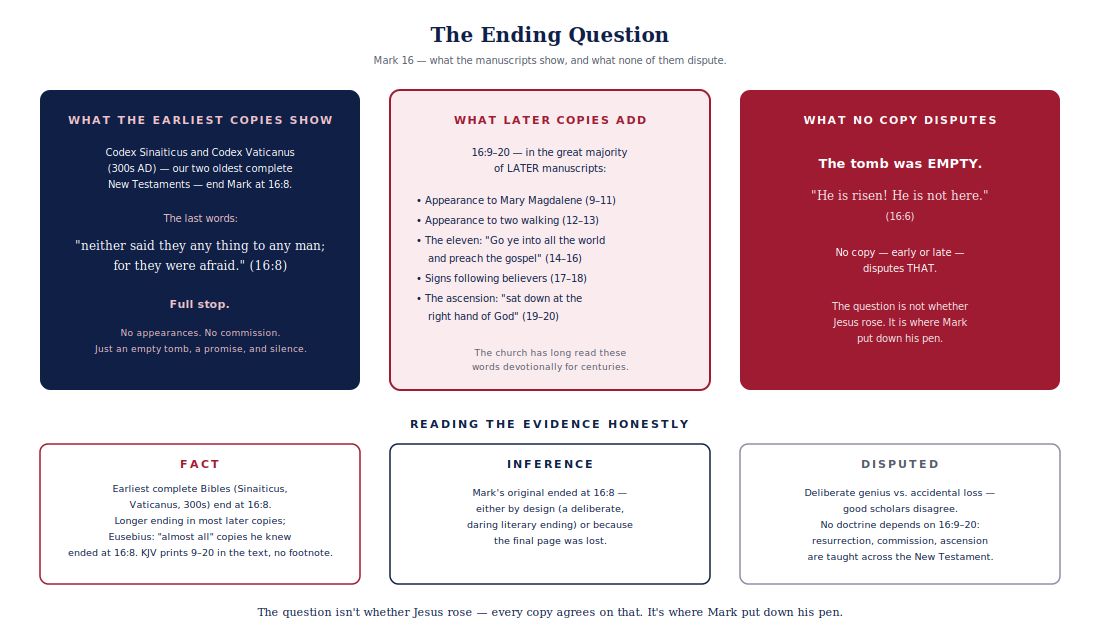
Full stop. That's how Mark's Gospel ends — in the two oldest nearly complete Bibles we have, Codex Sinaiticus and Codex Vaticanus (both 4th century): no appearances of the risen Jesus, no Great Commission, no ascension. 142 Just an empty tomb, a promise ("there shall ye see him"), and frightened silence.
And look at where the sentence stops: in Greek, Mark's final words are ephobounto gar — "for they were afraid." A book ending on the word for — mid-explanation, mid-breath — is jarring. That dangling gar is part of why scholars keep asking whether Mark meant to stop here, or whether his last page was lost. 142
Sit with that a moment. The first readers heard: He is risen — go tell — and the women said nothing, because they were afraid. It's jarring. It's also deeply human — fear is the honest first response to the impossible. (We'll take the manuscript question head-on in Interpretation.)
Scene 4: The longer ending (16:9–20) — what later copies add
Here's what follows in most of our Bibles — and here's how to think about it, carefully and without fear:
What it says. The longer ending summarizes resurrection appearances and the mission: Jesus appears to Mary Magdalene first (16:9–11); then to two disciples walking (16:12–13, told more fully in Luke 24); then to the eleven, rebuking their unbelief, and giving the Great Commission — "Go ye into all the world, and preach the gospel to every creature" (16:14–16). He promises signs will follow believers — casting out demons, new tongues, protection, healing (16:17–18). Then the ascension: "He was received up into heaven, and sat on the right hand of God" (16:19) — and the disciples went out and preached everywhere (16:20).
The manuscript situation — stated exactly, because this is prime FIRM material:
- FACT: Our two earliest nearly complete Greek Bibles — Sinaiticus and Vaticanus, 4th century — end Mark at 16:8. (Vaticanus leaves a conspicuous blank space right after 16:8 — scholars disagree about what the gap means, but its copyist seems to have known something was in question there.) 142
- FACT: The longer ending (16:9–20) is in the great majority of later manuscripts — and it's old, older than Sinaiticus and Vaticanus. Around AD 184, Irenaeus quoted Mark 16:19 as Mark's own words ("towards the conclusion of his Gospel, Mark says..."), and Tatian's harmony of the Gospels (~AD 170) includes these verses. 4 Whoever wrote them, it was the 2nd century — not the Middle Ages.
- FACT: A few manuscripts carry an additional, shorter ending — a brief paragraph ("And all that had been commanded to them they quickly reported to those around Peter..."). In most of these copies it sits between 16:8 and 16:9, before the longer ending; one ancient copy (Codex Bobiensis) has it standing alone. 142 Almost no one thinks it's original, but it shows the early church felt the abruptness too.
- FACT: The 4th-century church historian Eusebius knew the question — and he gave two answers, not one. Asked about an apparent clash between Matthew 28:1 and Mark 16:9, he first said one could set the passage aside, since "almost all" the copies he knew ended at 16:8 — but then he said another option was to keep the passage and harmonize it, reading "rising early" as a pause in the sentence. 143 And in the same work, Eusebius himself quotes Mark 16:9 as Mark's ("according to Mark"). His testimony is honest evidence, not a verdict.
- INFERENCE: The internal evidence points the same way as Sinaiticus and Vaticanus. The textual scholar Bruce Metzger counted seventeen words or word-usages in 16:9–20 that appear nowhere else in Mark; verse 9 changes subject awkwardly (verse 8 is about the women, but verse 9 opens with Jesus as the unstated subject); Mary Magdalene is reintroduced in verse 9 as if she hadn't just appeared in verse 1; and "Lord Jesus" appears only in this ending, never in the rest of Mark. 142
- INFERENCE: Mark's original text ended at 16:8 — either by Mark's design, or because the original last page was lost.
- DISPUTED: whether Mark intended the abrupt ending (many scholars now argue the fear-and-silence close is deliberate genius — the story breaks off and hands the pen to the reader: what will you do with the empty tomb?) versus an accidental loss.
- FACT: No Christian doctrine depends on 16:9–20. The resurrection is taught across the New Testament (1 Corinthians 15:3–8; Matthew 28; Luke 24; John 20–21); so are the commission and the ascension (Acts 1).
- And a note on your Bible: the KJV prints 16:9–20 in the main text with no footnote — the verses simply stand in the text. (Many modern editions add a note: the passage is lacking in Codex Sinaiticus and Codex Vaticanus, although nearly all other manuscripts of Mark contain it.) 1
WORD STUDY
Alarmed — ekthambeo (ek-tham-BEH-o). The women were "alarmed" (16:5) — but the Greek is stronger than nervousness: utterly amazed, awestruck, overwhelmed by something too big to process. Mark loves this word family — it's the shock of standing too close to glory. Fear and wonder, braided together.
Trembling and amazement — tromos kai ekstasis (TROH-mos kai EK-stah-sis). The exact phrase of 16:8: "they trembled and were amazed." Ekstasis is where we get "ecstasy" — literally standing outside yourself, displaced by wonder. This is Mark's final emotional chord: not tidy faith, but trembling astonishment. The Gospel ends in ekstasis.
Gospel — euangelion (yoo-an-GEH-lee-on), one last time. Mark began: "The beginning of the gospel of Jesus Christ" (1:1). The longer ending closes: "preach the gospel to every creature" (16:15). Bookends. Whatever questions surround 16:9–20, this much is certain: the Gospel that began as an announcement in the wilderness ends as a commission to the world — because the tomb is empty.
Why women first?
In the first century, a woman's testimony was discounted in court — it wasn't admissible evidence. 144 Now consider: if you were inventing a resurrection story and wanted people to believe it, the last thing you'd do is make women your first witnesses. You'd lead with Peter, or the eleven.
But God entrusted history's greatest news to the women who stayed — and the church preserved it that way, embarrassment and all. Skeptics call this the "criterion of embarrassment": nobody making up a story includes details that hurt their case. Mark's women-first account is a quiet mark of authenticity. Handle this without anachronism: the point isn't a modern debate — it's that God chose the faithful, not the powerful, to carry the news first. And note: the angel's first word to the church age is a commission to women — "go, tell."
"And Peter" — the Gospel's tenderest two words
Peter's story in Mark is a slow-motion fall: bold confession (8:29), proud boasting ("Even if all are made to stumble, yet I will not," 14:29), sleeping in Gethsemane, the sword, the flight, the courtyard denials, the rooster, the weeping (14:66–72). If Mark is Peter's own testimony — as the early church believed — then Peter told Mark to include all of it. 61 And then, at the resurrection, Peter made sure his own restoration was in the story too: tell the disciples — and Peter.
Don't rush past this. The denier is named by name. Before Peter repents, before he proves anything, the risen Jesus is already going ahead of him to Galilee. Grace gets there first. If you've failed and wondered whether the story still has a place for you — it does, and your name is on it.
Galilee: why there?
The angel could have said "He'll meet you in Jerusalem." Instead: Galilee — the backwater, the beginning. Why?
- It's where they were called (1:14–20) — beside that sea, nets in hand.
- It's where the crowds were fed and the sick healed.
- It's where Peter confessed (8:29) — the hinge of the whole Gospel.
Jesus doesn't meet them at the scene of their failure (Jerusalem, the courtyard, the cross). He meets them at the scene of their calling. Discipleship gets a restart — not at the place of shame, but at the place of grace. Whatever your Jerusalem is, Jesus is already going before you to your Galilee.
The fear-and-silence ending — sit with it
If Mark ended at 16:8 on purpose, the abruptness is the point. Think about it: every other Gospel ties things up with appearances and farewells. Mark breaks off mid-breath — trembling, amazement, silence — and hands the pen to you. The story stops; the decision doesn't. What will you do with the empty tomb?
And if the original ending was lost — a final page gone missing in the ancient world? Then nothing essential is missing. The tomb is still empty. The promise still stands: "there shall ye see him." Either way — humble confidence.
The Christ Thread
Messianic promise — the resurrection was promised too. This isn't a surprise twist; it's a kept promise. Psalm 16:10 — "Thou wilt not leave my soul in hell, neither wilt thou suffer thine Holy One to see corruption" — Peter quotes it at Pentecost as a direct prophecy of the resurrection (Acts 2:27). And Jesus predicted it Himself, three times in Mark alone: "be killed, and after three days rise again" (8:31; 9:31; cf. 10:34, "the third day he shall rise again") — plus the personal promise, "But after that I am risen, I will go before you into Galilee" (14:28). The angel at the tomb is simply quoting Jesus back to the disciples. Promise made; promise kept.
OT/NT parallels — where the New Testament picks it up. The resurrection is the most-attested event in the New Testament: Paul's list in 1 Corinthians 15:3–8 (written within 25 years — "seen of Cephas, then of the twelve... seen of above five hundred brethren at once"); Matthew 28, Luke 24, John 20–21, each telling it from a different angle; Acts 1, the ascension. Mark gives you the empty tomb; the rest of the New Testament fills the forty days. Read them as one story.
The Christian future — what this foreshadows for us. The resurrection isn't just Jesus' vindication; it's our preview. He is "the firstfruits of them that slept" (1 Corinthians 15:20) — firstfruits means harvest coming. "Because I live, ye shall live also" (John 14:19). Your resurrection is patterned on His; your eternity runs on the same power that rolled the stone away (Romans 8:11). And "and Peter" is the shape of every Christian future: failure named, restoration given, mission restarted in Galilee.
Where in the Covenant Story?
The resurrection is the New Covenant's seal and its first day. Jeremiah 31:31–34 promised a covenant of forgiven sins and heart-written law; the cross paid for it, and the empty tomb inaugurates it. The old covenant ended Friday afternoon ("It is finished"); the new age dawned Sunday morning. Notice the already-and-not-yet we live in: Christ is already risen and reigning, the Spirit already poured out (Acts 2:33) — but our own resurrection is still ahead. We are Easter people living between the empty tomb and the final trumpet.
Father, Son, and Spirit
The resurrection is a Trinitarian act — all three persons in the empty tomb. The Father raised Him: "Christ was raised up from the dead by the glory of the Father" (Romans 6:4); "God the Father...raised him from the dead" (Galatians 1:1). The Son took up His own life: "I have power to lay it down, and I have power to take it again" (John 10:18) — no one took it from Him. And the Spirit is the agent of resurrection life: "the Spirit of him that raised up Jesus from the dead... shall also quicken your mortal bodies" (Romans 8:11) — the same Spirit who raised Christ now lives in you. One resurrection, three persons, your guarantee.
WHAT THE CHURCH HAS ALWAYS BELIEVED: The Apostles' Creed — confessed by Christians for nearly two thousand years — stakes everything on this morning: Jesus Christ "rose again from the dead on the third day." The resurrection isn't the church's hopeful rumor. It's the creed's load-bearing wall.
It's Okay to Ask
Bring your honest questions to the empty tomb — there's room for them here:
- Why didn't Jesus just appear to everyone? Wouldn't that have settled it? (God has always worked through witnesses, not spectacle — "witnesses chosen before of God" (Acts 10:41). He still does: the angel's commission made the women the first preachers, and their testimony is how the news reached you, two thousand years later.)
- What if my faith feels more like the women's fear than the angel's confidence? (Then you're in the story, not outside it. Fear was the first response of the first witnesses. Faith isn't the absence of trembling — it's what you do with the empty tomb while trembling.)
- Does the manuscript question mean I can't trust my Bible? (The tomb is empty in every copy ever found — no manuscript, early or late, disputes that. The question is where Mark put down his pen, not whether Jesus rose. And honest questions asked in good faith have never been the enemy of real faith.)
FACT, INFERENCE, OR DISPUTED? — the ending question
- FACT: Codex Sinaiticus and Codex Vaticanus (4th century — our two earliest nearly complete New Testaments) end Mark at 16:8. The longer ending appears in the great majority of later manuscripts; some copies have a shorter alternative ending. 142145
- FACT: The longer ending is 2nd-century old: Irenaeus, writing around AD 184, quoted Mark 16:19 as Mark's own words — before our earliest manuscripts existed. 4146
- FACT: Eusebius (4th century) answered the question two ways in the same work: one could set the passage aside (noting "almost all" copies he knew ended at 16:8), or keep and harmonize it — and he himself quotes Mark 16:9 as Mark's ("according to Mark"). 143
- FACT: The KJV prints 16:9–20 in the main text with no footnote. The passage is lacking in Codex Sinaiticus and Codex Vaticanus, although nearly all other manuscripts of Mark contain it. 1
- FACT: No doctrine — resurrection, commission, ascension — rests on 16:9–20 alone; each is taught across the New Testament.
- INFERENCE: Mark's original text ended at 16:8 — the two earliest manuscripts and the internal evidence (seventeen non-Markan words per Metzger; the verse-9 subject shift; the book ending mid-sentence on the word "for," gar) agree. 142
- DISPUTED: Deliberate literary ending (the reader must respond) vs. accidentally lost final page. Good scholars disagree; the church can live with the question.
- DISPUTED: When and by whom the longer ending was added (most place it in the 2nd century, drawing on the other Gospels and Acts).
SCHOLAR'S NOTE: How do scholars weigh manuscripts? Not just by counting — by weighing. Codex Sinaiticus (43 leaves found at St. Catherine's Monastery in Sinai in 1844, the bulk recovered in 1859 — the oldest complete New Testament in existence) and Codex Vaticanus are earliest, and earlier copies sit closer to the originals, with fewer generations of copying in between. The later manuscripts are far more numerous — but number alone doesn't win; a thousand copies of a later text still postdate one early one. Textual criticism (the careful comparing of manuscripts) is how the church has preserved Scripture so precisely. That's why many modern Bibles carry footnotes at passages like this: scholars showing their work, not hiding something. (Your KJV prints this passage without one — see above.) The ending question is the most famous place you'll see it — and seeing it should build confidence, not fear: this is what honesty about the text looks like. One detail scholars weigh in the balance: Codex Vaticanus leaves a conspicuous blank space right after 16:8 — as if its copyist knew an ending was in question there. 142146 The space doesn't settle the debate (scholars disagree on what it means), but it shows the question itself is ancient, not modern.
Cross-references (explained, not just listed)
- 1 Corinthians 15:3–8 — Paul's resurrection list, written within 25 years of the event: "He rose again the third day... he was seen of Cephas, then of the twelve... seen of above five hundred brethren at once." The earliest creed in Christianity — and it never needed Mark 16:9–20.
- Mark 14:28 — Jesus' own promise: "But after that I am risen, I will go before you into Galilee." The angel at 16:7 is quoting Jesus back to the disciples. Promise made; promise kept.
- Matthew 28:1–10 — Matthew's fuller telling: the angel, the earthquake, the women meeting the risen Jesus Himself, worshiping at His feet.
- Luke 24 — the road to Emmaus and Jesus appearing to the gathered disciples: "Behold my hands and my feet, that it is I myself."
- John 20–21 — Mary Magdalene at the tomb ("Rabboni!"), Thomas's doubt answered, the lakeside breakfast — and Peter's restoration, face to face.
- Acts 1:9–11 — the ascension: "He was taken up; and a cloud received him out of their sight."
Go Deeper
Hungry for more? Two doors worth opening:
- 1 Corinthians 15, the whole chapter — Paul's full resurrection argument, written within 25 years of the event. The earliest and most detailed account we have.
- John 20–21 — Mary Magdalene at the tomb ("Rabboni!"), Thomas's doubt answered, the lakeside breakfast and Peter's restoration, face to face.
Theological truth (arising from the text)
The resurrection is God's vindication of the crucified Jesus — the Father's final verdict on the Son: "Thou art my beloved Son" (1:11), now proven true beyond death. The cross looked like defeat; the empty tomb declares it victory. And notice the order of grace: the angel's message comes before anyone believes, before Peter repents, before the disciples do a single brave thing. God speaks resurrection over failures. Fear is the honest first response — but the promise ("there shall ye see him") turns fear into mission.
Humble — and confident
Humble, because the first witnesses were afraid. The women trembled; the disciples doubted; Thomas needed to touch. Faith isn't the absence of fear — it's what you do with the empty tomb while trembling. If manuscript questions unsettle you, you're in good company: the church has wrestled with Mark's ending for 1,600 years, and the wrestling itself is an act of taking Scripture seriously.
Confident, because the tomb is empty in every manuscript tradition — no copy, early or late, disputes that. "He is risen" (16:6) stands on the earliest evidence we have, and the resurrection is confessed in creeds older than any of our Bibles' disputed passages. Humble about the questions; confident about the core.
Confess It
The angel named Peter before Peter repented — grace got there first. But restoration still means coming back. Name one place you've been "neither said they any thing to any man; for they were afraid" (16:8) — one truth you've kept quiet, one failure you've hidden, one "and Peter" you've been waiting to claim — and bring it into the open with God now (1 John 1:9). The tomb is empty; the hiding can end.
For discussion
- The first witnesses said nothing "for they were afraid" (16:8) — yet the news got out anyway. When has fear kept you quiet about something true, and what moved you to speak?
- "And Peter" — the denier, named by name in the resurrection message. Who in your life needs a specifically-named restoration — someone who assumes they're disqualified? What would it look like to say their name with grace this week?
- If Mark ended at 16:8 on purpose, the Gospel hands the pen to the reader: what will you do with the empty tomb? How would you answer — not with a slogan, but honestly?
What He has done (the indicative)
Before one "you should," hear what He did: God raised Jesus — vindicating the crucified Son, defeating death itself, keeping every promise He ever made. The angel spoke grace before anyone believed; "and Peter" was named before Peter repented. The stone was rolled away before the women arrived. Everything below is response to resurrection, not a way to earn it.
This week's practices
- Read the creed aloud. 1 Corinthians 15:3–8 is the church's oldest confession of the resurrection — read it out loud, slowly, as your own creed this week. Let the list of witnesses ("seen of Cephas, then of the twelve... seen of above five hundred brethren at once") steady you: this was never a private vision.
- Write your own "and Peter." Who is disqualified in your mind — yourself, or someone you know? Write their name (or yours) into the angel's message: "Go, tell the disciples — and ____ — He is going before you." Then take one concrete step of restoration: a call, an apology, a prayer prayed out loud.
- Pray It Back. Take Mark 16:6 into prayer each morning: "He is risen; he is not here." Tell the Father what that changes about your fear today — name the fear, then set the empty tomb down next to it.
- One act of witness. The angel's commission is the whole Christian life in two words: "go, tell." Tell one person one true thing about Jesus this week — not a presentation, just the news, the way the women would have told it breathlessly.
- Memorize Mark 16:6. The center of the Gospel's climax: "Be not affrighted: Ye seek Jesus of Nazareth, which was crucified: he is risen; he is not here."
For Us Together
Ask your small group, your family, or one friend this week: "What would change if we actually lived like death was defeated? Where are we still living like the tomb is sealed?" Easter isn't a day on the calendar — it's the operating system of the church.
Who Needs This?
Who in your life needs an "and Peter" — a specifically-named restoration, someone who assumes they're disqualified? One name. Go tell them they're still on the guest list.
Take It Home
At the table or at bedtime, ask your kids: "The women were afraid at the empty tomb — and that was okay, because the angel spoke to them anyway. When are you afraid? What would you want an angel to tell you?" Then tell them what the angel said: "Do not be alarmed. He is risen!" — and that God says it to them too.
Praise Him
This one should feel like Easter, not homework. Out loud — standing up if you can — finish this sentence: "Father, I praise You because He is risen — _____." (Death defeated? Peter restored? My Galilee restart? Fear turned to mission?) Say it like you mean it. Sing it if you want. The tomb is empty, and theology that doesn't become doxology hasn't finished its work.
The bottom line
We began this series answering Peter's question — "Whom say ye that I am?" (8:29) — and we've walked the long road from that confession to this empty tomb. The hinge held: the Christ had to suffer, die, and rise. Mark's story ends where discipleship begins — in Galilee, at the place of calling, with a risen Jesus going before us and a two-word commission: go, tell. The pen is in your hand now. What will you do with the empty tomb?