
Before You Read: Open My Eyes
Before you read a single verse, pray this — out loud if you can:
"Father, I'm about to stand before the cross — the darkest day in history and the brightest hope I have. Open my eyes to see what it cost, and open my heart to receive what it won. Don't let me skim this. In Jesus' name, amen."
(Psalm 119:18 — "Open thou mine eyes, that I may behold wondrous things out of thy law.")
Welcome
This is the longest night and the darkest day in Mark's Gospel — and the reason Mark wrote the book at all. In nearly seventy verses we watch a rigged night trial, a best friend's collapse, a governor trading justice for the crowd's approval, and an innocent Man nailed to a Roman cross. By sunset He is in a borrowed tomb. Read it slowly — this is not a story to skim; it's a story to stand before.
CHECK WHAT YOU THINK YOU KNOW
- ☐ "Jesus had a fair trial before the Jewish court." (Read 14:53–65 again — then see Interpretation.)
- ☐ "The crowd chose Jesus over Barabbas." (Exactly backwards — see "The exchange.")
- ☐ "Mark records several of Jesus' sayings from the cross." (Only one with words recorded. See "The cry.")
- ☐ "The temple veil tore from the bottom up." (The direction matters enormously.)
Where we are in the story
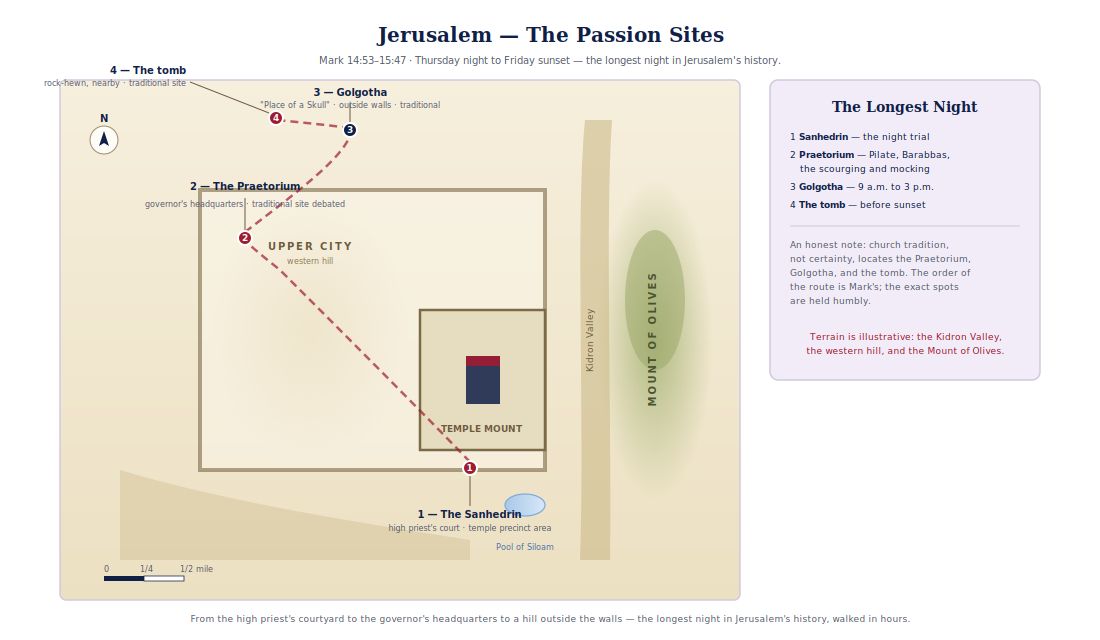
It's Thursday night turning to Friday — Passover. Hours ago Jesus shared His last meal with the Twelve and prayed in Gethsemane while they slept. Judas has betrayed Him with a kiss; the disciples have fled. Now, under torchlight, Jesus is dragged from garden to courtroom to governor to cross — all before the sun goes down twice.
Check What You Think You Know
Many sincere Christians have heard Jesus' cry from the cross — "My God, my God, why hast thou forsaken me?" (15:34) — as the moment the Father stopped loving the Son, as if the Trinity fractured. But Jesus was praying Psalm 22:1 — the opening line of a psalm every Jew knew, and a psalm that ends in vindication: "He hath not despised nor abhorred the affliction of the afflicted" (Psalm 22:24). The cry is real abandonment to God's wrath against sin — and the psalm it quotes already contains the resurrection hope. The darkest verse in Mark points to the brightest psalm.
Scene 1: Before the Sanhedrin — the trial at night (14:53–65)
Jesus is led to the high priest's house, where "all the chief priests and the elders and the scribes" have assembled — the Sanhedrin, the 71-member Jewish ruling council. The verdict is decided before the witnesses arrive: "the chief priests and all the council sought for witness against Jesus to put him to death; and found none" (14:55).
False witnesses step forward, but their stories contradict each other — under Jewish law, two agreeing witnesses were required, and they can't produce them. Finally the high priest takes over directly: "Answerest thou nothing? what is it which these witness against thee?" (14:60). Jesus is silent.
Then the question that decides everything: "Art thou the Christ, the Son of the Blessed?" (14:61). "The Blessed" is a reverent Jewish way of saying God without speaking the divine name — they considered it too holy to pronounce.
Jesus answers: "I am." Then He adds: "And you will see the Son of Man sitting at the right hand of the Power, and coming with the clouds of heaven" (14:62). "I am" — ego eimi in Greek — is at minimum a direct, unambiguous yes. And many hear in it an echo of Exodus 3:14, where God names Himself "I AM WHO I AM." The council certainly heard blasphemy in it: the high priest tears his clothes — the ritual gesture of outrage (in a further irony, the high priest was forbidden by the Law to tear his garments — Leviticus 21:10) 126 — and cries, "What further need do we have of witnesses? You have heard the blasphemy!" (14:63–64). Blasphemy — speaking against God, claiming what belongs to God alone — carried the death penalty under Jewish law.
They condemn Him as deserving death. Then the dignity of the courtroom collapses: some spit on Him, blindfold Him, strike Him, and jeer, "Prophesy!" (14:65) — mocking His claim by making Him guess who hit Him.
Scene 2: Below in the courtyard — Peter's denial (14:66–72)
While Jesus stands trial upstairs, Peter waits below in the courtyard — the same Peter who swore, "If I should die with thee, I will not deny thee in any wise!" (14:31). A servant girl looks at him: "Thou also wast with Jesus of Nazareth" (14:67). Peter deflects: "I know not, neither understand I what thou sayest" (14:68). A rooster crows.
She spots him again and tells the bystanders, "This is one of them." He denies it again. Then the bystanders press him: "Surely thou art one of them: for thou art a Galilaean, and thy speech agreeth thereto" (14:70) — his northern accent gives him away. And Peter, the rock, the leader of the Twelve, "began to curse and to swear, saying, I know not this man of whom ye speak!" (14:71) — calling down God's judgment on himself if he's lying. The strongest oath he can make, used to deny the One he loves most.
The rooster crows a second time. And Peter remembers — Jesus had predicted exactly this, hours earlier: "before the cock crow twice, thou shalt deny me thrice" (14:30). "Then Peter... wept" (14:72). Mark's last word on Peter in this passage is tears — until the angel names him again in 16:7.
Scene 3: Before Pilate — the governor's court (15:1–5)
At dawn the council holds a hurried consultation, binds Jesus, and delivers Him to Pontius Pilate, the Roman prefect (governor) of Judea. Why? Because — as their own leaders admit in John 18:31 — they had no authority under Rome to carry out a death sentence; only Rome could execute. 12729
Pilate's question cuts to politics, not theology: "Art thou the King of the Jews?" (15:2). The Sanhedrin's charge — blasphemy — means nothing to Rome; so they've reframed it as sedition, a rival king, the one charge that would make a Roman governor act. Jesus answers, "Thou sayest it." The chief priests pile on accusations — "many things" (15:3). Jesus answers nothing. And "Pilate marvelled" (15:5). Prisoners beg, bargain, and blame. This One is silent.
Scene 4: Barabbas — the exchange (15:6–15)
Pilate had a custom — or so Mark tells us: 128 at the feast, release one prisoner the crowd requests. (Honest note: this Passover amnesty is attested only in the Gospels. No Roman record and no Jewish writer outside the New Testament — not even Josephus, who documents Pilate's administration in detail — mentions it.) 128129 Enter Barabbas — "who had committed murder in the insurrection" (15:7). An insurrectionist: a violent revolutionary who killed in an uprising against Rome. This is the kind of man Rome crucified.
Pilate, sensing the chief priests handed Jesus over "because of envy" (15:10), offers the crowd a choice: Jesus or Barabbas? But the chief priests stir the crowd, and the crowd demands Barabbas.
"What will ye then that I shall do unto him whom ye call the King of the Jews?" Pilate asks. They shout: "Crucify Him!" "Why, what evil hath he done?" Louder: "Crucify Him!"
"So Pilate, willing to content the people, released Barabbas unto them, and delivered Jesus, when he had scourged him, to be crucified" (15:15). Scourging — the Roman flogging with a whip laced with bone and metal — was so brutal it sometimes killed on its own.
Sit with the exchange: the guilty revolutionary walks free; the innocent King takes his cross. Mark lets the irony preach. We won't hammer it.
Scene 5: Mocked in the Praetorium (15:16–20)
The soldiers take Jesus into the Praetorium — the governor's headquarters — and call out "the whole garrison." What follows is a soldier's idea of comedy: a purple robe (royalty's color), a crown of thorns, and the chant, "Hail, King of the Jews!" (15:18). They strike Him on the head with a reed, spit on Him, and "bowing their knees worshipped him" (15:19) — every gesture of homage turned into a sneer. Then they lead Him out to be crucified.
Scene 6: Simon of Cyrene (15:21)
On the road, the soldiers seize a passerby — Simon of Cyrene, "coming out of the country," and compel him to carry the cross. Cyrene was a city in North Africa (modern Libya); Simon was likely a Jewish pilgrim in Jerusalem for Passover — Cyrenian Jews even had their own synagogue in the city (Acts 6:9). 130 Mark adds a curious detail: Simon is "the father of Alexander and Rufus." Mark names them because his readers knew them — his Gospel was written for the church in Rome, and Paul greets a Rufus in Rome in Romans 16:13, quite possibly the same man (strong inference, labeled as such). 112131
Scene 7: The crucifixion — 9 a.m. (15:22–32)
They bring Him to Golgotha, "which is, being interpreted, The place of a skull" (15:22) — perhaps a hill shaped like a skull, perhaps a place of execution littered with the dead; the name's origin is uncertain, but the dread in it is not.
"And they gave him to drink wine mingled with myrrh: but he received it not" (15:23). The drugged wine was a mercy — it dulled the pain. (Later Jewish tradition describes condemned men being given spiced wine by charitable women of Jerusalem "to ease their agony" — b. Sanhedrin 43a.) 2429 Jesus refuses it. He will drink the cup the Father gave Him fully conscious, to the last drop.
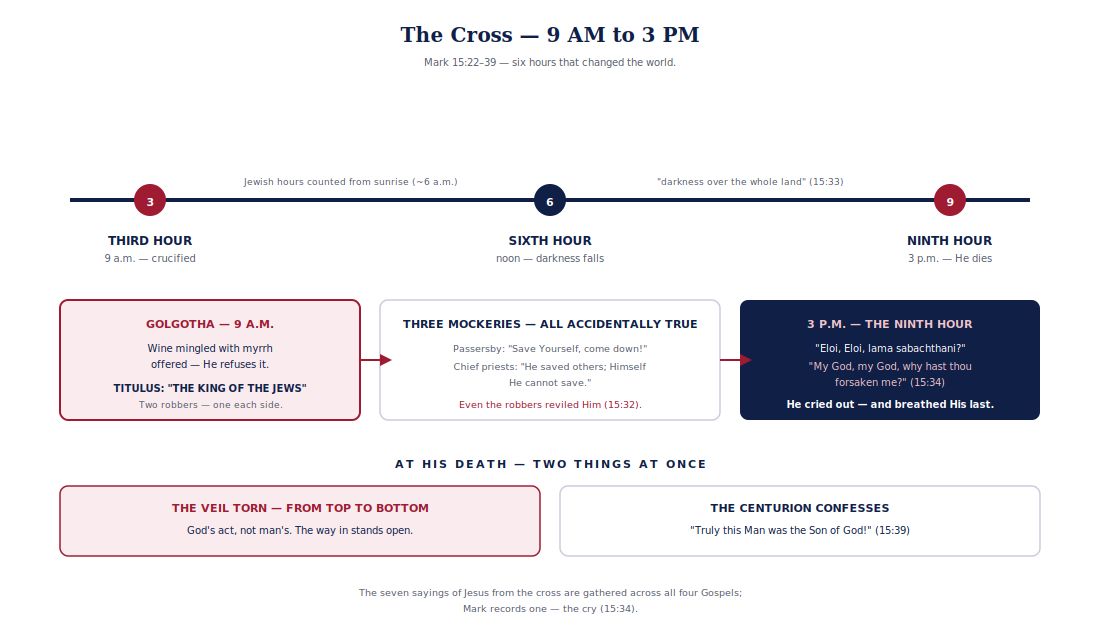
"And it was the third hour, and they crucified him" (15:25) — 9 a.m. (Jewish hours were counted from sunrise, roughly 6 a.m.) Above His head the titulus, the placard stating the crime: "THE KING OF THE JEWS" (15:26) — Pilate's charge, nailed where everyone could read it. Many readers hear a second edge in it (inference): Pilate's parting shot at the priests who forced his hand — the chief priests protested the wording, and Pilate refused to change it (John 19:21–22). 90132133 They crucify two robbers with Him, "one on his right hand, and the other on his left" (15:27) — Isaiah's prophecy fulfilled: He was "numbered with the transgressors" (Isaiah 53:12). (A note on your Bible's verse 28 — see FACT, INFERENCE, OR DISPUTED? below.)
Then the mockery, from three groups:
- Passersby, shaking their heads: "Ah, thou that destroyest the temple, and buildest it in three days, Save thyself, and come down from the cross!" (15:29–30)
- The chief priests, sneering to each other: "He saved others; himself he cannot save." (15:31)
- "they that were crucified with him" reviled Him (15:32).
Here is Mark's deepest irony, and the Gospel in one sentence: every mockery is accidentally true. He is saving others precisely by not saving Himself. "He saved others; himself he cannot save" — they meant it as a joke. It is the truest thing anyone says at the cross.
Scene 8: The death — noon to 3 p.m. (15:33–39)
"When the sixth hour was come, there was darkness over the whole land until the ninth hour" (15:33) — noon to 3 p.m., the brightest hours of the day, swallowed in black. (This cannot be a solar eclipse: Passover falls at full moon, and eclipses require a new moon. Mark presents it as a divine sign.)
At the ninth hour — 3 p.m. — Jesus cries out: "Eloi, Eloi, lama sabachthani?" which Mark translates: "My God, my God, why hast thou forsaken me?" (15:34). Some bystanders mishear — or mock-hear — "Behold, he calleth Elias!" (15:35). (In Aramaic, Eloi — "my God" — sounds something like Eliyahu, "Elijah." Whether they genuinely misheard or seized the chance to sneer is disputed.) Someone soaks a sponge in sour wine and lifts it on a reed. And "Jesus cried out with a loud voice, and breathed His last" (15:37).
Two things happen at once:
-
The veil of the temple was torn in two from top to bottom (15:38). The massive curtain shielding the Holy of Holies — God's symbolic dwelling — ripped from the top, where no human hand could reach. God's act, not man's. The way into God's presence stands open (see Hebrews 10:19–20).
-
The centurion — the Roman officer in charge of the execution, a Gentile professional killer — standing opposite Him, watching how He died, says: "Truly this man was the Son of God!" (15:39). Since Peter's confession in 8:29, no one in Mark's Gospel has said it rightly. The priests condemned; a soldier confessed.
Scene 9: The burial — before sunset (15:40–47)
A few women watch "from afar": Mary Magdalene (delivered from seven demons, per Luke 8:2); Mary the mother of James the Less and of Joses; and Salome. Mark notes they "followed Him and ministered to Him when He was in Galilee" (15:41) — they had served the ministry from the beginning. Everyone else has fled. They stayed.
Then Joseph of Arimathea — "an honourable counsellor" (a Sanhedrin man himself), "waited for the kingdom of God" — "came, and went in boldly unto Pilate," does the bravest thing in the chapter: he goes to Pilate and asks for the body (15:43). It is Preparation Day — sunset will bring the Sabbath, and the Law required a hanged man's burial the same day (Deuteronomy 21:22–23) — so there is no time to waste. For most crucified men there was no burial at all; Rome left bodies on the cross or dumped them in common graves. Joseph's request was the exception, not the rule. 134135 To claim a crucified "criminal" was to associate yourself with Him publicly.
Pilate is surprised Jesus is already dead — crucifixion usually took days — and confirms it with the centurion before releasing the body. Joseph wraps Him in linen (the Jewish burial custom), lays Him in a tomb hewn out of the rock, and rolls a stone against the door (15:46). And Mary Magdalene and Mary the mother of Joses "beheld where he was laid" (15:47).
The stone is in place. The women are watching. Mark lets the tomb sit in silence.
WORD STUDY
Sanhedrin — synedrion (sun-ED-ree-on). Literally "a sitting together" — the 71-member Jewish supreme council: chief priests, elders, and scribes, presided over by the high priest. It handled religious law and civil disputes, but under Rome it had lost the power of capital punishment. This night session — convened in darkness, in the high priest's house, to condemn a man before dawn — violated its own later-recorded rules about justice. 13639
Blasphemy — blasphemia (blas-fay-MEE-ah). Speech that insults or dishonors God — including claiming for yourself what belongs to God alone. For the council, Jesus' "I am" was blasphemy; for Mark's reader, it is the truth that got Him killed.
Golgotha — Golgotha (gol-GOTH-ah). Aramaic for "skull." Mark translates it for his Roman readers: "Place of a Skull." Whether the hill was shaped like a skull or was simply a place of death, the name marks the spot where the world did its worst.
Veil — katapetasma (kat-ap-et-AS-mah). Literally "something spread thoroughly" — a heavy curtain. The temple had two curtains; Mark means the inner one, the paroket, screening the Holy of Holies from the Holy Place — the veil the New Testament always means. 3245 The word appears only six times in the New Testament, and Hebrews 10:20 calls Christ's own flesh the katapetasma: the veil that had to be torn.
Forsaken — enkataleipo (en-kat-ah-LAY-poh). To abandon, to leave behind in a time of need — the verb inside Jesus' cry, "why hast thou forsaken me?" It is the word of Psalm 22:1, and the weight of the cross is inside it. (See Interpretation — we handle this verse with special care.)
Centurion — kenturion (ken-TOO-ree-on). A Roman officer commanding about a hundred soldiers. Mark borrows the Latin word centurio straight into Greek — a small signal to his Roman readers: this man is one of yours. An executioner by trade becomes the Gospel's first Gentile confessor.
The cry of dereliction (15:34) — the hardest verse in Mark
"My God, my God, why hast thou forsaken me?" We will not give you a cheap answer to this verse, because there isn't one. But there are two faithful readings, and they are not enemies:
(a) Jesus truly experienced abandonment as He bore sin. "God... hath made him to be sin for us, who knew no sin" (2 Corinthians 5:21). Habakkuk says of God, "thou... canst not look on iniquity" (Habakkuk 1:13). On this reading, the cry is real — the Son, carrying the world's sin, endures the darkness of separation so we never have to.
(b) Jesus is praying Psalm 22. The cry is the psalm's opening line — and first-century Jews knew their psalms the way we know song lyrics: cite the first line and the whole song comes with it. Psalm 22 begins in forsakenness but ends in vindication: "All the ends of the world shall remember and turn unto the LORD" (Psalm 22:27).
Which is it? The text leaves the mystery standing, and we will too. Say this plainly: we don't get a comfortable explanation, and that's okay. The cross is not a puzzle to solve but a horror and a hope to stand before. Anyone who tells you they have 15:34 fully figured out hasn't sat with it long enough.
The darkness at noon
From the sixth hour to the ninth — noon to 3 p.m. — darkness covers the land. It cannot be an eclipse (Passover is at full moon; eclipses need a new moon). Mark presents it as a divine sign, and the Old Testament gives it a vocabulary: Amos 8:9 — "'And it shall come to pass in that day,' saith the Lord GOD, 'that I will cause the sun to go down at noon, and I will darken the earth in the clear day.'" Judgment-day darkness (inference, labeled). Creation itself is reacting to what's happening on the cross.
The veil — torn from the top
The temple veil was the massive curtain screening the Holy of Holies — the innermost room where God's presence dwelt, entered once a year by one man. Later Jewish writings describe it as a handbreadth thick (m. Shekalim 8:5); Josephus says the curtain before the sanctuary's golden doors stood 55 cubits high and 16 broad — roughly 80 by 24 feet (War 5.212). 137117 Whatever its exact measure, no human hand reached the top to tear it. Its tearing means access: "boldness to enter into the holiest by the blood of Jesus, By a new and living way...through the veil, that is to say, his flesh" (Hebrews 10:19–20). And Mark stresses the direction: from top to bottom. No human hand reaches that high. God tore it Himself — from heaven downward, toward us.
Why "King of the Jews"?
Rome didn't crucify people for blasphemy — it crucified them for sedition, for threatening Caesar's order. The Sanhedrin's blasphemy charge wouldn't move Pilate an inch, so they reframed Jesus as a rival king: "the King of the Jews." The logic of the text suggests a political repackaging of a religious verdict (inference from the text's logic — labeled). Pilate's titulus then reads as his own sneer at the priests who forced his hand — here's your king (inference; the chief priests objected to the wording and Pilate refused to change it — John 19:21–22).
The centurion's confession — and the exchange
A Gentile executioner — a man who has watched a hundred men die this way — becomes the first person since Peter (8:29) to declare Jesus' identity rightly. Mark's irony is devastating and deliberate: the priests, who had the Scriptures, condemned Him; the soldier, who had only a hammer and nails, confessed Him. The Gospel's first Gentile confession comes not from a sermon but from watching how He died.
The Christ Thread
Messianic promise — here, the promise lands. This chapter isn't pointing forward to the cross; it is the thing the promises were pointing to. The cry is Psalm 22:1, prayed word for word. The two robbers fulfill Isaiah 53:12 — "numbered with the transgressors." The sour wine echoes Psalm 69:21. The pierced One is Zechariah 12:10. He was "with the rich in his death" (Isaiah 53:9) — Joseph of Arimathea, "a rich man" (Matthew 27:57), gave Him his own tomb. And behind it all, Deuteronomy 21:23 — "he that is hanged is accursed of God" — which Paul renders "Cursed is every one that hangeth on a tree," saying Christ became "a curse for us" (Galatians 3:13). Centuries of prophecy converge on six hours outside Jerusalem.
OT/NT parallels — where the New Testament picks it up. The apostles never let go of this day: Paul preaches "Christ crucified" as the whole message (1 Corinthians 1:23); Hebrews reads the torn veil as "a new and living way...through the veil, that is to say, his flesh" (Hebrews 10:20); Peter says He "our sins in his own body on the tree" (1 Peter 2:24). Mark gives you the event; the epistles give you its meaning. Read them together.
The Christian future — what this foreshadows for us. Because He was forsaken, you never will be — "I will never leave thee, nor forsake thee" (Hebrews 13:5) is the cross's promise in reverse. The veil torn from the top means your access to God is open permanently, from God's side. And the centurion — a Gentile executioner confessing at the foot of the cross — is the firstfruits of the nations streaming in. Your future was decided here before you were born.
Where in the Covenant Story?
The cross is where the covenants turn. At the supper, hours earlier, Jesus lifted the cup and said, "This is my blood of the new" (14:24) — the covenant Jeremiah 31:31–34 promised: sins forgiven, the law written on hearts, "they all shall know Me." Every old-covenant sacrifice pointed here and stopped here; the priesthood, the temple, the veil — fulfilled and finished in one death. The veil torn from top to bottom is God's own announcement: the old order is open, the new has come. We live under the covenant sealed that afternoon — forgiven, indwelt, known.
Father, Son, and Spirit
The cross is a Trinitarian act — all three persons, one salvation. The Father gives: "He that spared not his own Son, but delivered him up for us all" (Romans 8:32). The Son offers: He "through the eternal Spirit offered himself without spot to God" (Hebrews 9:14) — Father, Son, and Spirit named in a single verse about the cross. And the cry itself — "My God, My God" — is the Son speaking to the Father in the dark. When you stand before the cross, you're watching the Trinity at work: love giving, love offered, love empowering.
WHAT THE CHURCH HAS ALWAYS BELIEVED: The Apostles' Creed — confessed by Christians for nearly two thousand years — anchors the faith to this day: Jesus Christ "was crucified, dead, and buried." The cross isn't an illustration of the faith. It is the faith, nailed down in history.
It's Okay to Ask
Bring your hardest questions to the foot of the cross — they're welcome here:
- Did the Father really turn away from the Son? Was Jesus truly abandoned? (The church has held this mystery with reverence for 2,000 years — see "The cry of dereliction" above. We won't resolve it cheaply, and you don't have to either. Some truths are for standing before, not solving.)
- Why did God need blood? Couldn't He just forgive? (Because sin is real and justice is real — and forgiveness that costs nothing means nothing. The cross is what love looks like when it refuses to look away from evil. God didn't waive the price; He paid it.)
- I feel far from God right now. Does the cry mean He might forsake me? (Hear this tenderly: the opposite. He was forsaken so that you never will be. Your worst fear already happened — to Him, for you.)
FACT, INFERENCE, OR DISPUTED?
- FACT: A solar eclipse at Passover is astronomically impossible — Passover falls at full moon. The darkness is presented as a divine sign, not a natural event.
- FACT: Mark records exactly ONE saying of Jesus from the cross with words we can read — the cry of 15:34. (The loud voice of 15:37 is recorded, but Mark doesn't give its words.) The "seven sayings" are gathered across all four Gospels; do not attribute the other six to Mark.
- FACT: Mark 15:28 — "And the scripture was fulfilled, which saith, 'And he was numbered with the transgressors'" — is absent from the earliest manuscripts and was likely copied in from Luke 22:37; the KJV prints the verse in the text with no footnote. 138 The Isaiah 53:12 fulfillment is real — the verse is a later copyist's addition.
- FACT: The Passover prisoner-release custom is attested only in the Gospels. No Roman record and no Jewish writer outside the New Testament mentions it.
- INFERENCE (strong): The Sanhedrin's night session violated principles found in later Jewish legal sources (no capital trials at night, no trials on feast days). Those sources postdate the event, so the case rests on inference — but the irregularities Mark reports (a rushed night hearing, false witnesses, a verdict before evidence) speak for themselves.
- INFERENCE (strong): Jesus' "I am" (ego eimi) carries an echo of the divine name of Exodus 3:14. The council's instant charge of blasphemy shows what they heard in it.
- INFERENCE: The Sanhedrin reframed blasphemy as sedition ("King of the Jews") because only a political charge would move Pilate — the narrative's own logic.
- INFERENCE: Mark names Simon's sons Alexander and Rufus because his Roman readers knew them (cf. Romans 16:13).
- DISPUTED: What the bystanders heard at 15:35 — did they genuinely mishear Eloi as "Elijah," or were they mocking? The text doesn't settle it.
- DISPUTED: How much the Gentile centurion grasped by "Son of God" — Mark's Greek lacks the article, and scholars debate whether he voiced a full confession or a soldier's awe at a heroic death. 139140 Mark's readers, who know 1:1, hear the truth in it either way.
- DISPUTED: Whether Rome had fully stripped the Sanhedrin of capital authority — John 18:31 records the Jewish leaders claiming so; Stephen's stoning (Acts 7) was mob action, not a court sentence.
- DISPUTED: The clock — John's "about the sixth hour" (19:14) against Mark's "third hour" (15:25); usually resolved by different time-reckoning or approximation.
- DISPUTED: How the Last Supper aligns with Passover day — Mark places the meal on Passover itself (14:12–17); John places the crucifixion on the day of Preparation (19:14). The lesson follows Mark's framing.
SCHOLAR'S NOTE: The horror Mark describes is archaeologically real. In 1968, excavators in Jerusalem found the heel bone of Jehohanan, a first-century crucifixion victim — an iron nail still driven through it, with wood fragments from the cross. Crucifixion wasn't symbolic; it was engineered agony. And Pilate is no legend either: a stone inscription naming Pontius Pilate, prefect of Judea, was unearthed at Caesarea Maritima in 1961. The men in this chapter walked real ground. The Roman scourging (verberatio) Jesus endured before the cross was often fatal by itself — which is why Pilate is surprised He is already dead (15:44).
Cross-references (explained, not just listed)
- Psalm 22 (the whole psalm) — Jesus' cry quotes its first line; the psalm moves from "why hast thou forsaken me?" to worldwide worship (22:27). Read it end to end — it is the cross's own soundtrack.
- Isaiah 53 — the Suffering Servant: "He was numbered with the transgressors" (53:12 — the two robbers); "wounded for our transgressions" (53:5); "with the rich in his death" (53:9 — Joseph's tomb).
- Zechariah 12:10 — "they shall look upon me whom they have pierced" — mourning for the pierced One.
- Deuteronomy 21:23 — "he that is hanged is accursed of God" — which Paul renders in Galatians 3:13 as "Cursed is every one that hangeth on a tree": Christ having become a curse for us.
- Psalm 69:21 — "They gave me also gall for my meat; and in my thirst they gave me vinegar to drink" — the sour wine at the cross.
- Amos 8:9 — "I will cause the sun to go down at noon, and I will darken the earth in the clear day" — the vocabulary of the sixth-hour darkness.
- Hebrews 10:19–20 — the torn veil: "a new and living way...through the veil, that is to say, his flesh"
Go Deeper
Hungry for more? Two doors worth opening:
- Isaiah 53, read aloud slowly — the Servant's suffering, written 700 years before the cross. Mark 15 is this chapter happening.
- Hebrews 9–10 — the New Testament's own commentary on what the torn veil means: one sacrifice, once for all, no more barrier.
Theological truth (arising from the text)
Substitution is the heartbeat of this chapter: Barabbas freed, Jesus condemned; the mockers' taunt — "He saved others; himself he cannot save" — is the Gospel's deepest irony and its truest sentence. He could not save Himself and save others; He chose us. The veil torn from the top means the way to God is opened from God's side.
Humble — and confident
Humble, because Peter — the strongest voice in the room, the one who swore he'd die first — ended the night swearing he'd never known Him. If Peter could collapse that completely, none of us is beyond falling. Our strength is not the point; His hold on us is.
Confident, because the veil tore from the top and a Gentile soldier confessed at the foot of the cross. Access is open — not because we are strong, but because He was forsaken. The tomb is sealed, the women are watching, and Sunday is coming.
Confess It
Peter's tears are the model: he didn't excuse, explain, or despair — he wept and came back. Name one denial of your own — one place you've distanced yourself from Jesus, one courtyard where you've gone quiet — and confess it now (1 John 1:9). The rooster crowed for Peter; grace is crowing for you too.
For discussion
- Peter denied Jesus within hours of swearing he never would. Where are you most tempted to distance yourself from Jesus — and what would it look like to come back honestly, the way Peter's tears began his return?
- "He saved others; himself he cannot save" was meant as mockery, but it's the truest sentence at the cross. How does that irony reshape the way you think about what Jesus' death accomplished?
- What do you do with a verse you can't fully explain — like the cry of 15:34? Is it okay to stand before the mystery without resolving it? What does that kind of faith look like in practice?
What He has done (the indicative)
Before one "you should," hear what He did: the innocent was condemned so the guilty could go free. The veil tore from the top — God opened the way from His side, not ours. "He saved others; himself he cannot save" — He chose us over Himself. Every step below is a response to that, not a way to earn it.
This week's practices
- Read Psalm 22 aloud, start to finish. Don't study it — hear it. Notice where the lament turns. This is the psalm Jesus prayed from the cross.
- One "Barabbas gratitude" act. Barabbas walked free because Another took his place. Do one concrete, undeserved kindness this week for someone who can't repay you — and when you do it, remember whose place you were in.
- Pray It Back. Take the centurion's confession into prayer each morning: "Truly this man was the Son of God." Say it to the Father — not as information, as worship. Let the cross re-evangelize you daily.
- Answer one taunt from Scripture. Pick one of the mockers' lines — "save Yourself," "He saved others; himself he cannot save" — and write out your answer to it from Scripture, in your own words. Keep it where you'll see it.
- Memorize Mark 15:39. The centurion's confession — the first Gentile voice in Mark to get it right: "Truly this man was the Son of God!"
For Us Together
Ask your small group, your family, or one friend this week: "Where do we need the courage of Joseph of Arimathea — to publicly associate with Jesus when it costs something?" The tomb was sealed by one brave man's public act. Boldness is contagious.
Who Needs This?
Who in your life is carrying Barabbas guilt — convinced they're too far gone, that the verdict is already in? One name. Tell them the exchange this week: the guilty walked free because Another took his place.
Take It Home
At the table or at bedtime, ask your kids: "The soldiers made fun of Jesus by pretending to worship Him — bowing down and chanting 'Hail, King of the Jews!' But the joke was true: He really IS the King. What's the difference between pretending and really believing?"
Praise Him
Don't end at the tomb — end with worship. Right now, out loud or in writing, finish this sentence: "Father, I praise You because at the cross I saw that You _____." (Gave Your Son? Tore the veil from Your side? Let mockery speak truth?) Sit in it for a minute. And remember: Sunday is coming. Theology that doesn't become doxology hasn't finished its work.
The bottom line
The innocent was condemned so the guilty could go free — and the guilty one is us. The veil tore from the top: God opened the way from His side. Stand before the cross without cheap answers, weep with Peter without despairing, and confess with the centurion what the priests couldn't see: truly, this Man was the Son of God.